

In Duct UV Air Purifier Explained and Compared
You've vacuumed, changed filters, and still notice dust settling on furniture. Perhaps someone in the home feels congested when the HVAC runs, or an odor returns every time the system starts. A portable purifier may help in one room, but it can't treat air moving through every supply register.
That's why an in duct UV air purifier attracts attention. Installed inside the HVAC system, it exposes moving air, coils, or nearby surfaces to germicidal ultraviolet energy. The important question isn't only whether UV “works.” It's whether a particular installation delivers enough exposure under the airflow, humidity, temperature, and placement conditions in your home.
This guide separates documented performance from marketing shortcuts. It also compares UV with HEPA filtration, ActivePure, and bipolar ionization, then addresses a topic many buying guides rush past, UV-C safety and byproducts. If you're in Avondale, Phoenix, or the surrounding area, understanding those trade-offs before contacting a contractor can help you avoid paying for a lamp that mainly keeps a coil cleaner when your real goal is whole-home air treatment.
Introduction to Cleaner Air Inside Your Ductwork
A homeowner may call for help after noticing the same pattern: the HVAC system runs for long periods, dust returns quickly, and allergy discomfort doesn't disappear. The natural assumption is that the ductwork must be the only problem. Sometimes it contributes, but air quality depends on several connected parts, including filtration, coil condition, airflow, moisture, and the purification method itself.
An in-duct system differs from a portable unit because it sits within the forced-air path. As the blower circulates air, the treatment device works inside the equipment or ductwork rather than relying on one room's air mixing with a floor-standing purifier. That can make whole-home coverage more practical, but it doesn't guarantee that every particle, odor, or microorganism receives the same treatment.
What this guide will clarify
UVGI, or ultraviolet germicidal irradiation, has a long history in air disinfection. Researchers demonstrated airborne organism inactivation in the 1930s, and direct, high-intensity UVGI was applied in a Duke University Hospital operating room in 1936. Later work in the 1940s reported infection rates of 12.5% in a control ward compared with 2.7% in a ward using UVGI barriers, while upper-room studies from 1937 to 1941 helped prevent measles spread in suburban Philadelphia day schools. These historical milestones are documented in the history of ultraviolet germicidal irradiation for air disinfection.
The history matters, but an operating room or upper-room installation isn't the same as a compact lamp in a residential return duct. A realistic decision starts with the intended outcome:
Particle removal requires filtration, not UV alone.
Microbial inactivation depends on dose and exposure.
Coil cleanliness may be the primary practical benefit of some installations.
Odor and gas control require a technology designed for those pollutants.
For homeowners researching air cleaning before scheduling an assessment, this overview of in-home air purification systems provides useful context. The central lesson is simple: choose the treatment based on the pollutant and the HVAC conditions, not the word “purifier” on the product label.
How an In Duct UV Air Purifier Works Inside Your HVAC
UVGI uses ultraviolet energy to damage the genetic material of susceptible microorganisms. A lamp installed inside an air handler, return duct, supply duct, or near an evaporator coil creates an irradiated zone. Air passes through that zone, and the result depends on how much UV energy each organism receives.
A sunlight analogy helps, with one important correction. Sunlight can damage or inactivate organisms on exposed surfaces because those surfaces receive energy over time. Inside a duct, the lamp has to treat air moving past it quickly. The system therefore needs the right combination of intensity, distance, exposure time, and organism-specific dose.
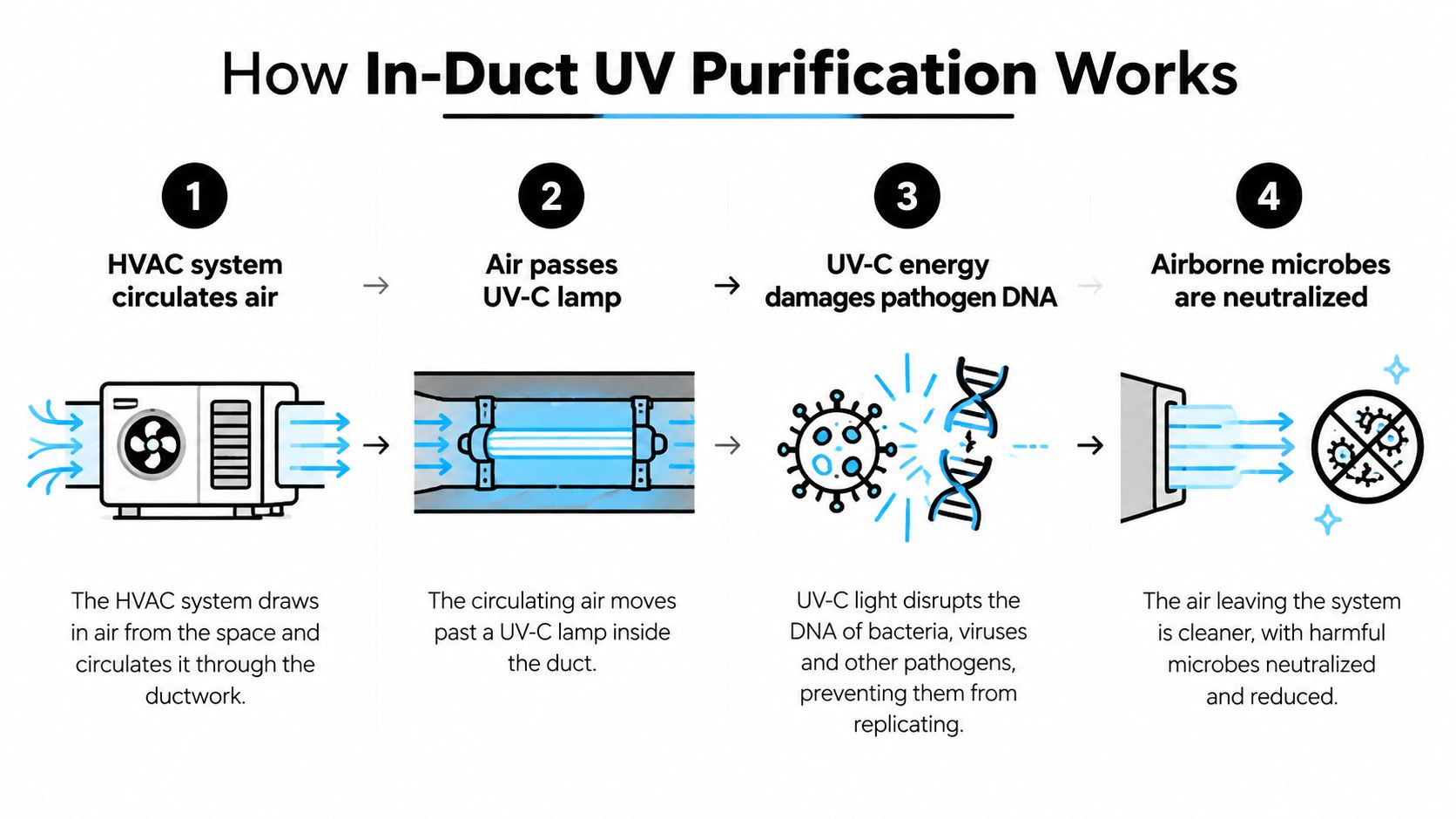
From blower movement to microbial inactivation
The process is easier to visualize in four stages:
The HVAC blower moves air through the duct system.
The air enters the area illuminated by a UV-C lamp.
UV-C energy interacts with microbial genetic material.
Microorganisms that receive a sufficient dose become inactivated.
That fourth step is where many product descriptions oversimplify the science. A lamp doesn't automatically deliver the same dose to every passing organism. Air closest to the lamp may receive more energy than air farther away, and faster airflow shortens the exposure window.
A single-pass inactivation rate describes what happens during one trip through the irradiated zone. If a system mainly irradiates a coil, its purpose may be to discourage microbial growth on that surface rather than to deliver a strong dose to every airborne organism. Those are different objectives, and a contractor should identify which one the design targets.
Dose is the useful measurement
The EPA evaluated HVAC in-duct UV systems and reported that all nine tested UV-C devices were more than 99% efficient at inactivating vegetative bacteria under the test conditions. The evaluation also found that three devices were more than 93% effective against all three microorganisms tested, as documented in the EPA evaluation of HVAC in-duct ultraviolet systems.
Those results show that engineered systems can perform strongly in testing. They don't mean every residential lamp produces the same result. ASHRAE Standard 185.1-2020 established a method for testing UV-C lights used in air handlers or air ducts, while a later review estimated that an appropriate in-duct UVGI design should deliver at least 4.64 J/m² for 90% SARS-CoV-2 inactivation and 5.84 J/m² for 90% SARS-CoV inactivation, as summarized in the EPA-linked technical discussion above.
The practical takeaway is to ask for the design dose, irradiated length, airflow assumptions, and target organism. A wattage claim alone doesn't tell you how much UV energy reaches the air.
For a broader explanation of how duct-mounted technologies differ, see what an air scrubber is used for. The key distinction is whether the equipment treats passing air, exposed HVAC surfaces, or both.
Benefits and Real World Limitations You Should Expect
The strongest case for an in-duct UV air purifier is microbial inactivation under measured conditions. The EPA testing described above found high vegetative-bacteria inactivation among the devices evaluated. UV can also support cleaner coils when the lamp is positioned to irradiate the coil surface, which may help reduce biological buildup in a damp part of the HVAC system.
That benefit doesn't make UV a replacement for a filter. UV energy doesn't function like a pleated filter that captures dust, pollen, or pet dander. If airborne particles are the main complaint, the system needs an appropriate filtration strategy, adequate airflow, and regular filter service.
Why real ducts perform differently from test chambers
Air doesn't move through a residential HVAC system under perfectly stable conditions. AHRI explains that germicidal effectiveness in a return-air duct depends on lamp output, intensity, distance, and the dose required for each organism, while ASHRAE notes that there are still no industry standards for rating UVGI device effectiveness or installations. That gap makes broad “whole-home sanitizing” language difficult to interpret without a design calculation.
A peer-reviewed study found that performance declined as airflow velocity and relative humidity increased. When relative humidity rose from 50% to 90%, the Z values for airborne bacteria fell by 40% for S. epidermidis, 60% for P. alcaligenes, and 38% for E. coli, according to the study indexed by PubMed. The same study found peak performance at 20 to 21°C, lower efficacy at 15 to 16°C and 25 to 26°C, and lower efficacy in a black-surfaced duct than in a clean duct.
These findings explain the lab-to-home performance gap:
Airflow changes exposure: Faster air gives the lamp less time to act.
Humidity changes susceptibility: Moist conditions can reduce measured efficacy for some organisms.
Temperature matters: The study's peak range didn't represent every operating condition.
Surface condition matters: Dust or dark duct surfaces can absorb or interfere with UV energy.
Lamp aging matters: Output can decline, so maintenance affects delivered dose.
Practical rule: Treat a UV performance claim as a system result, not a lamp result. The duct dimensions, airflow, lamp position, cleanliness, and maintenance schedule all shape the outcome.
When UV adds value
UV adds more meaningful protection when the installer designs an adequate irradiated zone and verifies the system under realistic airflow and temperature conditions. It may be especially useful when a homeowner wants microbial treatment integrated into the central HVAC path and understands that filtration still handles particles.
It may add less value when the lamp is placed mainly to keep a coil clean but marketed as a complete solution for dust, gases, and odors. That isn't necessarily a bad installation. It's a problem only when the homeowner expects a coil-treatment lamp to perform like a particle filter or gas adsorber.
Compatibility Installation and What Affects Performance
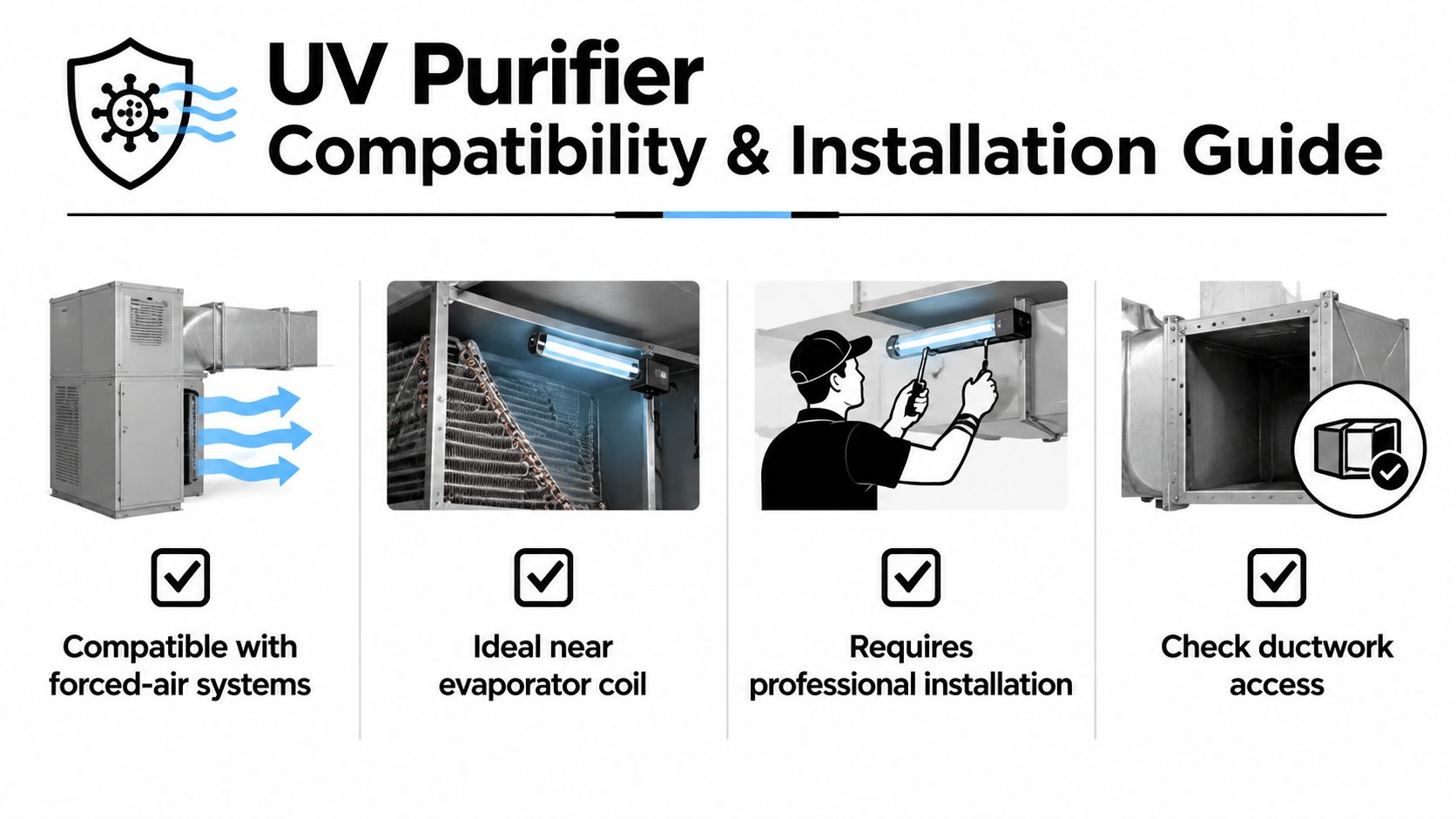
Start with the HVAC system, not the product box. An in-duct UV air purifier generally needs a forced-air system with a suitable access point, enough physical space for the lamp chamber, and electrical capacity for safe installation. A technician should inspect the air handler, coil, return path, duct dimensions, service panels, and existing filtration before recommending a model.
Placement can change the purpose of the system. A lamp aimed at an evaporator coil may focus on surface cleanliness. A lamp in a mixed-air or return-air location may be designed for airstream treatment. Review literature discussed by AHRI indicates that a mixed-air location can sometimes outperform other configurations on cost and performance, but placement still depends on the actual equipment and airflow pattern.
The irradiated zone controls exposure
ASHRAE guidance says designers should calculate the desired single-pass inactivation rate under worst-case air temperature and velocity conditions in the irradiated zone. At 500 fpm, about 2.5 m/s, an 8 ft irradiated zone provides roughly 1 second of exposure. The same example explains that a shorter minimum of 0.25 seconds can reduce system cost and power use, corresponding to about 2 ft of irradiated length, as described in ASHRAE guidance for in-duct UVGI design.
That example doesn't prescribe a universal residential size. It shows why a short chamber and high airflow may not deliver the same treatment as a longer, carefully designed zone.
Ask the technician to address these points:
Airflow calculation: What velocity will the lamp encounter during heating and cooling operation?
Placement purpose: Is the installation aimed at the coil, the airstream, or both?
Dose design: What dose does the system target for the relevant organisms?
Access: Can the lamp and nearby surfaces be cleaned safely?
Maintenance: How will the installer track lamp replacement and output?
Duct condition: Are dust, dark surfaces, or obstructions reducing exposure?
A clean HVAC system also gives purification equipment a better starting point. For homeowners reviewing broader options, this guide to whole-home air purifiers for HVAC systems explains why the equipment and ductwork should be considered together.
Professional sizing matters more than a large wattage number printed on a brochure. A capable installer should explain the design assumptions in plain language and identify what the system won't remove.
How In Duct UV Compares to ActivePure HEPA and Ionization
Homeowners often compare technologies as if each one performs the same job. They don't. UV primarily uses light to inactivate susceptible microorganisms, HEPA uses a physical filter to capture particles, ActivePure systems use a duct-mounted technology intended to treat air and exposed surfaces, and bipolar ionization electrically charges particles so they can agglomerate or interact with collection surfaces.
The right choice depends on the complaint. Someone focused on pollen and pet dander may prioritize filtration. Someone concerned about microbial growth on HVAC surfaces may consider UV. Someone seeking odor or broader contaminant treatment should ask for product-specific evidence rather than assuming every air cleaner addresses gases.
Technology | How It Cleans | Best For | Key Limitation |
|---|---|---|---|
In-duct UV | Uses UV-C energy to inactivate susceptible microorganisms receiving sufficient dose | Microbial treatment and coil irradiation | Results depend heavily on dose, airflow, placement, humidity, temperature, and lamp condition |
ActivePure | Uses a duct-mounted active treatment approach intended to address air and exposed surfaces | Homeowners seeking a broader air and surface strategy | Performance depends on the specific certified system, installation, and operating conditions |
HEPA | Captures airborne particles as air passes through the filter media | Dust, pollen, and other particulate concerns | Adds resistance and needs appropriate equipment sizing and filter maintenance |
Bipolar ionization | Generates charged particles that interact with airborne particles and surfaces | Applications where an active air-cleaning approach is being considered | Byproduct and efficacy questions require careful product documentation and verification |
Match the technology to the pollutant
UV doesn't capture dust. HEPA doesn't disinfect every exposed duct surface. Active systems shouldn't be treated as interchangeable with a filter, and ionization claims should be evaluated alongside safety documentation.
Maintenance also changes the comparison. HEPA systems need filter replacement and airflow management. UV lamps need cleaning and replacement planning. Active technologies require attention to their specific cells, modules, or generators. A useful resource on maintaining air purification equipment can help facility operators think beyond installation day.
For a homeowner considering an ActivePure option, this explanation of what an ActivePure air purifier is offers a product-specific starting point. The decision should still begin with an assessment of particles, odors, moisture, microbial concerns, and HVAC limitations.
A combined approach can make sense, but only when each component has a defined role. Duct cleaning and coil cleaning address accumulated material. Filtration captures particles. UV targets microorganisms in its irradiated zone. An active system may address additional air or surface concerns, depending on its documentation.
Safety Enclosure and Byproduct Concerns Explained
UV-C is useful because it carries enough energy to damage microorganisms. That same energy can injure eyes and skin if people receive direct exposure. An in-duct installation therefore must keep the lamp inside a sealed chamber or HVAC compartment that prevents leakage into occupied spaces.
ASHRAE materials state that in-duct UV systems should be fully enclosed, with warning labels on access panels and electrical disconnect devices on the lamp chamber. The same guidance reports that in-duct systems may produce 1,000 to 10,000 µW/cm², while NIOSH exposure limits for 253.7 nm UVC are 600 µW/cm² for 1 second, 100 µW/cm² for 1 minute, 1.7 µW/cm² for 1 hour, and 0.2 µW/cm² for 8 hours, as documented in ASHRAE's safety guidance for UV-C systems.
What safe installation should include
A proper installation should make accidental exposure difficult during normal operation and service. Ask to see the access-panel warning label, confirm that the lamp chamber has an electrical disconnect, and ask how the system prevents operation when a service panel is open.
You should also ask:
Where can UV leakage occur? The installer should identify seams, access doors, and viewing points.
Who services the lamp? Maintenance requires power isolation before opening the chamber.
What does the product documentation say? Look for tested enclosure and safety information.
Does the system generate another byproduct? UV-C itself isn't the same as bipolar ionization or ozone-generating equipment.
Properly enclosed germicidal UV-C isn't intended to release ozone into the occupied space. That differs from some ionization approaches, where the byproduct profile must be evaluated from the specific equipment documentation. Don't assume that every product sold under “air purification” has the same chemistry or safety characteristics.
An ozone treatment is also a different process from continuous in-duct purification. Before considering any chemical or oxidizing approach, review what ozone shock treatment involves. The safest choice is the one with a clearly defined mechanism, enclosed installation where required, and a maintenance procedure your household or facility can follow.
Choosing the Right System for Your Home and Next Steps
An in-duct UV air purifier can make sense when you want microbial treatment integrated with a forced-air HVAC system and the installer can demonstrate an appropriate dose, placement, airflow design, and maintenance plan. It's less suitable as a standalone answer for heavy dust, pollen, or gas odors, because those concerns call for filtration or a technology specifically designed for gases.
Use this decision sequence:
Identify the primary complaint. Separate particles, odors, moisture, coil growth, and airborne-microbial concerns.
Inspect the HVAC system. Check duct cleanliness, filter fit, coil condition, airflow, and available installation space.
Choose the treatment role. Decide whether you need particle capture, microbial inactivation, surface treatment, or a combination.
Request design details. Ask about irradiated length, exposure time, target dose, lamp output, safety enclosure, and replacement planning.
Plan maintenance. Include filter service, lamp cleaning, lamp replacement, and periodic equipment inspection.
Clean ductwork and coils won't turn an undersized UV lamp into a high-performance system, but they can prevent accumulated debris from undermining the equipment's intended function. A professional evaluation is especially useful when symptoms persist despite normal filter changes or when the HVAC system has limited access.
Purified Air Duct Cleaning offers duct cleaning, HVAC coil cleaning, and installation of duct-mounted ActivePure systems for residential and commercial properties in the Phoenix metropolitan area. If you're in Avondale, Phoenix, Glendale, Mesa, or a nearby community, ask for an assessment that compares UV, filtration, and active purification against your actual indoor-air concern.
If you're ready to evaluate an in-duct UV air purifier, Purified Air Duct Cleaning can inspect your ductwork and HVAC components, explain suitable purification options, and help you plan installation and maintenance around your home's needs. Request an assessment before buying so the equipment, placement, and safety details match the result you want.