

Indoor Air Quality PM 2.5: Protect Your Phoenix Home
PM2.5 particles are roughly 1/40 the width of an average human hair, and their tiny size lets them travel deep into the lungs. That makes indoor air quality critical for Phoenix families, especially when wildfire smoke, dust, or indoor combustion adds particles to the air.
You may be sitting in your Phoenix living room with the windows closed, the air conditioner running, and the house looking perfectly clean. Yet cooking on a gas range, a candle, outdoor smoke entering through small openings, or dust being redistributed through HVAC ducts can still affect the air you breathe. Indoor air quality PM 2.5 management starts by identifying those sources, then combining source control, filtration, monitoring, and appropriate duct maintenance.
What Is PM2.5 and Why It Matters Indoors
You can be sitting in a cool Phoenix living room with the windows shut, the AC running, and every surface looking clean, while PM2.5 is still moving through the air. PM2.5 means fine particulate matter with aerodynamic diameters of 2.5 micrometers or less. These particles are roughly 1/40 the width of an average human hair, which is why they behave less like ordinary dust on a tabletop and more like smoke that hangs in the air.
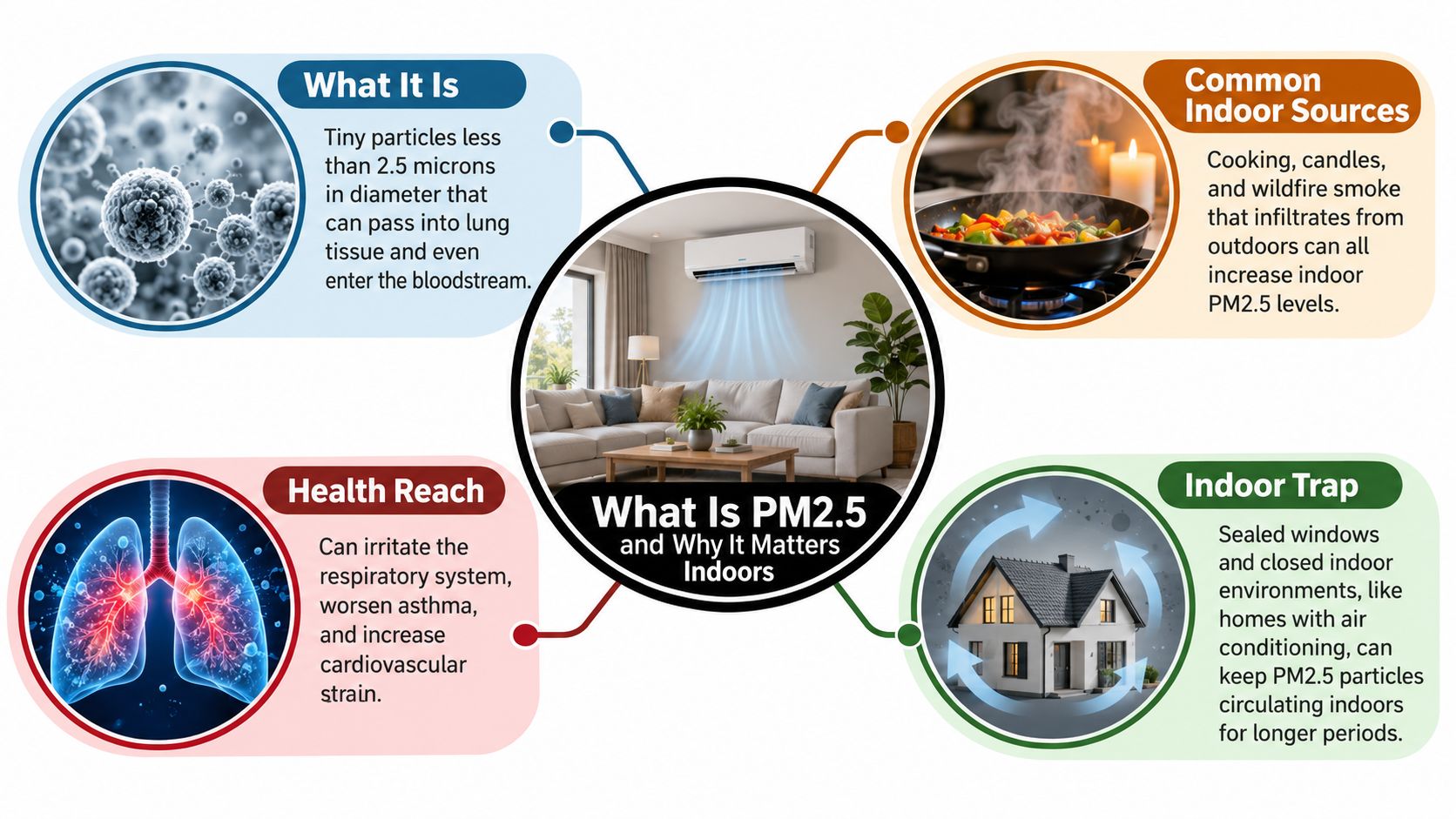
That difference matters indoors. Larger dust tends to settle where sweeping or vacuuming can remove it. Fine particles can stay suspended longer and travel anywhere air travels, across a room, into a return grille, through ductwork, and back out of supply registers. A home can also pull in particles from outside through small openings, doors, windows, and ventilation pathways, even when it feels sealed up. The U.S. Environmental Protection Agency notes that indoor air quality is shaped by both outdoor pollutants and sources inside the home.
Where particles come from
In Phoenix, the overlooked part is often what the house makes for itself. Wildfire smoke and desert dust can enter from outdoors, but many particle spikes begin indoors, during cooking, candle use, fireplace use, tobacco smoke, some cleaning activities, printer use, or fuel-burning equipment such as unvented or kerosene heaters. Chemical reactions indoors can add more particles after those sources are introduced.
Cooking deserves special attention because it can create a fast burst of fine particles right in the breathing zone. Frying, broiling, or scorching food can send particles upward and outward before the HVAC system starts pulling that air through the house. If a range hood only recirculates air instead of venting outdoors, some material may be captured, but fine particles can still remain in the room and then spread through the return side of the system.
Practical rule: A room that looks clean can still have high particle levels. Visible dust, airborne PM2.5, and debris sitting inside ductwork are separate issues.
Why Phoenix homes can trap particles
Phoenix homes depend heavily on air-conditioning, and that constant recirculation can keep fine particles in motion. If the filter does not fit well, is overloaded, or is too restrictive for the equipment, capture may be weaker than homeowners expect. Duct leakage, settled debris, and dirty coils can also turn the HVAC system into a redistribution path instead of a control measure.
That is why source control and air distribution have to be handled together. Reduce particle generation at the stove and from combustion sources. Limit outdoor smoke intrusion during poor air days. Use filtration the system can support, inspect ductwork when dust or debris is being blown back into rooms, and consider added in-system air treatment such as ActivePure where appropriate. Surface cleaning helps, but it does not stop particles that are still being generated or recirculated through the home.
Health Impacts of Indoor PM2.5 Exposure
A dinner cooked on the stove, dust stirred up by cleaning, and air pulled back through return vents can all affect the air people breathe within the same hour. In Phoenix homes that run air-conditioning for long stretches, that matters because fine particles do not always stay near the original source. They can move room to room through the duct system, which means exposure often comes from a mix of indoor generation and indoor redistribution, not just from outdoor pollution.
PM2.5 affects people differently based on concentration, exposure time, and underlying health status. One person may notice only mild irritation during a spike. A child with asthma, an older adult, or someone with cardiovascular disease may have a much harder response. Health agencies and clinicians connect particle exposure with respiratory and cardiovascular problems, including worsened asthma and reduced lung function.
The World Health Organization tightened its recommended annual PM2.5 guideline from 10 micrograms per cubic meter to 5 micrograms per cubic meter in September 2021. The benchmark is demanding. In 2021, only 222 of 6,475 cities covered by the report met the updated annual guideline, and no country met it nationally, according to the IQAir 2021 World Air Quality Report.
Short-term symptoms and longer exposure
Short-term exposure can line up with coughing, throat irritation, wheezing, chest discomfort, or worsening asthma symptoms. Those symptoms do not prove that PM2.5 is the only cause, but timing matters. If they repeatedly appear during cooking, vacuuming, smoky outdoor periods, or while the HVAC system is cycling, the home may have a particle problem that is being generated indoors and then recirculated.
Longer or repeated exposure is harder to notice because it may not create one dramatic event. Fine particles can travel deep into the lungs, and some components can pass into the bloodstream. A useful comparison is smoke that lingers after the smell fades. The room may seem normal again, while smaller particles remain suspended or get picked up again when air starts moving through the house.
Health perspective: Indoor PM2.5 is a measurable exposure tied to respiratory and cardiovascular harm. Lowering it helps protect household members who are more sensitive to particle spikes and repeated exposure.
Children, older adults, and people with asthma, chronic respiratory disease, or cardiovascular vulnerabilities need closer attention. Families do not need to panic over every isolated reading, but repeated peaks, persistent elevation, or symptoms tied to household activities deserve action. Medical decisions belong with a healthcare professional. Exposure control belongs with the home itself, through source reduction, filtration, and attention to whether ducts are distributing particles back into living spaces.
Housekeeping helps, but it has limits. For practical steps that support filtration and ventilation, read Aquastar's cleaning tips. Cleaning surfaces can reduce material that gets disturbed and re-enters the air, yet it does not stop fine particles produced at the stove or carried through the HVAC system. In homes with visible dust blowing from registers or recurring symptom patterns, duct inspection, cleaning when warranted, and added in-system treatment such as ActivePure may play a useful role alongside source control.
People often confuse allergy symptoms with particle exposure because both can cause irritation. PM2.5 is not the same as pollen, mold, or dust mites, even though the same home conditions can move several pollutants at once. A careful response looks at source, timing, symptoms, ventilation, filtration, and air movement through the house. For a broader discussion, see this guide to indoor air quality effects on health.

Measuring PM2.5 in Your Phoenix Home
A monitor turns a vague concern into a pattern you can investigate. Start with a consumer PM2.5 sensor in the main living area, then observe what happens when the range is used, the vacuum runs, the HVAC blower starts, or outdoor smoke arrives. One reading can be useful, but repeated readings across ordinary activities reveal more.
Place the monitor at breathing height, away from corners, direct sunlight, cooking steam, and supply or return vents. A sensor beside a register may measure a concentrated airflow stream rather than the room's typical exposure. Keep its location consistent while you establish a baseline, then temporarily move it to bedrooms, kitchens, or rooms where occupants spend significant time.

Readings need context
The WHO guideline is 5 micrograms per cubic meter for the annual mean and 15 micrograms per cubic meter for the 24-hour mean, as described in this WHO air-quality guideline document. These are health-protection benchmarks, not a guarantee that exposure below them is risk-free. Match the averaging period before making a comparison. A brief cooking spike shouldn't be compared directly with an annual mean.
A useful monitoring routine includes:
Establish a quiet baseline: Record readings when no one is cooking, cleaning, burning candles, or opening exterior doors frequently.
Test activities: Note readings during cooking, vacuuming, fireplace use, or other tasks that may release particles.
Observe recovery: See how quickly the reading falls after source control, ventilation changes, filtration, or HVAC operation.
Compare rooms: Check whether bedrooms, the kitchen, and rooms near return grilles behave differently.
Record outdoor conditions: Relate indoor changes to dust, smoke, and other outdoor events without assuming the outdoor reading equals the indoor reading.
A consumer sensor can help identify patterns, but it isn't a substitute for every type of professional assessment. Sensor readings can be affected by particle composition, humidity, placement, and calibration. If results remain high, differ sharply between rooms, or coincide with unexplained odors, visible debris, moisture damage, or health concerns, a qualified indoor-air professional can assess the building more thoroughly.
For a practical overview of device selection and placement, review this guide to an indoor air quality meter. The aim isn't to chase a perfect number. The aim is to learn which activities create peaks and whether the steps you take reduce those peaks.
This video provides another visual introduction to duct and indoor-air considerations:
Filtration Upgrades and Duct Cleaning Strategies
Filtration and duct cleaning address different parts of the problem. A filter captures particles carried through the HVAC system. Duct cleaning removes settled dust, debris, and contamination from appropriate parts of the system when those materials are being redistributed or when the system's condition warrants cleaning. Neither option stops a particle source at the stove, eliminates smoke from indoor smoking, or prevents outdoor infiltration through an open door.
EPA guidance recommends upgrading central HVAC filtration to at least MERV 13, or the highest rating the equipment can accommodate, and selecting portable air cleaners with high smoke-particle CADR. The EPA and ASHRAE residential air-cleaner guidance emphasizes that filter efficiency must be considered alongside delivered airflow and pressure drop.
Choose the filter the system can operate
A denser filter isn't automatically a better whole-home solution if the blower, cabinet, or return path can't handle it. A poorly fitted filter can allow air around the media, while excessive resistance can reduce circulation. Check the equipment manufacturer's requirements or ask an HVAC professional to verify compatibility before moving to a higher rating.
EPA's cited comparison describes approximately 45% removal for MERV 13 versus 15% for MERV 8 in the referenced 1 to 3 micrometer test-particle range, so the rating difference can matter for fine-particle capture. Those figures describe the referenced test comparison, not a promise for every home's delivered performance.
Home condition | Practical priority | What to verify |
|---|---|---|
Routine dust with no major source | Correctly fitted compatible filter | Seal, size, and replacement condition |
Cooking-related particle peaks | Outdoor-vented hood plus filtration | Hood operation and post-cooking ventilation |
Wildfire smoke concern | MERV 13 or the highest compatible rating, plus portable filtration | Pressure drop, CADR, and closed-window operation |
Visible duct debris or recurring redistribution | Professional system inspection and targeted cleaning | Registers, supply and return ducts, blower, coils, and leakage |
Sensitive occupants | Source control, monitoring, and layered filtration | Patterns, symptoms, and professional advice when needed |
Where duct cleaning fits
Professional duct cleaning should begin with inspection, not a blanket promise that every home needs the same service. Technicians should examine accessible supply and return ducts, registers, the blower compartment, coils where relevant, filter fit, and signs of leakage or moisture. A credible service should explain what was found, identify the components cleaned, protect furnishings, and show before-and-after evidence when practical.
Duct cleaning is most relevant when settled dust or HVAC-system contamination contributes to redistribution. It can't prevent new PM2.5 from cooking, candles, smoking, or outdoor smoke. Source control remains the first move, while duct maintenance can support the system's ability to deliver filtered air.
System check: Ask whether the proposed work addresses a confirmed source. If the answer is only “clean the ducts” while cooking emissions, filter compatibility, and outdoor infiltration remain unexamined, the plan is incomplete.
Portable HEPA equipment can help in occupied rooms when sized for the space and operated with sufficient airflow. Homeowners comparing specialized options can find H14 HEPA air filters, but they should still evaluate the complete device, airflow, noise, maintenance, and room suitability rather than focusing on the filter label alone.
For a closer look at the approaches contractors may use, consult this guide to air duct cleaning methods. ActivePure technology can supplement mechanical filtration by treating air and surfaces within an installed system, but it shouldn't be presented as a replacement for source control, compatible filtration, or proper duct maintenance. Purified Air Duct Cleaning offers duct, dryer-vent, and HVAC-related services in the Phoenix metropolitan area, along with in-duct and portable ActivePure systems.
Phoenix-Specific Air Quality Challenges and Solutions
Phoenix homes experience a combination of heat, dust, air-conditioning dependence, and periodic wildfire smoke. During long cooling periods, the HVAC blower may recirculate indoor air frequently, making filter condition and system sealing important. During dust storms or smoke events, opening windows for relief can bring the outdoor problem indoors, while closed windows without adequate filtration can leave indoor particles circulating.
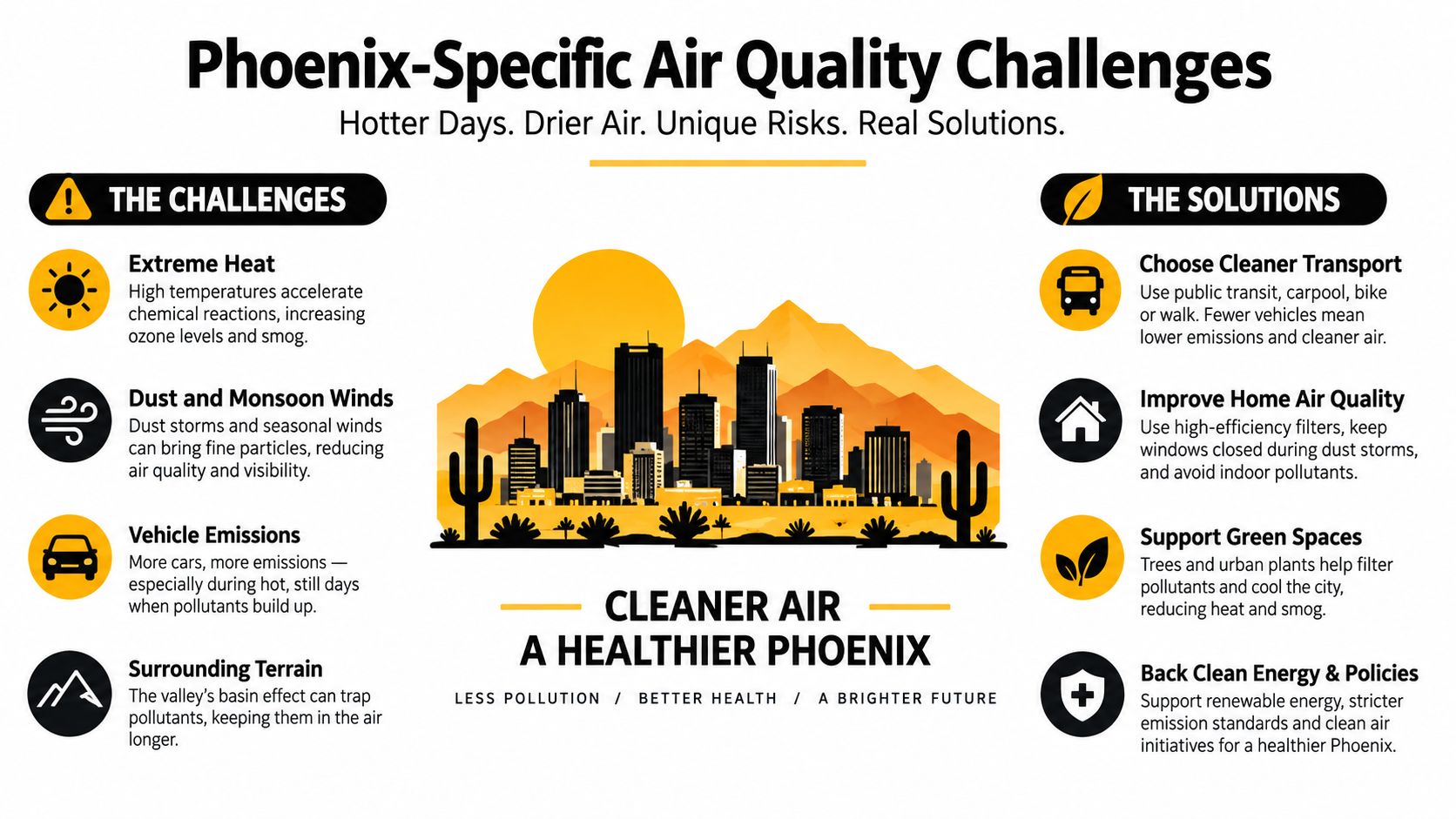
Desert dust also changes the maintenance picture. Dust can enter around doors, windows, penetrations, and mechanical systems, then settle in return paths or on components. Door sweeps, intact weatherstripping, and a well-sealed filter cabinet help reduce uncontrolled entry, but sealing should be paired with a deliberate ventilation and filtration strategy.
Household behavior changes the result
A CDC-indexed multi-city study found that 68% of indoor PM2.5 variation was associated with dwelling type, particularly multifamily housing, and indoor smoking after adjustment for study site. The same study found that 42% of measured black-carbon concentration was explained by cooking-related ventilation and gas-stove use, with venting while cooking accounting for 40% and gas-stove use for 2%, according to the CDC-indexed study material.
Those findings support a Phoenix plan that treats the home and occupant behavior together. Use an outside-vented range hood during cooking and afterward, avoid indoor smoking and unvented combustion, keep windows closed during smoke or dust events, and use filtration that the HVAC system can support. When outdoor air is cleaner, controlled ventilation can help dilute indoor sources.
Building age and design also matter. Older homes may have different leakage paths, return-air arrangements, and insulation conditions than newer construction. Multifamily residents may have less control over envelope sealing and central mechanical systems, so monitoring the occupied space and reporting recurring problems to property management becomes especially important.
For local considerations involving seasonal smoke, dust, and household systems, see this Phoenix-focused guide to Phoenix air quality. Before wildfire season, check filters, test monitors, inspect window and door seals, and confirm that portable cleaners operate correctly. After a dust storm or smoke event, replace loaded filters, clean settled surfaces with methods that don't resuspend dust, inspect return areas, and continue monitoring rather than relying only on improved outdoor conditions.
Building Your Complete Indoor Air Protection Plan
A workable plan starts with the source most likely to create the exposure. For one Phoenix household, that may be cooking. For another, it may be smoke infiltration, a loaded HVAC filter, or dust being redistributed from poorly maintained components. EPA identifies cooking, candles, fireplaces, unvented heaters, smoking, cleaning, and hobbies as indoor particle sources, while concentrations also depend on ventilation, filtration, outdoor pollution, and occupant behavior, as described in its guidance on indoor particulate-matter sources.
Use this priority order:
Control the source: Exhaust cooking outdoors, avoid indoor smoking and unvented combustion, and pause particle-generating activities during vulnerable periods.
Seal and filter: Fit the correct filter, seal obvious entry points, and confirm that a MERV 13 upgrade won't impair HVAC airflow.
Measure patterns: Monitor quiet periods and active tasks so you can identify peaks rather than relying on one snapshot.
Inspect the system: Arrange professional evaluation when debris, leakage, contamination, or repeated redistribution points toward ductwork or HVAC components.
Add layered treatment: Consider portable or in-duct purification when the building, occupants, and maintenance plan support it.
Don't treat this as a one-time purchase. Recheck filters, monitor trends after changes, and investigate any return of dust or particle spikes. A professional plan should explain what was found, what was cleaned or installed, and what the homeowner must maintain afterward. A complete indoor air quality management plan can help organize those decisions across rooms and seasons.
A homeowner success story can't be responsibly promised without measured, documented results for that specific home. What you can track is concrete: lower cooking-related peaks, faster recovery after activities, less visible redistribution from registers, and more stable readings during outdoor smoke or dust events. Those measurements, combined with attention to symptoms and professional advice where appropriate, show whether the plan is working.
Purified Air Duct Cleaning provides residential and commercial duct cleaning, HVAC-related cleaning, and ActivePure air-purification installations across the Phoenix metropolitan area. Visit Purified Air Duct Cleaning to request a quote and discuss a building-specific approach to PM2.5, duct redistribution, filtration, and indoor air quality.