

Phoenix Air Quality: What Residents Need to Know
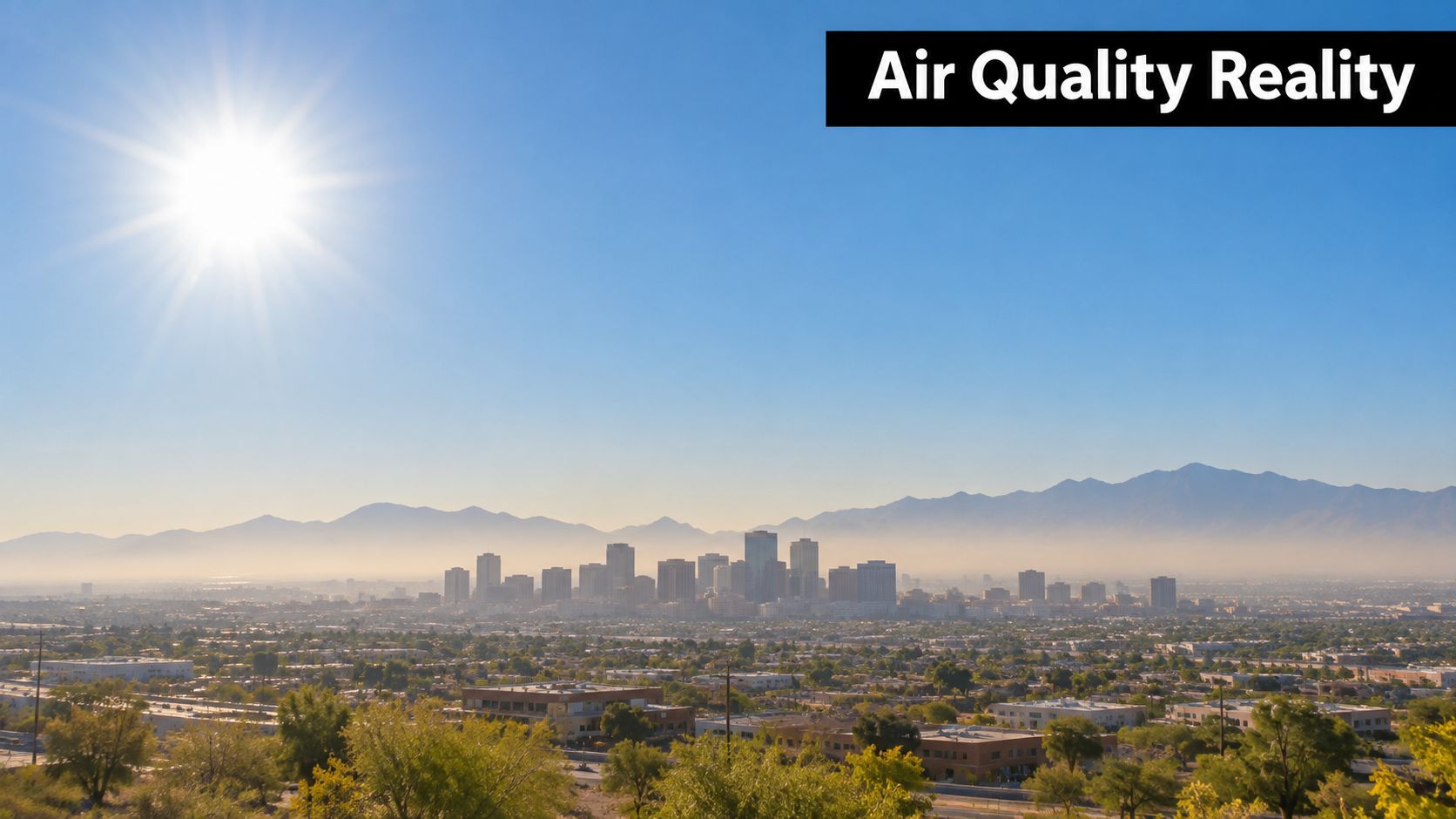
You step outside in Phoenix to a bright blue sky. The sun is sharp, the mountains are visible, and there may be only a thin band of dust along the horizon. Yet the air can still irritate your lungs. Ground-level ozone is invisible, and it can build during hot, sunny conditions even when the day doesn't look smoky or dusty.
That mismatch makes Phoenix air quality difficult to understand. Dust storms and wildfire smoke are obvious, but ozone, vehicle exhaust, PM10, and PM2.5 can affect outdoor and indoor conditions in different ways. Phoenix's warm climate, intense sunlight, basin geography, and heavy commuting patterns create a pollution mixture that changes by season, pollutant, location, and time of day.
The practical question isn't only whether the outdoor AQI looks acceptable. It's how outdoor pollution enters your home, how your HVAC system distributes it, and which indoor controls match the pollutant involved. This guide focuses on that connection, with special attention to ductwork, filtration, HVAC maintenance, and ActivePure technology.
What Phoenix Air Quality Actually Means
A Phoenix morning can look deceptively clean. Sunlight reflects off office towers, the sky appears blue, and the Valley's mountain outline may be easy to see. At the same time, chemistry driven by sunlight can produce ground-level ozone above the city, while dust remains suspended near roads, construction areas, and open desert surfaces.
Ozone is particularly confusing because you can't see it. It forms when sunlight acts on precursor emissions, including nitrogen oxides and volatile organic compounds released by vehicles, industrial activity, and other sources. The warm Valley environment gives that reaction plenty of energy, so a clear afternoon can still be a poor time for strenuous outdoor activity.
Phoenix's pollution history makes ozone a foundational concern. An Arizona Department of Environmental Quality historical report records earlier Phoenix ozone readings reaching 0.15 to 0.18 parts per million, with a 0.14 ppm high in 1996. The same record says that, in late-1990s monitoring, 24 of 28 sites in greater Phoenix recorded annual fourth-highest ozone values above the then-standard of 0.084 ppm, even though maximum one-hour averages had declined since 1980.
Practical rule: A clear sky tells you about visibility. The AQI tells you more about what your lungs may be breathing.
The pollutants behind the local picture
The four problems most relevant to households are ozone, coarse dust called PM10, fine particles called PM2.5, and combustion-related pollution from traffic and other sources. Wildfire smoke adds another mixture of fine particles and gases when regional fires affect the Valley.
These pollutants behave differently indoors. A tight building envelope and well-maintained HVAC system can reduce particle entry, but ordinary particle filters aren't designed to remove ozone gas. That means indoor protection requires more than placing a small purifier in one room. It requires source control, carefully timed ventilation, particle capture, and attention to the system moving air throughout the home.
A useful starting point is this guide to outdoor air pollution and indoor exposure, especially if your family spends most of the day inside while outdoor conditions are changing.
Reading the AQI and the Numbers Behind It
The Air Quality Index is best understood as a behavior signal, not a score to admire or ignore. Think of it as a traffic light. Green generally means routine outdoor activity is appropriate, yellow calls for awareness, and orange or red means some people, or eventually everyone, should adjust exertion and exposure.
Phoenix readings often require attention to the specific pollutant behind the number. The Arizona Department of Environmental Quality forecast page shows sample ozone conditions around 71 parts per billion, corresponding to 101 AQI, while sample PM10 conditions reached 62 AQI at 78 micrograms per cubic meter and PM2.5 reached about 48 AQI at 8.6 micrograms per cubic meter. These examples show why the same city can experience gas pollution and particle pollution at different times.
What the six criteria pollutants mean
The AQI can represent six major pollutants:
Ozone: A reactive gas that often becomes more important during hot, sunny afternoons.
PM2.5: Fine particles from combustion, smoke, and other sources that can reach far into the respiratory system.
PM10: Larger inhalable particles, including desert dust and road dust.
Carbon monoxide: A combustion gas associated with incomplete burning, traffic, and enclosed sources.
Nitrogen dioxide: A combustion-related gas and an ozone precursor, commonly associated with vehicles and fuel burning.
Sulfur dioxide: A reactive gas generally connected to sulfur-containing fuels and industrial sources.
The Phoenix air-quality forecast data illustrates the local split between ozone and particles. You shouldn't assume that a moderate overall reading means every pollutant is moderate, or that a low particle reading rules out an ozone concern.
Use the number to choose an action
AQI Range | Color | Typical Phoenix Pollutant | Recommended Action |
|---|---|---|---|
0 to 50 | Green | No single pollutant dominates | Continue normal activities |
51 to 100 | Yellow | Ozone or particles may be rising | Monitor symptoms and limit unnecessary exposure if sensitive |
101 to 150 | Orange | Ozone or PM10 can become a concern | Sensitive groups should reduce prolonged or strenuous outdoor activity |
151 to 200 | Red | Elevated ozone, dust, or smoke | Everyone should consider reducing strenuous outdoor exposure |
Above 200 | Purple or higher | Severe particle or mixed pollution episodes | Follow local health guidance and minimize outdoor exposure |
These categories are a practical framework, not a substitute for local alerts. Check AirNow and Arizona Department of Environmental Quality forecasts, then look at the pollutant listed as the main driver. A sensor can help you compare rooms and detect changes, but it needs proper placement and interpretation, which is why understanding how indoor air-quality sensors work matters.
Why Phoenix Air Gets Worse by Season
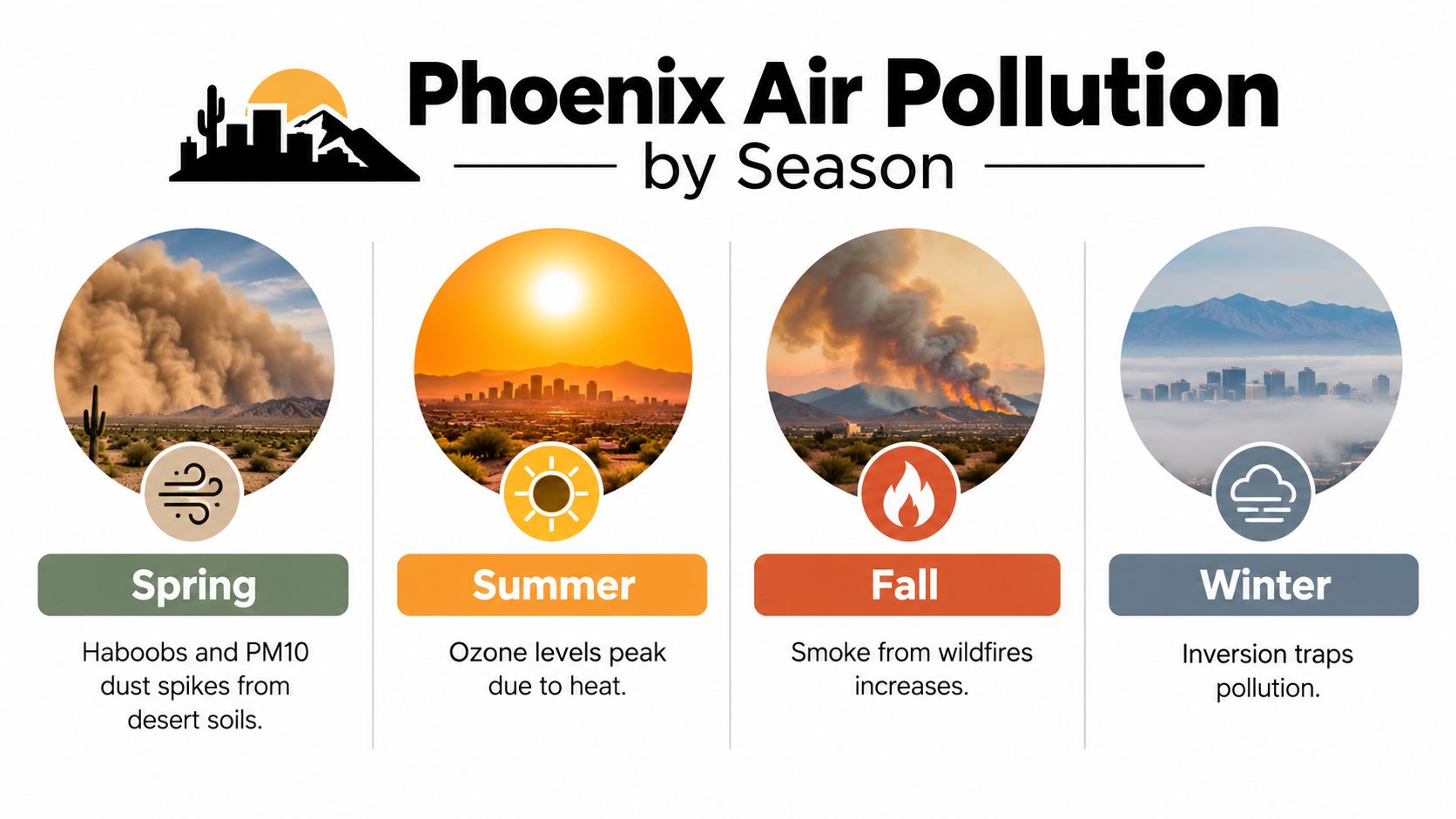
Phoenix doesn't have one pollution season. Each part of the year changes the balance between dust, ozone, smoke, and trapped combustion pollution. The same home may need different habits in spring than it does during a summer ozone alert or a winter inversion.
Spring brings dust and rapid changes
Spring winds can lift loose soil from desert areas, construction sites, agricultural fields, and roads. Haboobs associated with thunderstorms can push a dense wall of dust across the Valley, while smaller wind events create less dramatic but still irritating particle exposure.
PM10 is usually the pollutant to watch during visible dust events. Close windows and doors before the dust arrives, switch HVAC operation to recirculation when appropriate, and avoid unnecessary outdoor activity until conditions improve. A properly fitted HVAC filter can capture particles, but it can't prevent dust from entering through open doors, gaps, or unsealed duct connections.
Summer creates the ozone problem
Summer sunlight drives the chemistry that produces ground-level ozone. Vehicle and industrial emissions provide precursor gases, and heat accelerates the reaction. Ozone often becomes more concerning later in the day, so an early morning walk may not carry the same ozone exposure as vigorous outdoor work in the afternoon.
The City of Phoenix air-quality program notes that four monitors operate within the city, measuring ozone, PM10, and PM2.5. That mix reflects the local reality: Phoenix air quality isn't represented by dust alone, and a citywide reading may not describe every neighborhood equally.
Monsoon weather changes the indoor equation
Monsoon storms can temporarily suppress airborne dust when rain settles particles, but strong outflows can also create new dust events. Humidity can rise sharply, which makes damp areas, drain pans, and poorly maintained HVAC components more important indoor inspection points.
A useful educational overview of Phoenix's ozone monitoring helps explain why ozone deserves attention even when smoke isn't visible.
Fall smoke can arrive from far away
Fall may bring comfortable outdoor conditions and clearer skies, but regional wildfires can send smoke into the Valley. Smoke can travel long distances, and its fine particles may affect indoor air after entering through open windows, doors, leaks, or HVAC outdoor-air intakes.
Keep windows closed during smoke advisories, run suitable filtration, and avoid assuming that a clear horizon means the smoke risk has ended.
Winter traps pollution near the ground
Cold mornings can produce inversion conditions, where a layer of warmer air limits vertical mixing. Vehicle exhaust and other pollutants then remain closer to breathing level near roads and developed areas. Outdoor exercise may be more comfortable in winter, but an early morning inversion can make that timing less favorable.
For visual learners, this short explanation of seasonal air movement and pollution can add useful context:
Who Feels Phoenix Air the Most
An AQI value doesn't affect every person equally. Someone with healthy lungs may tolerate a short outdoor errand, while a child with asthma, an older adult with heart disease, or a worker exposed for an entire shift may need a different plan.
The American Lung Association's 2024 State of the Air report gave Maricopa County failing grades for ozone, 24-hour particle pollution, and annual particle pollution, based on 2020 to 2022 data. Its Maricopa County air-quality report supports treating recurring alerts as a public-health issue rather than an occasional inconvenience.
Groups that need earlier precautions
Children: Developing lungs and active outdoor play can increase exposure. During orange-level conditions, families should ask schools about recess changes and move strenuous play indoors when alerts persist.
People with asthma or COPD: Ozone and particles can irritate already sensitive airways. Keep prescribed medication available, reduce exertion during alerts, and take wheezing, chest tightness, or unusual coughing seriously.
Older adults: Cardiovascular and respiratory conditions can make pollution more stressful. Avoid strenuous walks during poor-air periods, particularly when heat and pollution occur together.
Outdoor workers: Gardeners, roofers, construction crews, and delivery workers can't close a window and stay inside. Employers and workers should monitor the AQI, schedule heavy exertion for safer periods when possible, use appropriate protective practices, and take symptoms seriously.
Pregnant people: Pregnancy can make breathing discomfort and heat stress more difficult to manage. Discuss recurring symptoms and exposure concerns with a healthcare professional.
AQI above 100 is a sensible point for sensitive groups to reduce prolonged or strenuous activity, but symptoms matter at every reading. Shortness of breath, wheezing, chest pain, confusion, blue lips, or rapidly worsening symptoms require prompt medical attention.
Dust events also create concerns beyond ordinary irritation. Valley fever spores can become airborne with disturbed soil and dust, so immunocompromised residents should follow local health guidance and speak with a clinician about persistent flu-like symptoms after heavy dust exposure.
Group | AQI Caution Threshold | Recommended Action |
|---|---|---|
Children with asthma | Above 100 | Limit strenuous outdoor play and follow the asthma action plan |
Adults with asthma or COPD | Above 100 | Reduce exertion, monitor symptoms, and carry prescribed medication |
Older adults with cardiovascular conditions | Above 100 | Avoid strenuous outdoor activity and watch for unusual fatigue or breathing trouble |
Outdoor workers | Rising orange-level conditions | Track alerts, adjust demanding tasks when possible, and use workplace controls |
Pregnant people or immunocompromised residents | Any level that causes symptoms, especially during dust or smoke | Reduce exposure and seek medical advice for persistent or severe symptoms |
Choosing the Right Indoor Air Tools
Indoor tools solve different problems. A portable purifier, a replacement filter, a duct cleaning visit, HVAC coil service, and an ActivePure installation shouldn't be treated as interchangeable purchases.
Match the tool to the contaminant
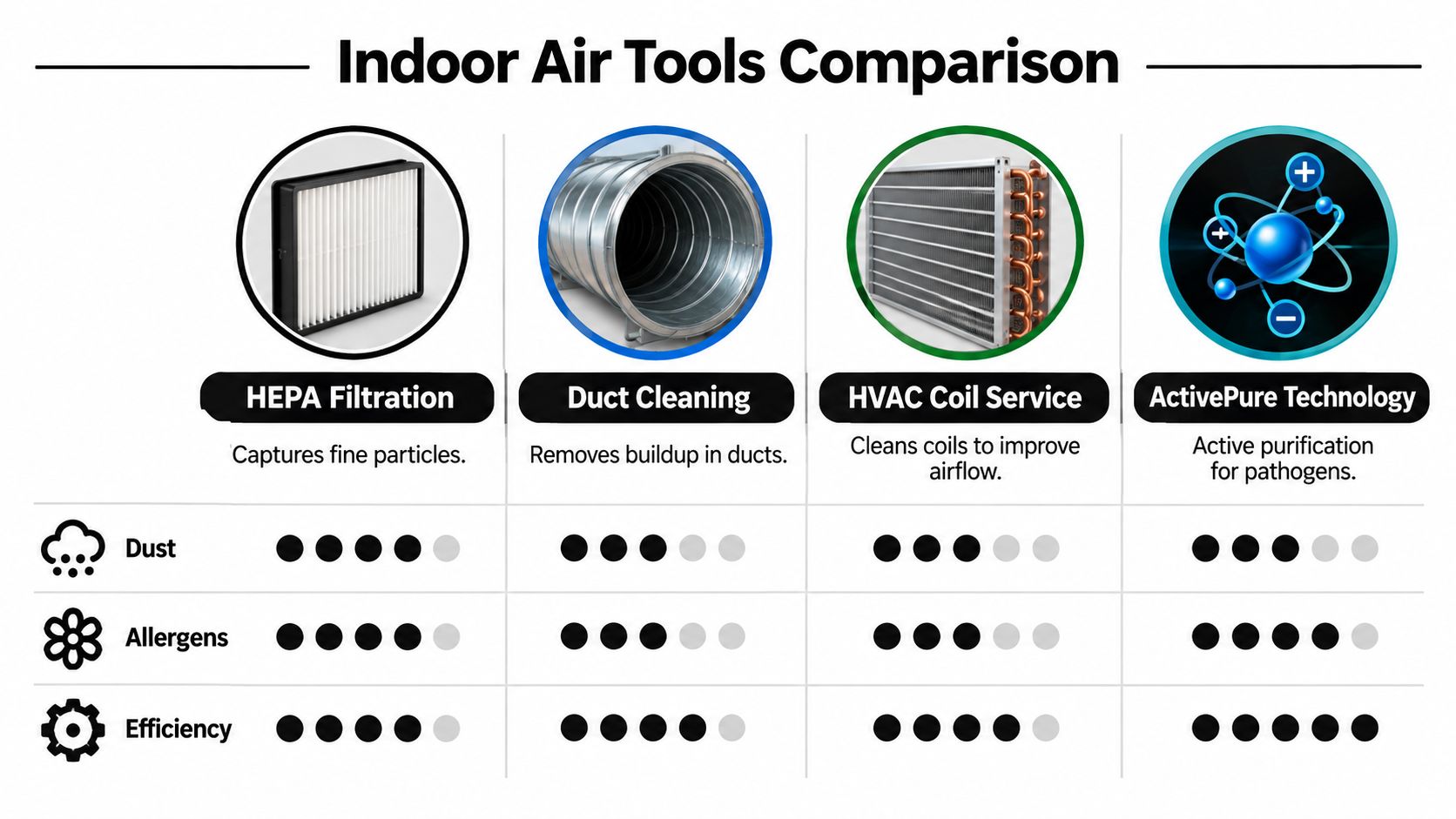
HEPA mechanical filtration is strongest at capturing fine particles. A portable HEPA unit can be useful in a bedroom, nursery, or home office, particularly during dust or smoke episodes. Its limitation is coverage. One room-sized appliance won't clean air in every room, and it won't remove ozone gas.
HVAC filtration works across the home because the central system moves air through the return and supply network. A higher-efficiency filter may capture finer particles, but the filter must fit correctly and the HVAC blower must handle the resistance. Particle filters also don't remove gases because their rating is higher.
Duct cleaning is appropriate when dust, debris, or contamination has accumulated inside accessible duct components. It can remove buildup that the system would otherwise redistribute, but it isn't a substitute for sealing leaks, correcting moisture, or changing a neglected filter.
HVAC coil service addresses the equipment itself. Dust on coils and blowers can restrict airflow and reduce heat transfer, while dirty components can make the system work harder. Coil cleaning doesn't replace air filtration, but it supports the mechanical system that delivers filtered air.
ActivePure technology is an active air-treatment option designed to work with the HVAC system or as a portable unit. Rather than only trapping particles, it is positioned as a technology that neutralizes contaminants at the molecular level. It can complement filtration where households are concerned about gases, VOCs, and biological contaminants, but homeowners should still maintain filters, control sources, and verify that any installed system is appropriate for the space.
A home air purifier guide can help you compare room-based purification with whole-home HVAC strategies.
Tool | Best fit | Main limitation |
|---|---|---|
HEPA purifier | Fine particles in a defined room | Limited room coverage and weak fit for gases |
HVAC filter | Particle capture throughout the ducted system | Filter resistance and limited gas removal |
Duct cleaning | Dust and debris inside ductwork | Doesn't correct every source or leak |
Coil service | Airflow and equipment cleanliness | Doesn't independently purify indoor air |
ActivePure | Complementary active treatment | Should support, not replace, filtration and source control |
Why Ductwork and HVAC Service Matter Most
Your duct system is the distribution path for the home's conditioned air. If return-side gaps pull in dusty attic or wall-cavity air, or if supply ducts contain accumulated debris, the HVAC system can move that material through multiple rooms during every cycle.
Phoenix homes face a distinctive combination of challenges: Sonoran dust, outdoor particles, pet dander, insulation fibers, and occasional moisture-related buildup after monsoon weather. Dust can collect around registers, inside accessible duct sections, on blower components, and on coils. A musty smell may indicate a moisture problem that deserves investigation rather than a fragrance spray.
The whole system beats scattered devices
A portable purifier can protect the room where it operates. It can't correct a leaking return duct, a clogged filter, a dirty blower, or a contaminated coil. Whole-system maintenance addresses the equipment and the delivery network, while room purifiers provide targeted help where occupants spend the most time.
Clean components also support airflow and cooling performance during Phoenix's hot season. Better airflow can reduce strain on the system, while removing combustible dust near equipment supports sensible fire-safety maintenance. These are practical HVAC concerns, not promises of a particular energy saving.
Whole-home principle: Treat the HVAC system as the home's air pathway. Clean the pathway before adding more devices at the end of it.
For a closer look at when accumulated debris justifies professional attention, see this explanation of why duct cleaning can matter.
Your Local Action Plan for Cleaner Indoor Air
Start with habits that connect outdoor alerts to indoor decisions. Check the daily AQI before strenuous activity, close windows during dust or smoke events, and run the HVAC system with a properly fitted filter when indoor circulation is needed.
A simple maintenance rhythm
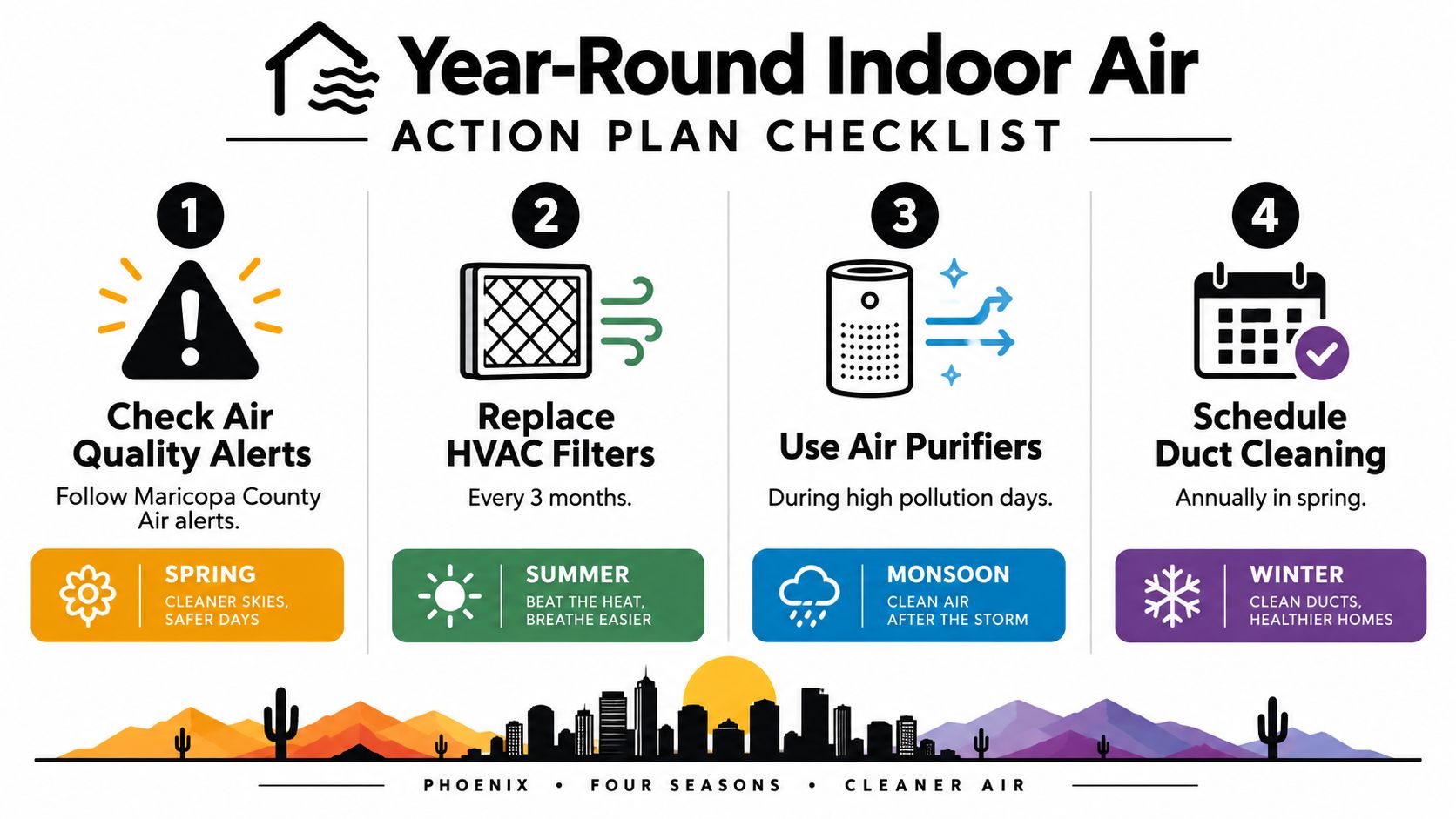
Follow alerts: Subscribe to the Maricopa County Air Quality Department's daily AQI email, check Arizona Department of Environmental Quality smoke advisories, and use the EPA AirNow app widget.
Check filters quarterly: Inspect HVAC filters every three months, and inspect them sooner after heavy dust, smoke, or renovation activity. Replace them when loaded or according to the equipment and filter guidance.
Prepare before summer: Schedule a pre-summer duct and HVAC inspection before ozone-season cooling demand increases. Confirm that returns, coils, blowers, and outdoor-air components are operating as intended.
Clean after monsoon weather: Have the HVAC coil and blower checked after the monsoon period if dust entered the system or airflow changed. This clears trapped material before winter heating.
Call when warning signs persist: Visible dust at registers, musty odors, recurring allergy symptoms indoors, or wildfire smoke that remains indoors after windows are closed all justify professional assessment.
Homeowners handling multiple exterior maintenance projects may also benefit from coordinating HVAC work with a trusted Phoenix roof replacement resource. Roof penetrations, attic dust, insulation, and return-air leaks can interact, so documenting one issue can help a contractor investigate the others.
Purified Air Duct Cleaning offers duct cleaning, dryer vent cleaning, HVAC coil cleaning, and ActivePure installation across the Phoenix metropolitan area. Its air duct cleaning service information can help you decide whether a combined inspection is appropriate for your home or facility.
Small monthly actions usually protect indoor air more reliably than a reactive purchase during one bad AQI day. Monitor the pollutant, control entry points, maintain the HVAC pathway, and choose active or mechanical treatment based on the contaminant you actually need to address.
Purified Air Duct Cleaning can inspect and clean ductwork, service HVAC coils, and install ActivePure systems as part of a coordinated indoor air-quality plan for Phoenix-area homes and commercial spaces. Visit Purified Air Duct Cleaning to request a quote and discuss the right combination of duct, HVAC, filtration, and active purification services.