

Air Scrubber for Home: A Complete 2026 Guide
A family notices the problem in small ways first. Dust hangs in the afternoon sunlight, a child sneezes through pollen season, or smoke from a nearby wildfire leaves a faint smell indoors even after the windows are closed. One portable purifier runs constantly in the bedroom, but the living room, hallway, and upstairs still feel connected to the same stale air.
That's when many homeowners search for an air scrubber for home. They're usually not looking for a flashy gadget. They want to know whether one system can help clean air across the house, whether it belongs in the HVAC system, and whether the technology is appropriate for allergies, smoke, odors, or renovation dust. The right answer depends on the problem, the home's airflow, and the type of device being considered.

The Moment a Homeowner Starts Searching for an Air Scrubber
A homeowner may start with a simple observation: the house looks dusty again shortly after cleaning. The vacuum removes what has settled on the floor, but the HVAC system keeps moving air through rooms, carrying particles that eventually land on furniture and bedding. A child with seasonal allergies may wake congested, while a parent notices that the portable purifier only helps when the family stays in that one room.
Smoke creates a different kind of urgency. After a wildfire advisory, ash and fine particles can enter through gaps, doors, ventilation systems, and normal household activity. Even when the windows stay shut, the family may smell smoke or see residue on surfaces. A new renovation can create a similar concern, especially when sanding, drywall work, flooring, or painting affects several connected rooms.
A homeowner might also be dealing with a new HVAC installation and wondering whether a stronger air-cleaning stage should be added while the ductwork is accessible. The search term air scrubber for home often appears at this point because “whole-home” sounds more suitable than placing separate devices throughout the house.
Practical rule: Start by identifying what you're trying to remove, where the problem appears, and whether your HVAC system moves air through every affected space.
An indoor air quality meter can help you observe changes in particles or other conditions, but a reading won't replace an inspection for moisture, leaks, combustion problems, or visible mold. An air-cleaning device can support cleaner air, but it can't correct the source of contamination. The useful next step is understanding what a residential air scrubber does and how it differs from a purifier sitting beside the sofa.
What a Residential Air Scrubber Actually Is
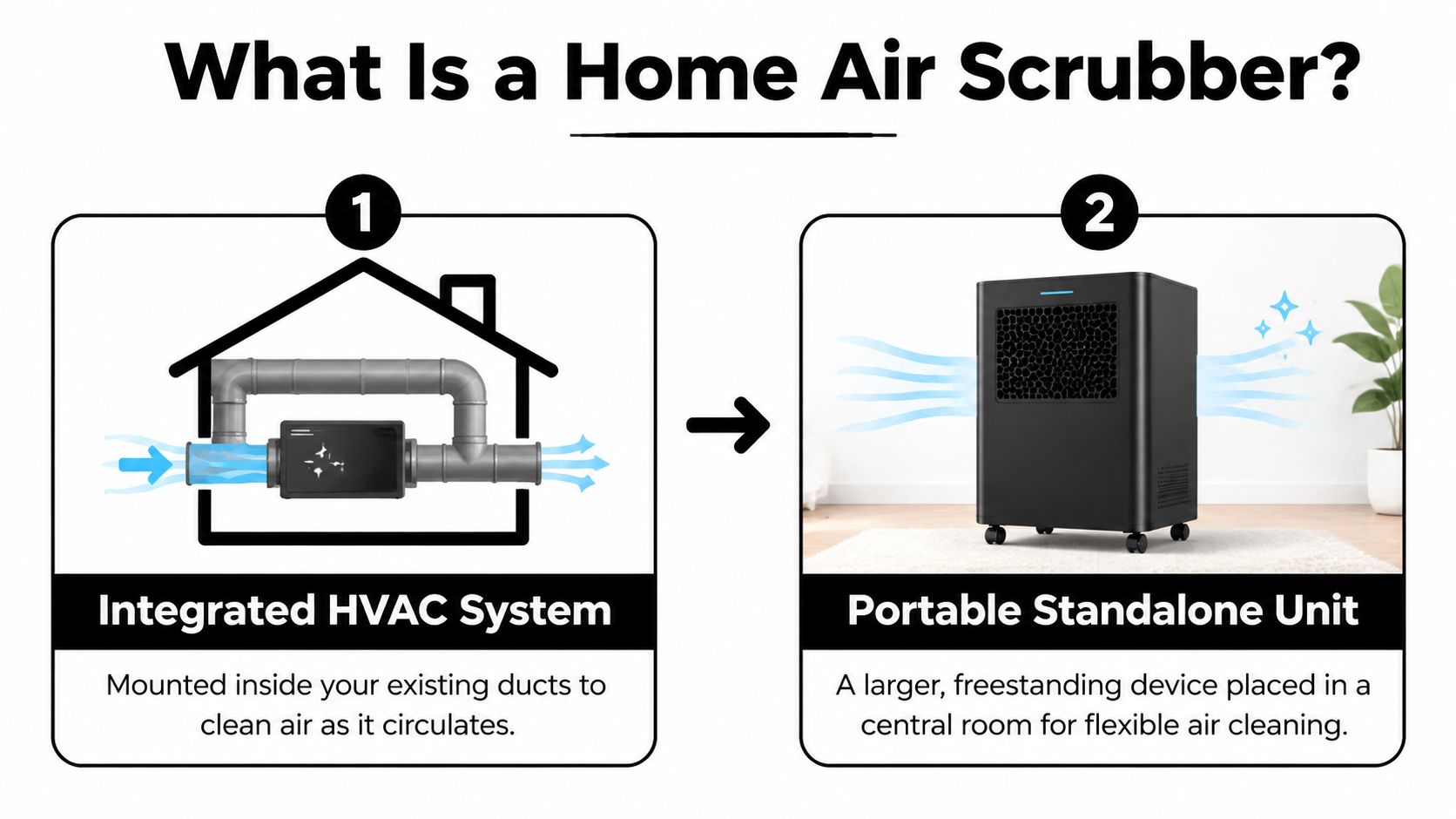
A residential air scrubber is an air-cleaning device designed to treat air as it circulates through a home. It may be installed inside HVAC ductwork, or it may be a larger portable unit that operates independently in a room. The important distinction is coverage: an in-duct system uses the home's air-distribution network instead of cleaning only the air immediately around one appliance.
Think of a portable purifier as one person dusting a single table. An in-duct scrubber is more like a cleaning crew that moves through the building whenever the circulation system runs. It doesn't visit every room at the same moment, and it can't overcome closed-off rooms or poor duct design, but it can treat air that passes through the central system.
The basic airflow path
The exact design varies, but a typical multi-stage system may work like this:
Air enters the return duct. The HVAC blower pulls room air back toward the air handler.
A pre-filter catches larger material. Hair, lint, and larger dust particles are intercepted before they reach finer stages.
An active stage treats the airstream. Depending on the equipment, this may involve UV light, ionization, or an ActivePure-style oxidation process. These technologies require careful evaluation because their operating methods and safety characteristics differ.
A HEPA or carbon stage provides additional treatment. HEPA media focuses on particles, while carbon is commonly used for certain odors and gases.
Treated air returns to the rooms. The HVAC system sends the air through supply ducts, distributing it through connected living areas.
The EPA emphasizes that residential air cleaners mainly focus on particle removal. Its technical summary says that properly sized portable HEPA air cleaners can reduce indoor particulate matter concentrations by an average of about 50%, while intervention studies in that summary reported reductions ranging from 23% to 92%. Those figures apply to the cited portable HEPA research, not automatically to every in-duct device or every active technology. Read the EPA technical summary of residential air cleaners before treating a product claim as a guaranteed household result.
For a homeowner-friendly explanation of integrated systems, see this overview of an in-home air purification system. The central idea is simple: the equipment needs adequate airflow, correct sizing, and a treatment method that matches the contaminant.
Air Scrubbers Compared to Other Air Cleaning Options
Homeowners usually compare three choices: an in-duct air scrubber, a portable HEPA purifier, or a better HVAC filter without an additional treatment stage. None is automatically superior. Each one handles a different pattern of airflow and a different household problem.
Feature | Whole-Home Air Scrubber | Portable HEPA Purifier | Standard HVAC Filter |
|---|---|---|---|
Coverage | Treats air that passes through connected ductwork | Focuses on one room or local area | Protects the HVAC equipment and catches particles as air passes through |
Treatment style | May combine filtration with an active stage | Primarily mechanical particle filtration, often with carbon | Particle capture, depending on filter construction |
Best fit | Homes with forced-air circulation and a house-wide concern | Bedrooms, nurseries, apartments, and targeted rooms | Baseline HVAC filtration and equipment protection |
Placement | Inside the return or supply duct | On the floor or a stable surface in the room | Inside the HVAC filter slot |
Maintenance | Cell, lamp, pre-filter, or media service varies by design | Filter replacement and housing cleaning | Regular filter replacement |
Main limitation | Doesn't treat rooms outside effective HVAC circulation | Doesn't clean the whole house at once | Doesn't actively address every odor or gas concern |
A portable HEPA unit can be the sensible choice for a nursery where a child spends most of the night. It can also help in a bedroom during pollen season, especially when the HVAC system doesn't run continuously. A whole-home unit becomes more practical when smoke, renovation dust, or general particle concerns affect connected rooms and the central system already circulates air.
A standard HVAC filter still matters. It catches particles before they move through the system and should remain part of the maintenance plan. However, a filter alone isn't the same as an active treatment device, and filter efficiency must be balanced against the blower's ability to move air.
For homeowners comparing residential options, this guide to a home air purifier offers another perspective on whole-home and room-based equipment. You can also review residential air purifier options, then ask whether your main concern is localized or distributed through the house.
The EPA recommends using a portable air cleaner and/or upgrading the furnace or central HVAC filter to help reduce indoor pollutants, as explained in its guidance on air cleaners and air filters for homes. That guidance supports a layered approach rather than assuming one device solves every indoor-air issue.
How In-Duct and Portable Scrubbers Get Installed
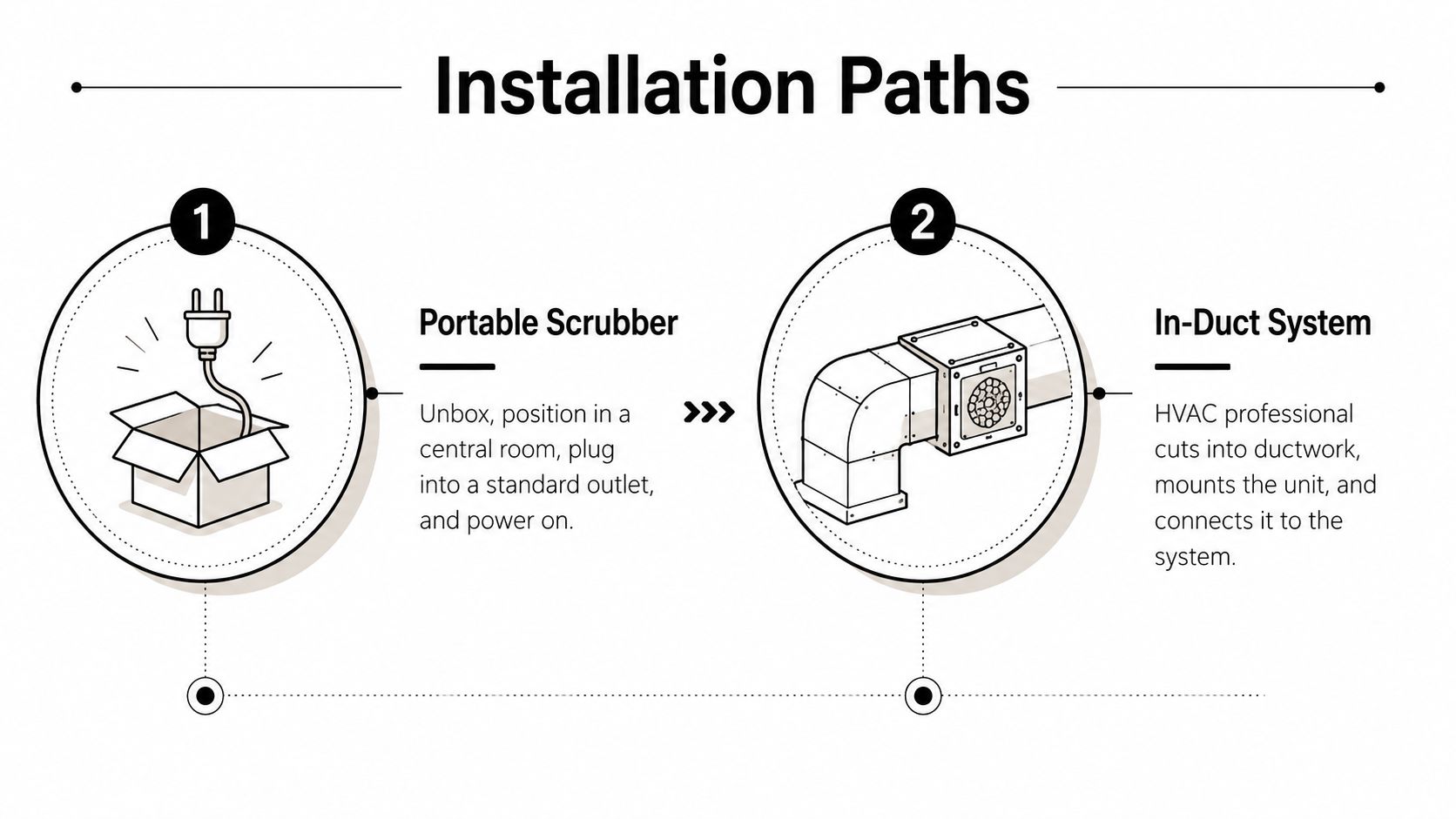
Portable equipment has the simpler installation path. You unpack the unit, place it on a stable surface in a central room, connect it to a standard outlet, and turn it on. Positioning it near, but not directly against, a return vent can help it participate in the room's circulation, while keeping the intake and outlet clear prevents the device from fighting furniture, curtains, or walls.
An in-duct system requires more planning because it becomes part of the HVAC assembly. A technician generally chooses a location on the return or supply side, creates an opening in the ductwork or plenum, mounts the cell or module securely, seals the joint, and connects the low-voltage wiring. The exact placement depends on equipment design, access, electrical requirements, and the airflow direction.
Why the HVAC inspection matters
A qualified HVAC technician should inspect the ductwork and verify that the added equipment doesn't create excessive resistance. The technician may check static pressure, airflow, filter dimensions, wiring, and the condition of the blower and coil. The installation should leave the duct connection airtight and the service access usable.
Consider a 2,000-square-foot ranch with one air handler. A technician may mount the device at the return plenum, connect it to the control circuit, seal the opening, and test operation in about two to three hours. That example describes a possible setup, not a universal installation time. A cramped attic, multiple air handlers, damaged ductwork, or a difficult electrical route can change the scope.
Companies such as Purified Air Duct Cleaning specialize in integrating ActivePure-style in-duct scrubbers alongside duct cleaning, allowing a technician to address existing dust in the system before installing new equipment. The company is one provider among several, so homeowners should compare qualifications, scope, and service terms.
A whole-home air purifier for HVAC systems may be appropriate when the equipment can be placed where a technician can access it later. Attic installations can save interior space but may be uncomfortable to service. Basements often provide easier access, while mechanical closets keep equipment close to the air handler but may have tighter clearances.
Maintenance, Filter Changes, and Expected Lifespan
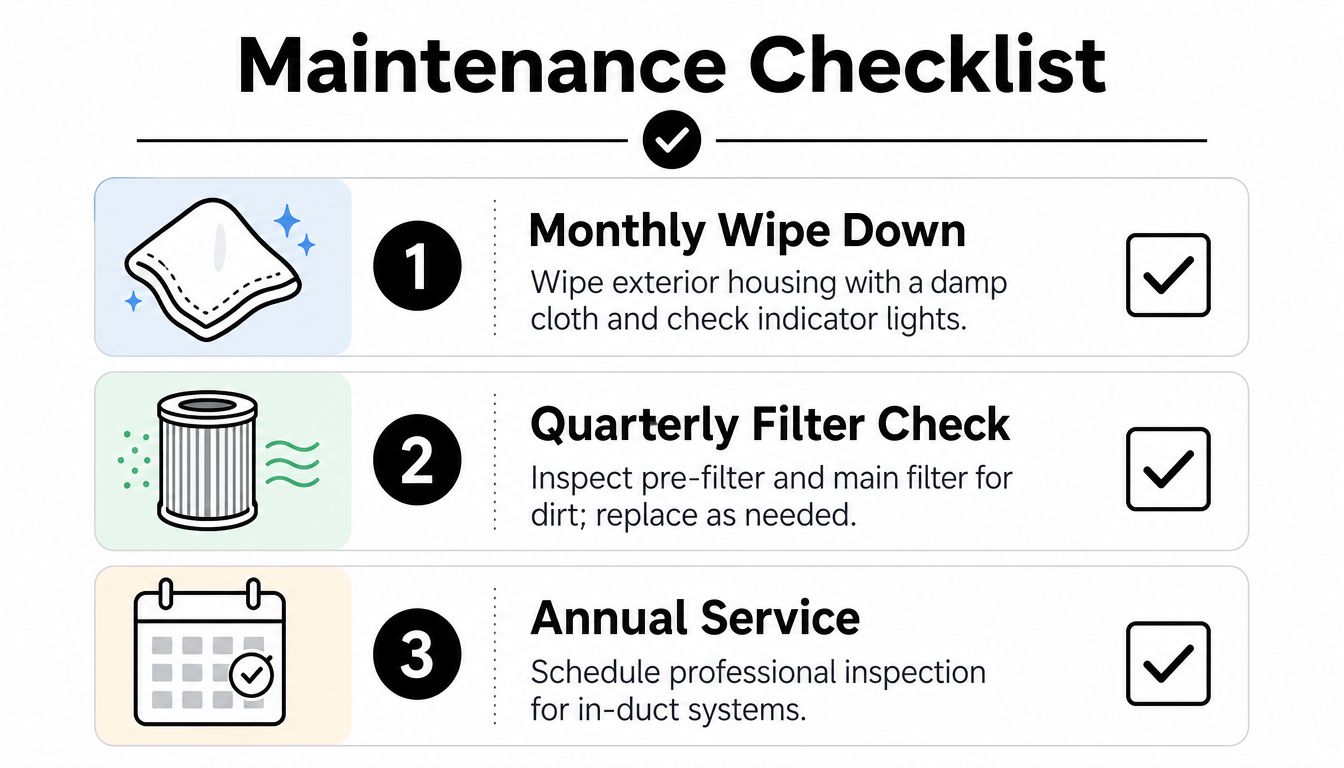
A scrubber works best when maintenance stays routine rather than becoming a repair emergency. The first task is simple: once a month, wipe the exterior housing and check indicator lights or control messages. A warning light, unusual sound, or visible dust buildup deserves attention before performance declines.
A practical service rhythm
Monthly: Wipe the housing, keep air openings clear, and check operating indicators.
Quarterly: Vacuum a portable pre-filter if the manufacturer permits it, and inspect an in-duct cell or module for dust.
Annually: Replace the HEPA or carbon media according to the manufacturer's schedule, clean the UV lamp or reaction chamber when applicable, and ask an HVAC technician to inspect the blower and coil during routine service.
The correct interval depends on the model, indoor conditions, and runtime. A home with pets, renovation dust, smoke exposure, or heavy pollen may load filters faster than a cleaner environment. Don't wash a disposable filter or open an electrical module unless the manufacturer specifically allows it.
Portable equipment can often last five to seven years with regular filter changes, while quality in-duct equipment such as ActivePure cells may operate for ten years or longer when lamps and cells are replaced on schedule. Those are general service-life expectations, not promises for every model. The manufacturer's parts schedule and warranty should control your planning.
One homeowner may run an active system for five years without replacing its lamp, then notice odors returning. The device may still power on, but an active component that has reached the end of its service interval can reduce the intended treatment. Add replacement dates to a phone calendar, and keep the model number and filter size with your HVAC records.
Costs, Energy Use, and What to Budget
Build the budget in three parts: equipment, installation, and ongoing operation. Portable scrubbers generally cost about $100 to $600, depending on design and features, and installation usually means choosing a safe location and plugging the unit in. In-duct equipment generally costs about $800 to $2,000 for the unit, with professional installation adding roughly $300 to $800 depending on duct access, wiring, and whether duct cleaning is included.
Cost Category | Portable Scrubber | In-Duct Scrubber |
|---|---|---|
Equipment | About $100 to $600 | About $800 to $2,000 |
Installation | Usually no separate installation charge | Roughly $300 to $800 for professional work |
Electrical work | Typically uses an existing outlet | May require low-voltage wiring and system integration |
Filter and parts service | Ongoing filter purchases | Media, lamp, cell, and professional inspection costs |
Coverage | Targeted room or area | Airflow through connected HVAC zones |
The EPA's technical summary estimates that running properly sized portable HEPA air cleaners continuously can cost just under $200 per year in electricity, making that a useful baseline for homeowners evaluating operating expense. Actual cost depends on the device, speed setting, runtime, and local electricity rate. An in-duct system can have a different electrical profile because the HVAC blower and treatment module don't operate in exactly the same way.
Some homeowners budget filter replacements at $50 to $150 annually, but the actual amount depends on media type, model, and replacement frequency. Don't treat a low purchase price as the full cost. A device that requires costly proprietary parts may cost more to own than a simpler unit with readily available filters.
A one-year budget should include the equipment, installation if needed, first replacement parts, and electricity. A five-year budget should add repeated filters, scheduled cells or lamps, service visits, and any duct repairs discovered during installation. For an explanation of how airflow condition and HVAC performance relate, review this guide to HVAC system efficiency.
Health, Energy, and Safety Benefits Worth Knowing
The strongest reason to install an air scrubber is usually practical comfort. Cleaner particle levels may help a home feel less dusty, and some people notice fewer allergy-related irritants in rooms where filtration is working well. A bedroom unit may support better sleep during pollen season, while whole-home treatment may help when several rooms share the same forced-air system.
The EPA's guidance is especially relevant here because it frames residential air cleaners mainly as particle-removal tools. A properly sized portable HEPA unit can reduce particulate matter, but a scrubber cannot remove a moisture source, repair a roof leak, eliminate established mold growth, or correct carbon dioxide buildup caused by inadequate ventilation. Those problems require building repairs, ventilation changes, or professional remediation.
Energy depends on system condition
Cleaner HVAC components can support airflow, but an air-cleaning device isn't an automatic energy-saving machine. A loaded filter can increase resistance, while an improperly selected high-efficiency filter or added module can make the blower work harder. A technician should verify airflow and pressure after installation instead of assuming the equipment will reduce runtime.
Portable devices and in-duct modules also consume electricity while operating. The EPA's technical summary places continuous portable HEPA operation at just under $200 per year, a figure that helps translate “always on” into a household budget. That estimate applies to the cited portable units and shouldn't be presented as a universal cost for every scrubber.
Safety boundary: Air cleaning can reduce particles and some odors, but it isn't a smoke alarm, carbon monoxide alarm, gas detector, or substitute for fixing a combustion or fuel leak.
Wildfire smoke and soot call for particle control, closed windows where appropriate, and attention to official emergency guidance. A nuisance odor may respond to ventilation or carbon media, but a gas-like smell requires leaving the area and contacting the appropriate emergency or utility service. No air scrubber makes an unsafe home safe.
Match the tool to the dominant issue:
Allergies and pollen: Use properly sized particle filtration, often a portable HEPA unit for a bedroom or an in-duct system for connected rooms.
Wildfire smoke: Prioritize particle removal and reduce outdoor-air infiltration during smoke events.
Odors: Consider source control, ventilation, and carbon media, while investigating persistent smells.
HVAC efficiency: Inspect filters, ducts, coils, blower operation, and static pressure before adding equipment.
Choosing the Right Air Scrubber for Your Home
Begin with a short self-assessment rather than a product search. Note the home's square footage, the age and condition of the HVAC system, the rooms where symptoms or odors appear, and whether the ducts are accessible. Write down the main concern, such as dust, smoke, pets, pollen, chemical odors, or renovation debris.
A whole-home in-duct unit may make sense for a larger home, including a 1,500-square-foot or larger property with forced-air distribution, when the concern affects connected rooms. A portable unit is usually more practical for an apartment, nursery, bedroom, or home without central ductwork. A hybrid setup can serve a central HVAC system while adding a portable unit in a finished basement, addition, or room with weak circulation.
Questions for a provider
Duct condition: Will the technician inspect for leaks, damage, restricted returns, and existing dust before recommending equipment?
System compatibility: What are the expected airflow and pressure effects, and how will the technician verify them?
Treatment method: Does the device use mechanical filtration, carbon, UV, ionization, ActivePure-style oxidation, or a combination?
Safety documentation: Does the manufacturer provide clear operating information, maintenance requirements, and emissions details?
Written scope: Does the quote identify the equipment, location, wiring, sealing, testing, warranty, and future service?
Provider qualifications: Is the contractor licensed and insured, and does the company service the products it installs?
The EPA doesn't certify or register air-cleaning devices and doesn't recommend specific manufacturers, as explained in its guidance on air-cleaner certification and acceptable-device lists. That means homeowners should examine independent performance metrics, published testing, warranty terms, and installation quality rather than treating an EPA reference as product approval.
For particle-focused equipment, CADR, or Clean Air Delivery Rate, is a useful comparison metric. The EPA and AHAM describe CADR as the amount of clean air delivered per minute, and a higher CADR generally means faster particle filtration and the ability to serve a larger room, as detailed in this residential air-cleaner guidance.
Purified Air Duct Cleaning offers duct cleaning, HVAC-related indoor air quality work, and in-duct or portable ActivePure-style systems, so a homeowner can ask the company to evaluate existing ductwork and discuss integration options. Compare that service with other qualified providers, request a written quote, and choose the system that addresses the actual source and distribution pattern in your home.
If dust, smoke, allergies, or uneven HVAC airflow are driving your search, Purified Air Duct Cleaning can evaluate your ductwork and discuss residential air-cleaning options, including ActivePure-style in-duct and portable systems. Request a quote that separates equipment, installation, duct cleaning, and ongoing maintenance so you can make a clear comparison.