

Does Air Purifier Help Asthma? What the Evidence Shows
A 64.4% drop in indoor PM2.5 did not improve asthma outcomes. In the 2025 AIRWEIGHS trial, portable HEPA cleaners ran for 12 weeks with 164 children with asthma. Particle levels fell. The children's asthma outcomes did not.
That split answers whether an air purifier helps asthma. Trials measure cleaner air consistently: fewer particles in the room, often within weeks. Symptom scores, control, and clinic visits move less often, and not in the same direction from one study to the next. A purifier supports medical care. It does not stand in for an inhaler.
The split to hold onto: a purifier is an exposure tool. The evidence says it moves particles, and only sometimes moves symptoms.
Across the trials below, symptom gains appeared most often in bedrooms where particle levels were high. A unit that only trims an already moderate particle load, or that runs outside the room where the person sleeps, leaves less for symptoms to respond to. Particles a filter can catch are not every trigger that reaches the airway.
Short Answer From the Clinical Trials
Start with the cleanest experiment. The 2025 AIRWEIGHS trial assigned 164 children with asthma to portable HEPA cleaners or to identical placebo devices without effective filters, and ran for 12 weeks. The HEPA group's air improved on every pollutant the researchers measured: ultrafine particles down 64.0%, PM2.5 down 64.4%, PM10 down 54.7% and nitrogen dioxide down 11.7%, all statistically significant, according to the trial record in the EPA health and environmental research database. That same record reports no improvement in the trial's primary or secondary asthma outcomes, in normal-weight or overweight children.
The counterweight is the HAPI randomized trial, which placed HEPA cleaners in the sleeping area and living room of 75 children with poorly controlled asthma. Compared with controls, treated homes had lower risk of crossing a poor-control threshold (incidence-rate ratio 0.45; 95% CI 0.21 to 0.97), of reporting symptoms in the preceding two weeks (ratio 0.71; 0.52 to 0.98), and of any unplanned clinical use (ratio 0.35; 0.13 to 0.94). The investigators flagged the caveats themselves: the study was unblinded, several measures were self-reported, and not every primary analysis reached significance. The same report carries a school cluster trial where classroom filtration produced 1.6 asthma symptom-days per two weeks against 1.8 with sham filtration, a difference that was not statistically significant.
Two smaller crossover trials lean toward benefit. The U.S. EPA guide to air cleaners in the home summarizes a South Korean double-blind crossover in 30 elementary-school students who used a HEPA purifier for three weeks after a two-week washout: severity, lung function, peak expiratory flow, exhaled nitric oxide and airway inflammation all improved. A U.S. crossover run from 2015 to 2017 in 43 children, one month of filtration at a time with a one-month washout, reported better asthma-control and quality-of-life scores. That same EPA guide is blunt that studies do not consistently show major improvements across all symptoms.
A 2024 pilot in seven asthma-affected households in Chelsea, Massachusetts ran portable cleaners for five months and tracked indoor PM1, PM2.5 and PM10, published in Environmental Health Insights. It measured particles, not symptoms.
Study | Design and group | Result | Limitation |
|---|---|---|---|
AIRWEIGHS trial (2025) | 164 children, HEPA versus filterless devices, 12 weeks | PM2.5 down 64.4%, ultrafine particles down 64.0%, PM10 down 54.7%, no asthma outcome gain | Cleaner air alone did not change symptoms |
HAPI trial | 75 children with poorly controlled asthma, HEPA in bedroom and living room | Poor-control ratio 0.45, symptom ratio 0.71, unplanned care ratio 0.35 | Unblinded, several measures self-reported, not every analysis significant |
U.S. crossover trial | 43 children, one month on, one month off, one-month washout | Better asthma control and quality-of-life scores alongside measured particle drops | Small sample, not generalizable to every patient |
Korean crossover trial | 30 elementary students, three weeks of HEPA, then washout | Better severity, lung function, peak flow and airway inflammation | Small sample, short run |
Chelsea pilot (2024) | 7 households, five months of portable cleaners | Lower PM1, PM2.5 and PM10 | Particles only, no symptom data |
How to read that table: particle reductions are the reliable finding, symptom gains are the fragile one, and the fragile gains cluster where exposure was high and the device sat in a bedroom overnight.
One boundary worth stating plainly: AIRWEIGHS, HAPI and both crossover trials enrolled children. They don't directly answer adult asthma, and no trial here proves a device changes the course of the disease.
Which Asthma Triggers a Purifier Can and Cannot Reach
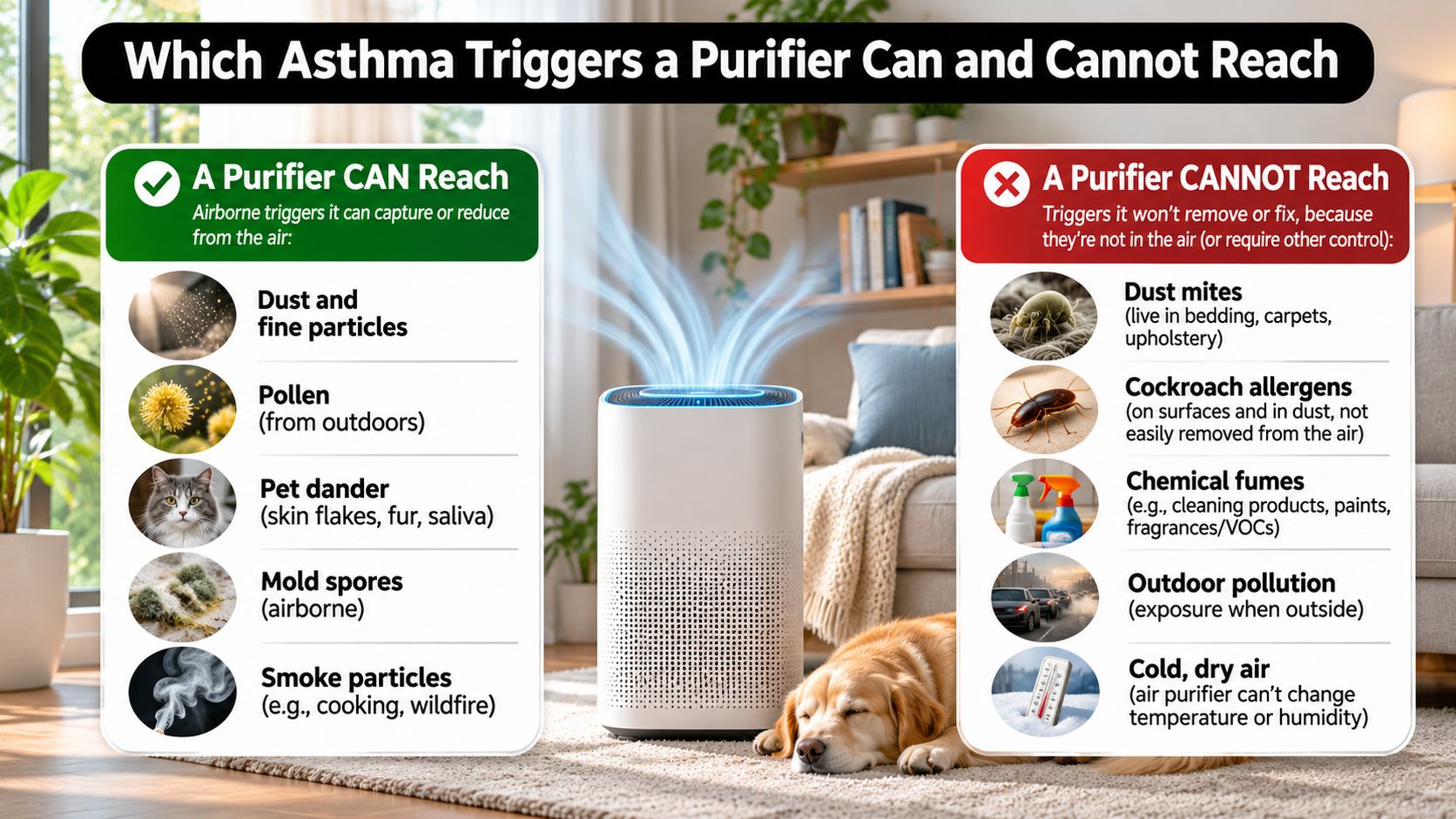
A HEPA filter does one job well. It traps particles that pass through it, so the triggers it reaches are the ones that stay suspended in room air long enough to be pulled in.
Triggers that stay airborne long enough to be filtered
Wildfire smoke and fine PM2.5 are the clearest case. The particles are small, they linger, and a sealed HEPA unit running in a closed room strips them out. Traffic particles behave the same way, which matters in a flat near a busy road. Cooking particles are the most controllable of all: run the unit on high while the pan is hot. Tobacco smoke particles fall, but the residue that coats curtains and walls keeps off-gassing after the visible haze clears. Cat dander is airborne mainly while the animal is moving or being handled, then it settles into soft furnishings.
Triggers that settle before the filter can reach them
Dust mite allergen in bedding and mattresses is mostly settled, so washing bedding in hot water and holding indoor humidity down does more than filtration. Mold spores are only partly airborne, and filtration helps only after the moisture source is fixed. Cockroach allergen is another settled trigger, and why water bugs show up inside usually traces back to damp conditions and accessible water, the same conditions that feed mold. Exercise, cold air and reflux are not airborne at all, so no filter touches them.
Trigger | Airborne in the room? | Expected purifier effect |
|---|---|---|
Wildfire smoke and PM2.5 | Yes | Strong particle reduction, the clearest use case |
Traffic and cooking particles | Yes | Good reduction when the unit runs continuously |
Tobacco smoke | Yes | Reduces particles, but residue on surfaces remains |
Airborne cat dander | Yes, while disturbed | Weak evidence for symptom benefit |
Dust mite allergen in bedding | Mostly settled | Limited, so wash bedding and control humidity |
Mold spores | Partly | Helps only when the moisture source is fixed |
Viruses and colds | Partly | Reduces some exposure, not a treatment |
Exercise, cold air or reflux | No | No effect, these triggers need other management |
The trial design that best ties a device to outcomes used this exact logic. In a randomized, double-blind crossover trial in 43 children with asthma, researchers ran residential HEPA filtration for one month, comparison treatment for one month, and a one-month washout, while measuring indoor PM2.5, black carbon, ultraviolet-absorbing particulate matter and fungal spores. Asthma control and quality-of-life scores improved alongside the particle measurements, which is what makes the result worth citing: the intervention was linked to both the exposure and the clinical score, not just to a satisfaction survey. The authors warn that a single trial doesn't transfer to every patient, room, purifier or asthma phenotype.
The U.S. EPA's guide to air cleaners adds the calibration. Its review found multiple studies reporting improvement in at least one allergy or asthma symptom, but the effects were generally small and inconsistent across symptoms. The agency identifies HEPA-rated units as the most effective portable type and stresses that filtration reduces, not eliminates, indoor pollutants, with less reliable control of larger settled allergens such as dust mite material or pet allergen on furnishings. It also advises against ozone-generating devices, and that matters more for an asthmatic airway than for anyone else in the house.
Practical rule: if you can watch the trigger float, a filter can help. If you have to disturb it to notice it, clean the fabric or fix the moisture instead.
Sorting your own triggers is the first real step, and this practical guide to asthma triggers in the home walks room by room through where each one hides.
Portable Unit or Whole Home Filtration
Almost every trial with a symptom signal used a portable HEPA unit in a bedroom, sometimes with a second unit in the living room. That's not a coincidence. A portable unit creates a clean zone in the one room where you spend eight uninterrupted hours, and closing the door makes the zone hold.
An in-duct or whole-home filter treats the air that moves through the heating and cooling system. It cleans only while the blower runs, and it does nothing about dust already resting on bedding, floors and furniture. That's a real limitation for asthma, because settled allergen gets resuspended every time someone sits on the bed or walks across the carpet.
Decision rule: filter the room where the trigger is, treat the system when the whole house is the exposure.
Choose a portable unit first when smoke, cooking fumes or traffic particles recur in one occupied room, or when you want to test the idea before spending on hardware. Move up to whole-home treatment when the problem isn't room-specific. Look for these signs:
Several rooms affected, so one unit can't keep up with the volume of air you breathe.
Dusty return ducts or grilles, which point to a distribution problem rather than a filtration problem.
Visible moisture or mold, which no filter fixes until the water source is stopped.
Pet allergen across the whole home, where the animal has the run of every room.
That last group is where a duct and airflow inspection earns its cost, because it separates what a filter can reach from leaks, dirty ductwork or a moisture problem a purifier will never solve. The tradeoffs between the two approaches are laid out in this comparison of in-duct air purifiers. Either way, prescribed asthma care stays exactly as it is, and one bedroom trial tells you more than a showroom demo.
How to Size and Choose a HEPA Purifier
Sizing is where most purchases go wrong. People buy for the square footage on the box, run the unit on low because it's loud, and end up moving a fraction of the air the filter was designed to handle.
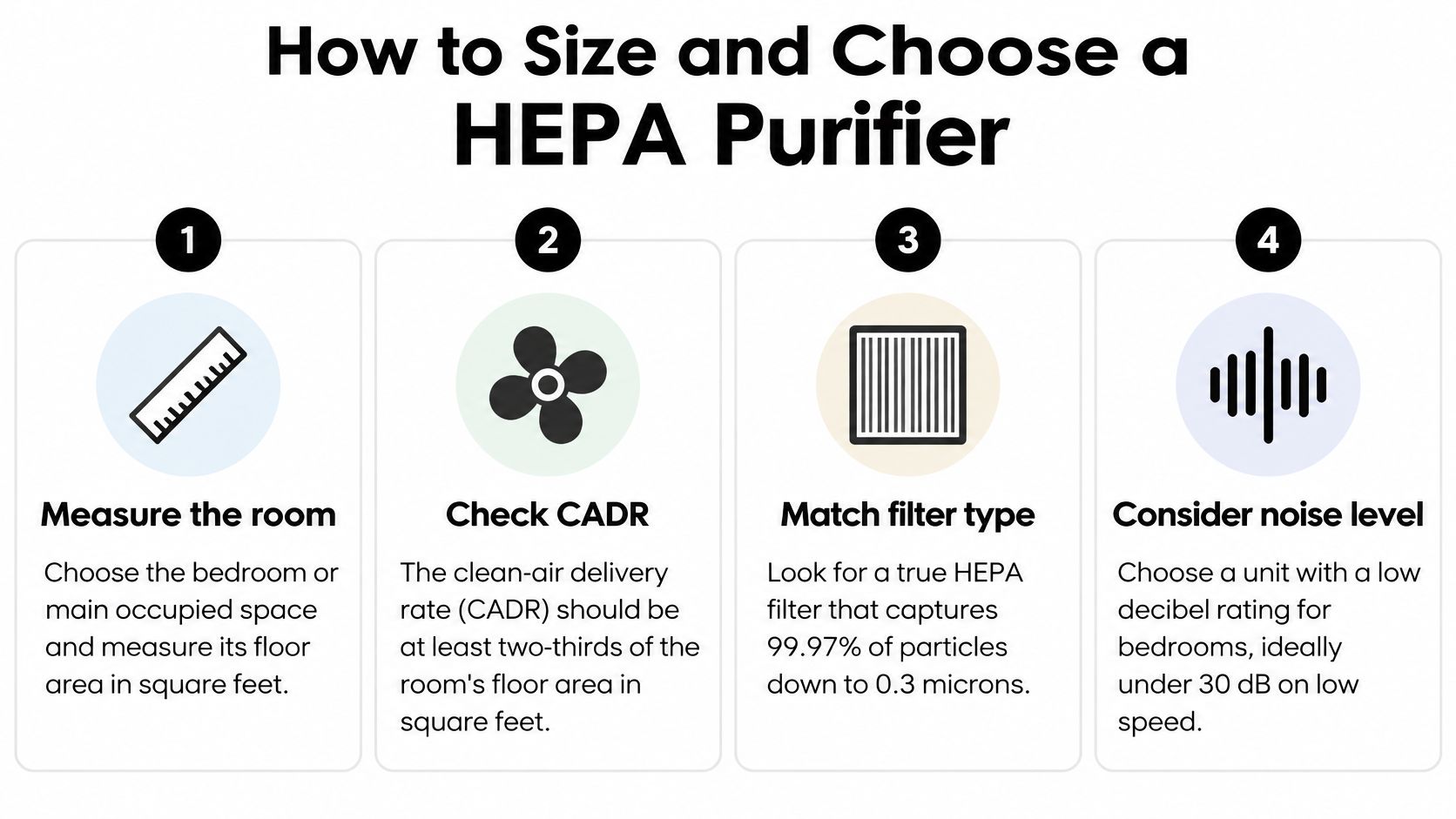
Start with the room, not the device. Pick the bedroom or the main evening room, measure its floor area in square feet, and size to that number alone. Then use the clean-air delivery rate, or CADR, the manufacturer lists for smoke and dust. A workable rule of thumb is a CADR of at least two-thirds of the room's floor area in square feet.
Room area | Minimum CADR (two-thirds of area) | Practical unit type |
|---|---|---|
100 sq ft | 67 | Compact bedroom unit |
150 sq ft | 100 | Standard bedroom unit |
350 sq ft | 233 | Top-tier unit or two units for an open area |
Here's how the setup looks in practice before you commit to a model.
Then run the checklist. Each item exists because skipping it cancels the benefit.
A true HEPA filter rating: not "HEPA-style" or "HEPA-like", which are marketing terms with no standard behind them.
A listed CADR for smoke and dust: two numbers, not a vague coverage claim.
No ozone generation: skip ionizers and any unit that advertises ozone output, because ozone irritates the same airways you're trying to calm.
A sealed filter housing: air that bypasses the filter is air you paid for and didn't clean.
Filters you can buy for years: check price and availability before purchase, because a discontinued filter turns the unit into a fan.
A noise level you can sleep through: the machine only works while it runs, and a unit you switch off at 2 a.m. isn't running.
On the portable-versus-whole-home question, a portable unit suits a single room and a whole-home system suits a house-wide problem, as covered in the comparison of HEPA air filtration systems.
One sizing habit pays off. Buy a unit rated for a larger room and run it on a moderate setting. A small unit pushed to maximum moves less air, makes more noise and loads its filter faster than a larger unit cruising in the middle of its range.
How to Set Up a Purifier for Asthma Control
Placement and runtime decide whether the device earns its electricity. A well-chosen purifier in a corner, run for two hours on a dusty afternoon, does almost nothing for a sleeper.
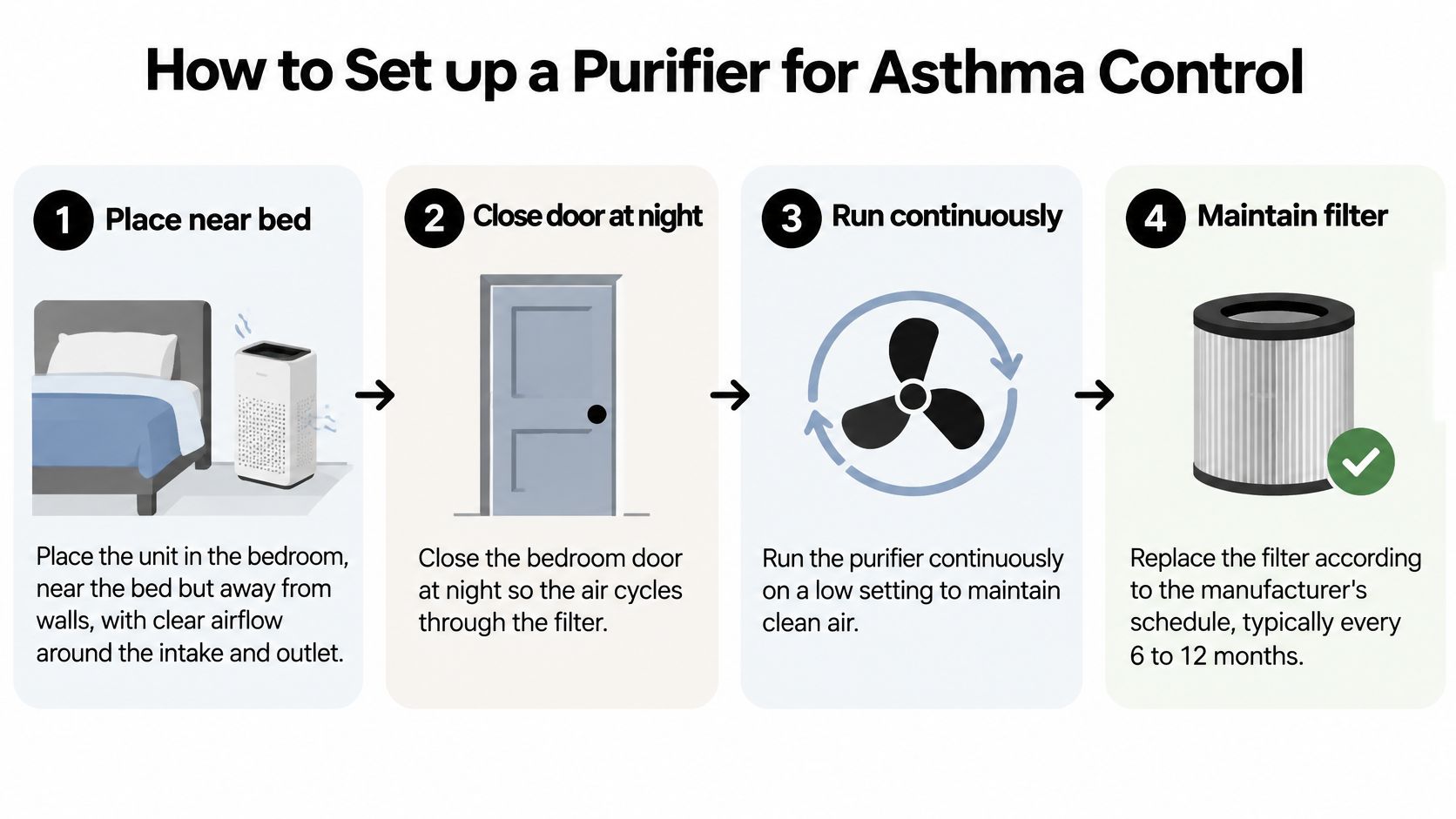
Put it near the bed, not against a wall. Leave clear space around the intake and outlet so the unit can cycle room air instead of choking against fabric or drywall.
Close the bedroom door at night. A closed room lets the filter process a defined volume of air repeatedly instead of chasing air from the rest of the house.
Run it continuously, day and night. Intermittent use lets particle levels climb back between cycles, which is the opposite of what a sleeper with asthma needs.
Boost to high for an hour after cleaning or dusting. Vacuuming and bed-making throw settled allergen into the air, and that hour is when the filter does its most useful work.
Keep windows shut on high-pollution days. Check local air-quality alerts during wildfire season, because a purifier fighting an open window loses.
Write the filter change date on the housing. Replace on the manufacturer's schedule, and sooner if the unit runs constantly or you live with pets.
Cut the source while the filter runs. Remove smoke sources, fix leaks and mold, wash bedding weekly in hot water, keep indoor humidity moderate, and change the HVAC filter on schedule with a guide to the best HVAC filter for allergies.
Log four weeks of nights. Note night waking, rescue inhaler doses and peak flow readings, because that record is the only honest test of whether the device is helping you.
What a useful result looks like: fewer night symptoms, fewer rescue doses and steadier peak flow readings across four weeks, judged against your log rather than against the particle readout on the device.
That last point is where it's easy to fool yourself. A display dropping from red to green proves the filter is working on particles. It doesn't prove your asthma is better. The log does.
Confirm the Plan With Your Doctor Before You Buy
Bring the buying question to your clinician before you spend anything, and bring a short home brief with it. List the rooms where you sleep and spend your evenings, the triggers you already know about such as smoke, pets, pollen or mold, the controller and rescue inhalers you use, and either recent peak-flow readings or a two-week symptom note. That turns a vague conversation into a decision.
Then ask three questions. Does my asthma look trigger-driven enough for a HEPA trial to be worth it? Which single room should I prioritize? And which changes should bring me back in, such as more night waking, more rescue doses or a falling peak flow?
Agree that medication stays unchanged during the test. If a dose changes mid-trial, the log reflects the prescription rather than the purifier, and you've learned nothing.
If the home has dusty ducts, ongoing moisture, or allergens a portable unit can't reach, ask whether a separate inspection makes sense. That's the point where an assessment helps: we look at each home's actual conditions and recommend the purification setup that fits it, rather than the largest unit on the shelf, and we maintain the systems we install. For bedding and soft furnishings, this guide to dust mite allergy covers the cleaning steps a filter can't do for you.
Buy one true HEPA unit sized to the bedroom, run it continuously for four weeks, and judge it on night symptoms, rescue use and peak flow. If the log is flat, don't buy a second device. Go back to the clinician and back to source control.
If you've confirmed with your doctor that airborne triggers are worth targeting, Purified Air Duct Cleaning can assess your home's actual conditions and recommend the purification system that suits it, from portable units to NASA-certified ActivePure systems installed in the ductwork, with regular maintenance for whatever we install. We also clean the ducts and coils that keep particles circulating long after a bedroom filter has done its job, serving Avondale and the wider Phoenix area. Visit Purified Air Duct Cleaning to talk through your home before you buy another appliance.