

Air Vent Cleaning Price Guide for 2026
A whole-home air vent cleaning price typically falls between $300 and $700, though per-vent rates average around $35 each. A 12-vent home may cost about $300 to $600, while a 20-vent home can reach $500 to $1,000, depending on the scope of work.
You're probably looking at two or three quotes that don't seem comparable. One contractor prices every register, another offers a flat package, and a third advertises a surprisingly cheap “whole-house” special that leaves you wondering what's included. The number of vents matters, but it stops being the main pricing factor once the job involves multiple HVAC zones, difficult access, flexible ductwork, contamination, or inspection technology.
The smart way to compare an air vent cleaning price is to start with the basic math, then ask what the contractor is cleaning, how they'll access it, and which services are included.
Understanding Baseline Air Vent Cleaning Costs
A homeowner comparing quotes may see one contractor price each vent and another quote the entire HVAC system. Both methods can be valid, but they measure different work. Check whether the proposal covers individual vents, one complete HVAC system, or multiple systems before comparing the totals.
The baseline numbers to know
In the U.S. market, air vent cleaning commonly runs $25 to $50 per vent, with many consumer estimates near $35 per vent. HomeAdvisor's air duct and vent cleaning cost guide uses this approach. Its examples put a 12-vent home at approximately $300 to $600, while a 20-vent home can reach $500 to $1,000.
Whole-system work is normally sold as a package rather than calculated from a single vent rate. Thumbtack's whole-home air duct cleaning cost information places the average U.S. job around $388 to $500, while other consumer guides commonly cite $300 to $700 depending on home size and complexity.
Quote type | What it usually measures | What to verify |
|---|---|---|
Per-vent | Registers or grilles counted individually | Whether supply and return vents are both included |
Whole-system | The connected duct network and HVAC system | Whether trunk lines, branch lines, and system components are included |
Multi-system | Separate heating and cooling systems or zones | Whether each system has its own inspection and access charge |
A low quote may cover only visible registers. A higher quote may include the main trunk, returns, branch lines, equipment access, and inspection technology. Duct material also matters. Flexible ductwork can require different handling from rigid metal, so a basic per-vent price may fail to represent the actual job.
Practical rule: Compare identical scopes, not competing headline prices.
For a clearer explanation of what air duct cleaning services involve, review the work listed in the proposal line by line. A precise scope shows whether the contractor is cleaning the connected duct system or only the openings you can see.
Per-Vent Rates Versus Whole-System Packages
A per-vent quote looks attractive in a simple home: count the openings, multiply by the rate, and confirm whether returns, access, and equipment carry separate charges. That approach works when one accessible system serves short, uncomplicated duct runs.
The calculation breaks down when visible registers hide the true workload. A property may have fewer openings but longer runs, multiple zones, cramped equipment locations, or contaminated trunk lines. A whole-system package can provide better value because it prices the connected network instead of each opening.
The same property can produce very different totals
Using the baseline ranges introduced above, the comparison looks like this:
Home Size | Per-Vent Estimate | Whole-System Estimate |
|---|---|---|
12 vents | $300 to $600 | $300 to $700 |
20 vents | $500 to $1,000 | $300 to $700 (standard system) |
Multiple zones | Count-based pricing may rise with every register | Usually priced by system, zone, access, and scope |
Complexity, access, or contamination can push a whole-system quote above this band. The table shows why a per-vent model can become expensive as the register count rises, while a package may cover the core system at a steadier price.
When each model makes sense
Choose per-vent pricing only when the contractor defines the count precisely, includes supply and return vents where appropriate, and confirms that the connected ductwork is part of the work. It suits a smaller, uncomplicated system with accessible equipment.
A whole-system package fits better when the property has many vents, multiple HVAC systems, long runs, difficult access, or duct material that requires different handling. Flexible ductwork, for example, needs more careful treatment than rigid metal. A quote based only on openings can miss that difference and understate the work.
Inspection technology can change the scope as well. If the technician uses a camera or other equipment to examine concealed sections, the estimate may reflect findings that a visual check at the register cannot reveal. Ask what inspection method is included before comparing totals.
Request a written scope that names the vents, trunk lines, branch lines, registers, returns, equipment, access points, and inspection work covered. A company that cannot answer those questions plainly has not supplied a usable estimate. Compare the proposal with these affordable vent cleaning options, then judge affordability by included work rather than the lowest advertised figure.
Hidden Variables That Drive Up Your Final Bill
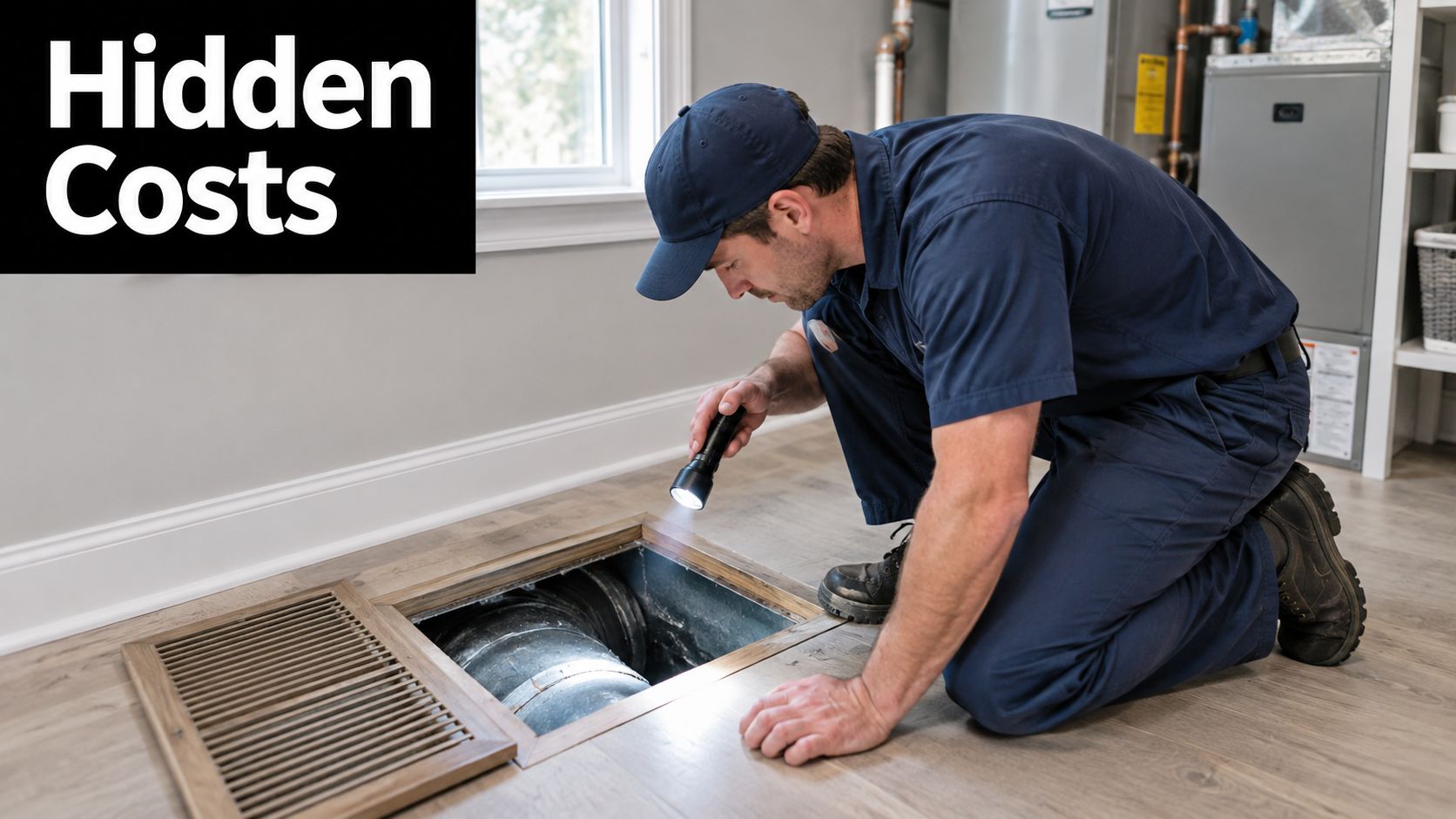
A base quote rarely captures the physical conditions inside the property. Technicians spend more time when they must work around finished ceilings, reach equipment through tight spaces, protect fragile flex ducts, or remove heavy debris. Those conditions explain many legitimate price differences.
Duct material changes the labor equation
Rigid metal ducts generally cost less to clean than flex ducts because technicians can use more aggressive tools on durable metal surfaces. Flex duct requires careful handling so the inner liner isn't torn, crushed, or separated from its support structure. That additional care can increase time even when the visible vent count looks ordinary.
Access creates another major difference. An air handler in an open utility room is easier to inspect and connect to than equipment in a cramped attic, crawl space, or tightly finished closet. Long duct runs and multiple access points also expand the setup and cleanup work.
Time is part of the price
Expert cost breakdowns put common technician labor at about $90 to $125 per hour, and a standard cleaning can take 3 to 8 hours, according to NerdWallet's air duct cleaning cost breakdown. That means a quote should reflect more than the number of grilles on your walls.
Use these questions to expose the variables before work begins:
Duct construction: Is the system rigid metal, flex, or a combination?
Equipment access: Where are the air handler, furnace, coils, and main trunk lines located?
System layout: Does the property have one system, several systems, or multiple zones?
Contamination: Is there ordinary dust, or are there heavy debris, pests, or microbial concerns?
Included labor: Does the price cover setup, register removal, cleaning, reassembly, and cleanup?
A discount marketplace offer isn't necessarily wrong, but it deserves a scope check. Before accepting a deal, compare its terms with this explanation of air duct cleaning through Groupon. If the contractor can't explain how the price changes with access, materials, or contamination, expect the final invoice to change after arrival.
Evaluating Add-On Services and Advanced Methods
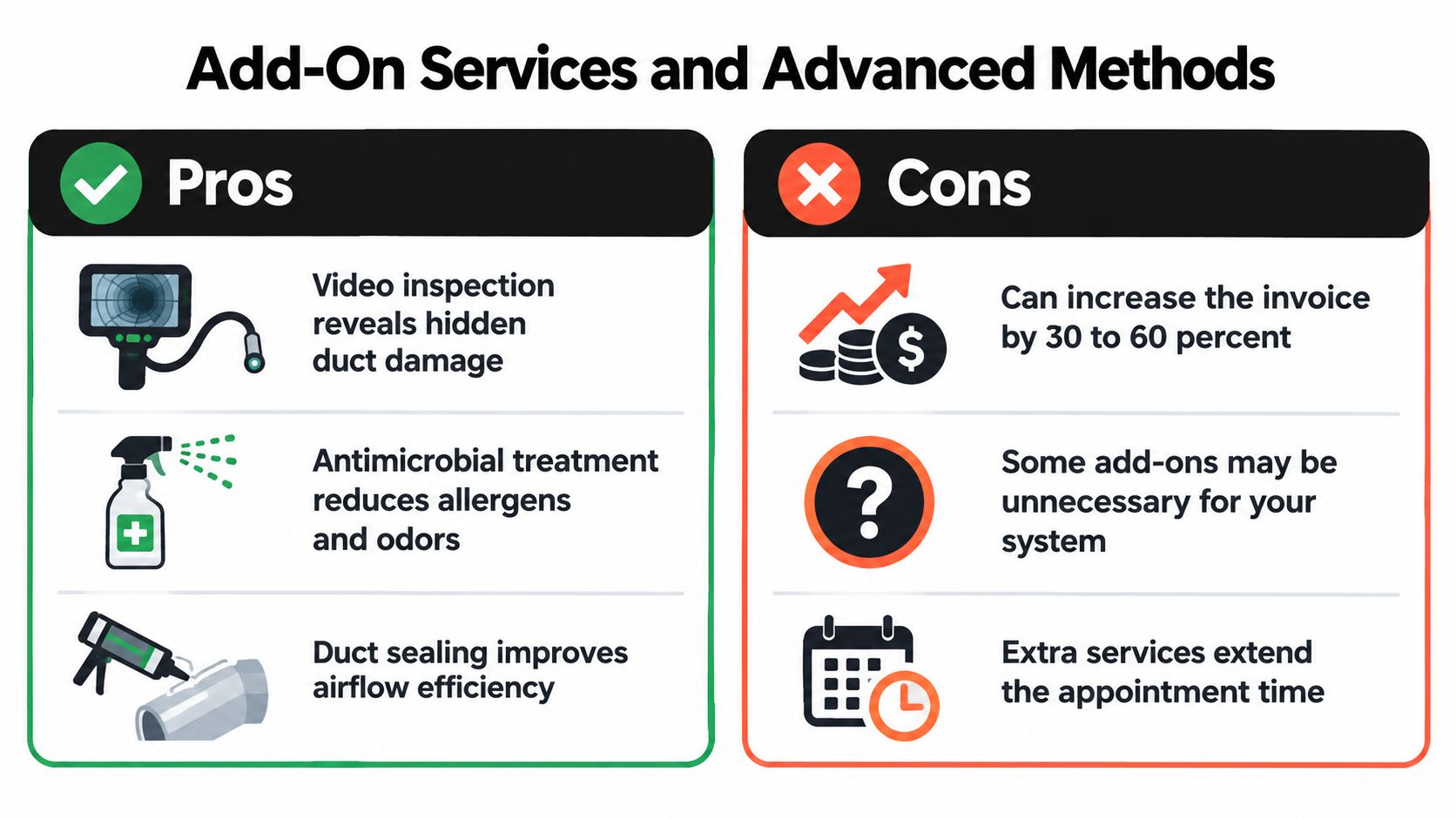
Basic debris removal and full system cleaning aren't the same service. A contractor may offer camera inspection, HEPA filtration, antimicrobial treatment, coil cleaning, dryer vent cleaning, sealing, or remediation for pests and microbial contamination. Some additions solve a documented problem. Others just increase the ticket.
Pay for evidence, not anxiety
Robotic inspection or camera work can help reveal damaged sections, disconnected ducts, or contamination that a visual check at the register can't confirm. HEPA filtration can be useful when the project involves significant debris or when the occupants need tighter containment. Antimicrobial treatment may have a role when a qualified professional identifies a relevant microbial issue, but it shouldn't be an automatic upgrade for every dusty system.
Advanced methods can add 30% to 60% to the invoice, and heavy debris, pests, or microbial issues may bring additional surcharges, according to EPA guidance on whether air ducts should be cleaned. The price increase is reasonable only when the method addresses a specific condition in the property.
Separate necessary work from profitable extras
Use a simple test for each add-on:
What problem does it address?
What evidence shows that problem exists?
What equipment or labor does it add?
What will the technician document afterward?
For example, a camera inspection has practical value when access is limited and the contractor can show you the findings. Coil cleaning may make sense when the coil is visibly impacted and included in a broader HVAC service. Duct sealing belongs in a repair conversation, not as a vague promise that cleaning alone will transform airflow.
Commercial properties, multi-zone homes, and post-construction projects deserve a system-level assessment. They often involve more access points, larger duct networks, and different contamination patterns, so a simple per-vent price becomes a poor measurement. Before booking, compare the proposed process with these air duct cleaning methods, then approve only the upgrades tied to visible findings or a defined performance problem.
Measuring Long-Term Value Beyond The Initial Quote
The cheapest estimate can become the most expensive choice when it leaves trunk lines dirty, misses returns, or fails to identify damaged ductwork. You pay once for the incomplete visit, then pay again when dust, odors, or airflow complaints return.
A fair air vent cleaning price should buy a defined result. That result may include removing accumulated debris, documenting the condition of the ductwork, cleaning accessible HVAC components, and identifying repairs that cleaning alone can't solve. It shouldn't promise miracles, but it should leave you with a clear record of what was done.
Evaluate the service by outcome
Ask what the cleaning is supposed to improve. If your concern is visible dust near registers, the contractor should inspect the relevant supply and return pathways. If the issue is an odor, the technician should investigate moisture, microbial growth, filters, and nearby components instead of automatically selling sanitizer.
Energy performance also requires realistic reasoning. Clean passages and maintained components can support proper airflow, but cleaning won't correct undersized ductwork, insulation failures, leaks, blocked returns, or a failing blower. A responsible contractor separates cleaning from repairs and explains which condition affects which outcome.
The right question isn't “How cheap is the visit?” It's “What condition will the technician document, and what work will the quoted price actually complete?”
For allergy or asthma concerns, treat duct cleaning as one part of indoor air management. Filtration, moisture control, source removal, ventilation, and regular HVAC maintenance may matter just as much. A cleaning is more defensible when it responds to visible contamination, renovation debris, pest material, or a specific indoor air quality concern.
Commercial and residential value differ
A facility manager should focus on system coverage, access planning, occupant protection, documentation, and disruption to operations. A homeowner may care more about dust, odors, comfort, or protecting a recently renovated space. Both should reject a price that hides the scope.
Choose a contractor who explains limitations. If the proposal claims that cleaning alone will guarantee lower utility bills or eliminate every allergy symptom, the sales pitch has moved beyond what the service can reliably support. Pay for thorough work, transparent evidence, and a maintainable system, not an inflated promise.
Securing An Accurate And Transparent Estimate
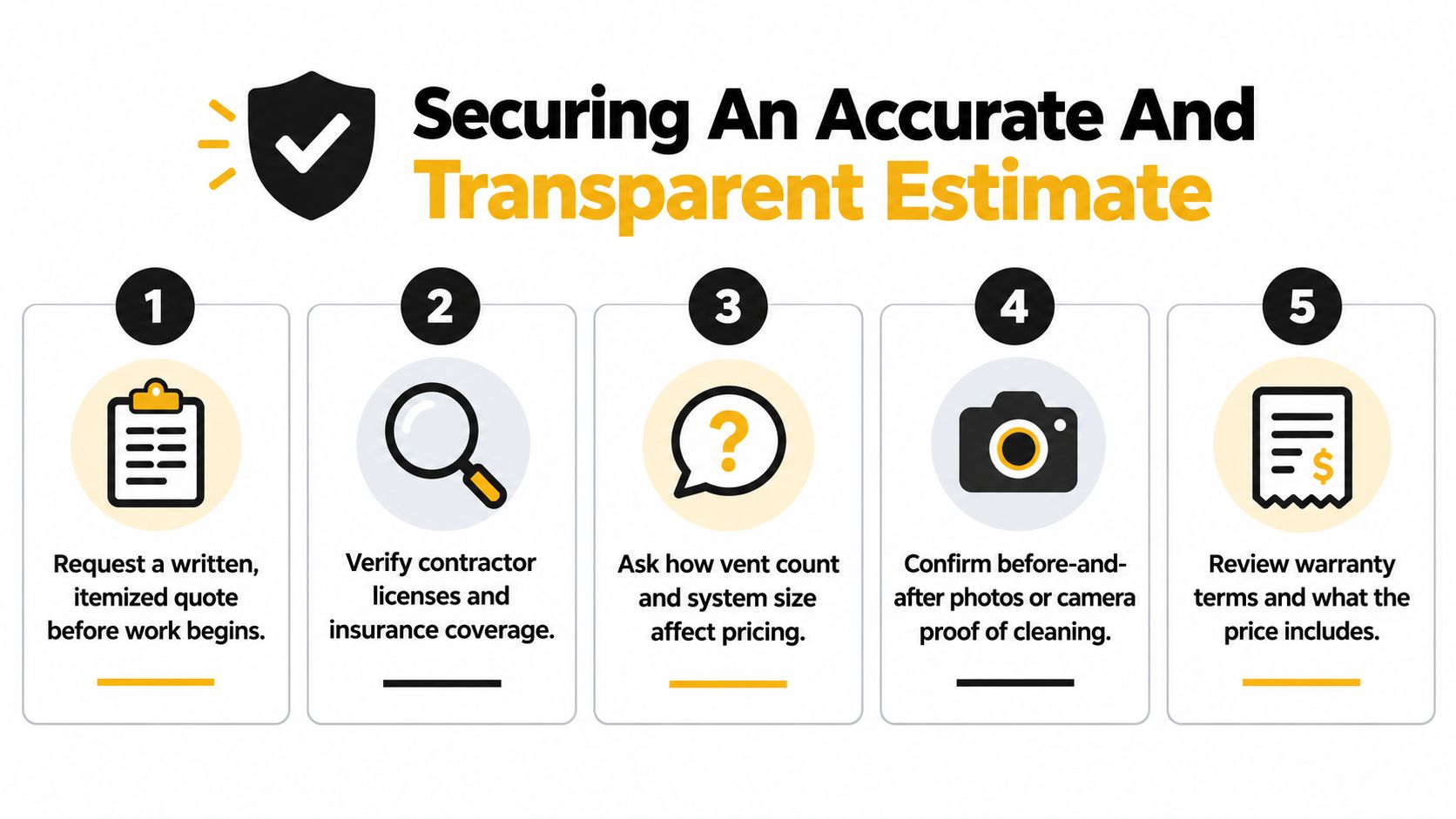
Start with a written quote before anyone removes a register. A reliable contractor should ask about the number of HVAC systems, duct material, access, recent construction, odors, visible debris, and the specific outcome you want. If the company gives a final price without asking basic property questions, the estimate probably isn't final.
Walk through the quote line by line
A transparent proposal should identify the system or systems covered, supply and return vents, main trunk lines, branch lines, equipment access, cleaning method, containment, cleanup, and any excluded work. It should also state the circumstances that could change the price, such as hidden access problems or confirmed contamination.
Use this checklist during the call or inspection:
Request itemization: Get the base cleaning, system count, add-ons, taxes, and possible surcharges in writing.
Verify credentials: Ask for licensing and insurance information appropriate to your location and project.
Clarify equipment: Ask whether the crew uses a negative-pressure vacuum system, agitation tools, HEPA filtration, or camera inspection where needed.
Confirm documentation: Request before-and-after photos or camera evidence when the scope includes inspection or concealed ductwork.
Review the warranty: Check what the company guarantees, what the price excludes, and how it handles damage discovered during service.
A contractor following recognized practices should be able to explain the process without hiding behind jargon. You can use this overview of NADCA duct cleaning standards as a conversation starter, then ask the company to connect each proposed step to your property.
This video can help you visualize the type of process and equipment questions worth asking before you approve a quote:
Before the appointment, clear access to registers and the HVAC equipment, identify rooms with comfort or odor problems, and keep previous inspection records available. Don't authorize an open-ended upgrade list at the door. Ask the technician to show the condition, explain the remedy, and provide the revised total before any additional work starts.
If you're comparing providers in the Phoenix metropolitan area, Purified Air Duct Cleaning offers residential and commercial duct cleaning, dryer vent cleaning, HVAC coil cleaning, and ActivePure air purification installations, with quotes based on the defined scope of work. Request a clear estimate from Purified Air Duct Cleaning and compare it against the checklist above before scheduling service.