

Indoor Air Quality Worse at Night: Causes and Fixes
CO2 concentrations in bedrooms are about 100 ppm higher at night than during the day, and in single-family homes they exceed 1,000 ppm during 67% of nighttime hours. That means a bedroom can spend more than five hours of the night with inadequate dilution, even when the rest of the home feels comfortable.
You close the window, shut the door, turn down the lights, and settle into bed. By morning, the room feels heavy, your throat is dry, and you're tired despite spending the night asleep. The air hasn't become “bad” because darkness creates pollution. It has changed because people keep producing indoor contaminants while ventilation often drops.
The bedroom is a useful small-scale example of home air dynamics. Occupants add carbon dioxide and moisture, bedding and furnishings can release volatile compounds, and closed boundaries slow the removal of everything that accumulates. Understanding that chain makes the solution clearer: measure the room, control indoor sources, and provide enough outdoor air without creating new problems.
Why Your Bedroom Feels Stuffy at Night
You wake with a dull headache and reach for water before you've even left bed. The room feels warmer than it did at bedtime, although the thermostat hasn't changed. Nothing looks obviously wrong, but the invisible composition of the air has shifted while you slept.
A large harmonized analysis of bedroom air-quality data found that mean CO2 concentrations were about 100 ppm higher at night than during the day, with a statistically significant difference across measured bedroom datapoints. In one subset, the gap reached 207 ppm after a large child-bedroom study was excluded, showing that the pattern persisted across datasets. The same analysis found that CO2 exceeded 1,000 ppm for 67% of nighttime hours in single-family and townhouse bedrooms, meaning poor dilution was present for more than five hours of the night (bedroom air-quality analysis).

CO2 is useful here because people exhale it continuously. A rising reading usually signals that the room isn't replacing indoor air quickly enough, although CO2 itself doesn't account for every pollutant or every symptom. A stuffy bedroom may also contain more moisture, odors, particles, and VOCs because the same weak air exchange affects several contaminants at once.
Why the bedroom becomes the critical room
The effect is strongest where occupancy and isolation overlap. A sleeping person remains in the same small space for hours, often behind a closed door and closed window. Ventilation may be reduced to avoid noise, drafts, security concerns, or heat loss, so the room receives less outdoor air just as occupants continue adding CO2 and water vapor.
That makes nighttime indoor air quality a measurable building-performance issue, not merely a matter of personal comfort. Homeowners who want a broader explanation of the variables involved can review this guide to what affects indoor air quality, including ventilation, sources, moisture, and building conditions.
A single morning symptom doesn't prove that CO2 caused it. Still, repeated stuffiness, condensation, odors, or consistently higher monitor readings point toward a ventilation problem worth investigating. The first useful question is simple: what enters the room, what leaves it, and how quickly?
The Four Main Causes of Nighttime Air Degradation
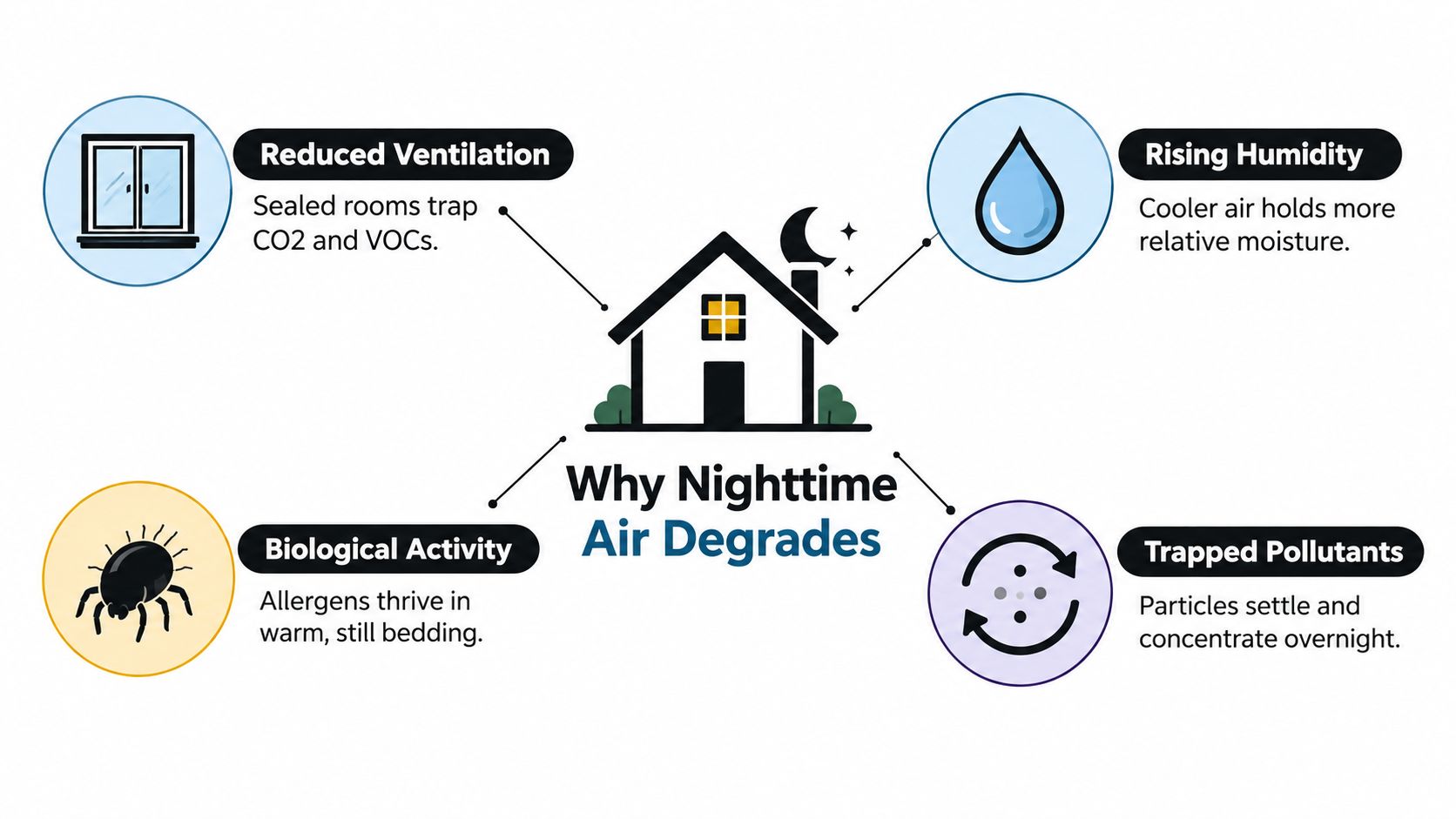
You close the bedroom door, lower the window, and settle in for the night. Hours later, the room may feel heavy or stale even though nothing obvious happened. Four processes explain why: limited air exchange, continuous occupancy, changing temperature and moisture, and emissions from materials and activities.
Closed boundaries reduce dilution
A closed window removes direct outdoor-air exchange. A closed door can also weaken the bedroom's connection to a central return-air path. Mechanical ventilation may be operating, yet the bedroom can still receive too little effective supply air or circulate air poorly around the bed.
The cause-and-effect chain is simple: occupants keep breathing, while the room removes contaminants slowly. A bedroom ventilation study reported a median sleep-period CO2 concentration of 981.8 ppm with an air-change rate of 0.6 h-1. CO2 rose significantly when both the window and door were closed, while NO2 fell with openings. Openings can therefore improve dilution while also allowing more outdoor pollutants inside (bedroom ventilation study).
Occupancy adds CO2 and moisture
A sleeper is a continuous nighttime source. Every breath adds CO2, and the same body releases water vapor. With limited replacement air, these additions remain in the room longer, making the bedroom feel stale and raising the moisture load.
The bedroom is often the worst room at night because one or more people occupy a small, enclosed space for hours. The rest of the house may have more volume, more airflow, or fewer occupants, so its air does not change in the same way.
Cooler conditions alter the room climate
Nighttime cooling changes how air moves and how moisture behaves. Cooler surfaces can become damp, while bedding can hold heat and moisture close to the sleeper. Poor mixing then allows different parts of the room to develop different conditions.
These changes mainly amplify the underlying ventilation problem. Moisture and heat remain near their sources when replacement air is weak, which affects comfort and can support biological contaminants if dampness persists.
Materials and activities release other pollutants
The sleeper is not the only source. Mattresses, furniture, textiles, personal care products used before bed, and cleaning residues can release VOCs. Cooking or cleaning elsewhere may also reach the bedroom through pressure differences and air movement.
Research on bedroom VOC accumulation found that about 66% of measured VOCs increased overnight as occupant-related and room sources built up in the closed space (bedroom VOC and ventilation research).
Cause | Mechanism | Typical impact |
|---|---|---|
Reduced ventilation | Closed windows, doors, or weak mechanical exchange slow replacement | CO2, odors, and VOCs accumulate |
Occupancy | Sleepers continuously add CO2 and moisture | Air feels stale and humid |
Temperature change | Cooler surfaces and weaker mixing alter moisture behavior | Condensation and uneven air quality become more likely |
Indoor sources | Bedding, furnishings, products, pets, cooking, and cleaning add emissions | The bedroom develops its own nighttime pollutant profile |
A practical explanation of indoor air quality and ventilation shows why pollutant removal depends on more than moving air. Ventilation determines how long each contaminant remains in the breathing zone.
How Temperature and Humidity Amplify the Problem
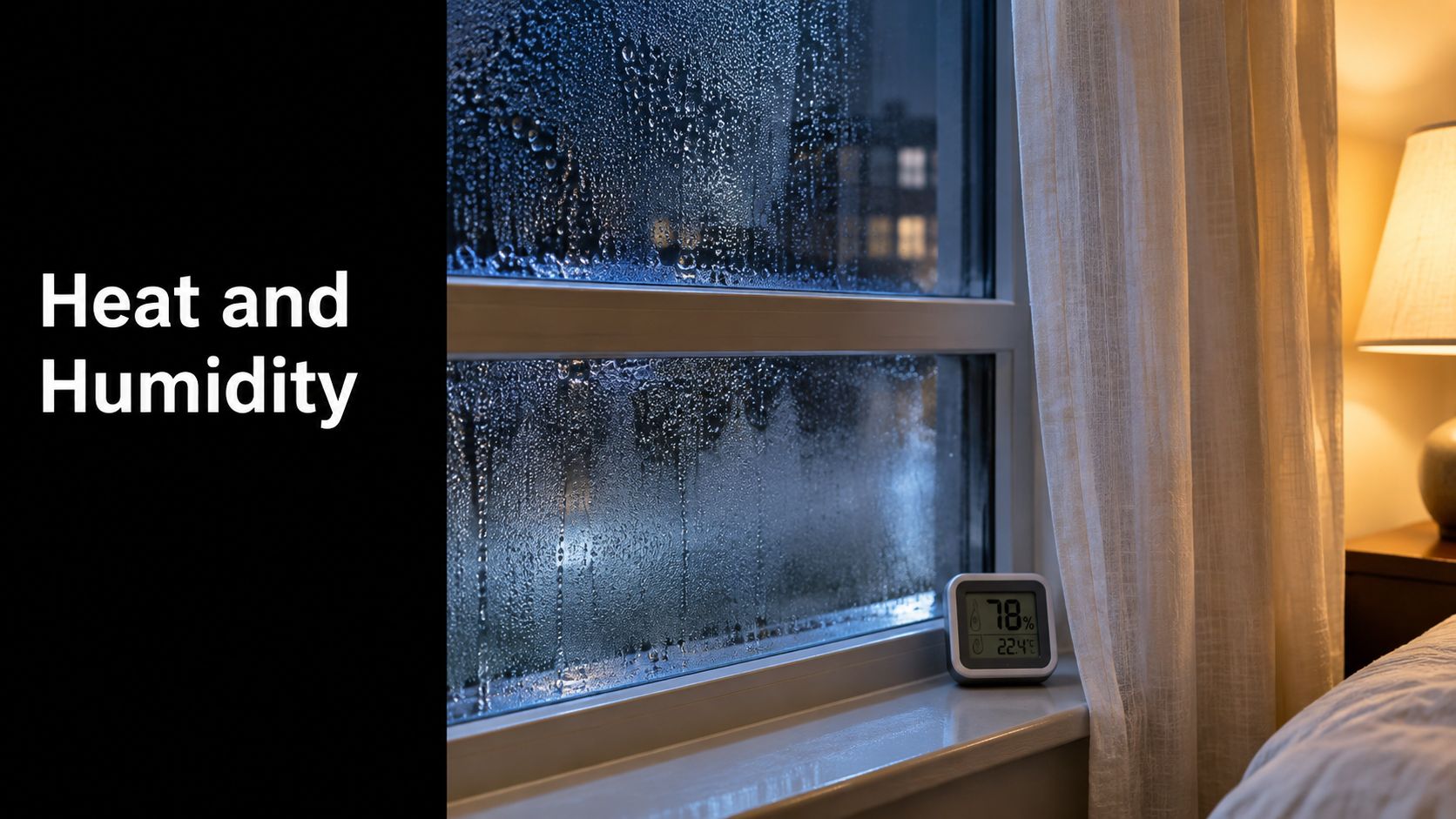
Air temperature and humidity can make a bedroom feel worse even when the CO2 reading hasn't changed much. As the room cools, the same amount of water vapor represents a higher relative humidity because cooler air holds less moisture before becoming saturated.
That shift can leave windows, exterior walls, and other cold surfaces damp. Persistent condensation creates conditions for musty odors and biological growth, especially where airflow is poor. It also makes bedding feel less comfortable, which can encourage people to close windows more tightly and further reduce air exchange.
Why still air feels heavier
Air in a bedroom isn't perfectly mixed. Warm air tends to rise, while cooler air settles lower, and furniture or bedding can interrupt circulation. A monitor on a dresser may therefore report a different condition from the air immediately around a sleeper.
This doesn't mean CO2 forms a permanent layer at floor level in every room. It means placement and air movement matter. A closed bedroom with weak circulation can contain local pockets where heat, moisture, and pollutants persist longer than a homeowner expects.
Practical rule: Treat humidity as a companion measurement to CO2. A rising CO2 reading identifies weak dilution, while rising humidity can reveal moisture generation and condensation risk.
Opening a window may help when outdoor conditions are suitable, but it isn't always the complete answer. Outdoor air may contain pollutants, noise, or uncomfortable temperatures, and a single opening may not create reliable whole-room exchange. Balanced mechanical ventilation can provide a more controlled way to remove stale air and supply replacement air.
For help understanding moisture sources and control options, see this guide to indoor humidity control. The goal is not just to make the room drier. It's to maintain a stable environment where moisture doesn't condense and ventilation remains effective.
The Hidden Sources of Bedroom Pollution
At bedtime, the bedroom becomes a small, occupied enclosure. Doors and windows may be closed, ventilation may be weak, and people spend hours breathing, moving, and releasing moisture among fabrics and furnishings. A room can look clean while its indoor air changes quickly.
Bedding shapes this microenvironment. Sheets, blankets, pillows, mattresses, upholstered headboards, and curtains collect settled dust and may release compounds from their materials. With fewer routes for air to leave, those emissions remain near the sleeping area longer than they would in a more open, frequently used room.
Indoor sources can dominate the nighttime pattern
Outdoor pollution can enter a home, but it does not explain every nighttime rise. Manufacturer-reported connected-air data show an evening PM2.5 peak between 6 p.m. and midnight across the markets included in that dataset (connected indoor air-quality data). Treat that pattern as observational manufacturer data, not as a universal measurement of every home.
The cause-and-effect chain is straightforward. Cooking and cleaning add particles and vapors in the evening. Pressure differences and open interior doors can move some of that air through the home. The bedroom then adds its own load from bedding, furniture, pets, and products used before sleep. By nighttime, a closed bedroom may be the worst room even when the rest of the house feels normal.
A room-specific exposure pattern
Lotions, hairspray, perfume, and similar products can release VOCs after application. Pets contribute dander and may bring outdoor material indoors. Books, paper, fabrics, and upholstered surfaces hold dust, while turning in bed can disturb particles that had settled earlier.
Fragrance products need separate attention. Learning what air fresheners are helps clarify why covering an odor does not remove its source. Adding fragrance to a poorly ventilated bedroom can add emissions without improving the underlying air.
Start the inspection where exposure is longest: beside the bed. Check textiles, pets, personal products, and the movement of air as one connected system. The bedroom's nighttime condition often comes from that combination, not from a single visible layer of dust or one outdoor pollution event.
Practical Fixes for Cleaner Nighttime Air
Start with measurement, then make the least disruptive change that addresses what the room is showing. A CO2 monitor can reveal whether the bedroom loses dilution overnight, while a humidity reading helps identify moisture and condensation risk. Place the monitor near the breathing zone, away from a window, supply register, or the sleeper's direct exhalation.
Low-effort changes
If outdoor air is clean and comfortable, crack a window before bed or leave it slightly open as appropriate for security and weather. Run a bathroom or kitchen exhaust fan when those spaces are generating moisture or pollutants, and make sure the fan exhausts outdoors rather than recirculating air.
Vacuum floors and fabric surfaces with a HEPA-filter vacuum, wash bedding regularly according to the manufacturer's instructions, and reduce unnecessary scented products. These actions limit sources, but they won't compensate for a bedroom that receives almost no replacement air.
Choose ventilation deliberately
A balanced ventilation system, such as an HRV or ERV, can exchange indoor and outdoor air while reducing the comfort penalty associated with uncontrolled openings. The right design depends on the home, climate, duct layout, and existing HVAC system, so sizing and commissioning matter more than just installing a fan.
A portable HEPA purifier can remove airborne particles, but it doesn't replace outdoor-air ventilation and won't directly solve rising CO2. Choose a unit sized for the bedroom, place it where air can circulate freely, and avoid positioning it behind furniture or immediately beside the bed. For a broader explanation of selection factors, compare this guide for office managers on purifiers, then apply the same principles to room size, filtration, noise, and maintenance.
The research-based CO2 bands below provide a practical way to interpret readings, rather than treating one universal number as a complete diagnosis (Danish bedroom ventilation summary).
CO2 level | Ventilation status | Sleep effect |
|---|---|---|
Below 750 ppm | Adequate ventilation | No negative effect on sleep quality was reported |
750 to 1,150 ppm | Possibly insufficient | Conditions may warrant closer monitoring |
Above 1,150 ppm | Insufficient ventilation | Could adversely affect sleep quality |
Above 2,600 ppm | Very poor dilution | May affect next-day cognitive abilities |
Plan the durable fix
If readings remain high, ask an HVAC professional to assess supply and return airflow, duct leakage, ventilation rates, filter condition, and coil cleanliness. Air purification may complement source control and ventilation, while it shouldn't be presented as a substitute for either. Residential options are described in this guide to the best residential air purifier.
What Clean Bedroom Air Looks Like
A cleaner bedroom doesn't smell like perfume, feel artificially cold, or depend on a window being open all night. It has enough air exchange to remove occupant-generated CO2 and moisture, controlled sources, and stable conditions that don't produce repeated condensation or stale odors.
The most useful comparison comes from bedroom measurements under different ventilation conditions. A 2016 Indoor Air study found overnight CO2 without ventilation ranging from 1,620 to 3,300 ppm, compared with 795 to 935 ppm with ventilation. Average CO2 was 2,395 ppm without ventilation and 835 ppm with ventilation, directly linking nighttime air exchange with markedly different indoor conditions (2016 bedroom ventilation study).
Two different nights
Poorly ventilated bedroom | Better-ventilated bedroom |
|---|---|
CO2 rises as sleepers remain in a closed room | CO2 is diluted by a reliable air exchange |
Odors and VOCs remain near their sources | Pollutants have a route out of the room |
Moisture is more likely to persist on cold surfaces | Moisture is removed more consistently |
Morning air feels heavy or stale | The room feels neutral rather than trapped |
The contrast isn't a promise that every home will match a study. Bedroom size, occupancy, door position, ventilation equipment, weather, and building airtightness all affect the result. It does show why “the room feels stuffy” deserves a measurement-based response.
A Dutch bedroom study found CO2 increased to 1,409 ± 412 ppm at a ventilation rate of 15 m³/h, compared with 680 ± 106 ppm at 91 m³/h, illustrating how strongly airflow changes nighttime conditions (Dutch bedroom ventilation study).
Use a sensor to observe the overnight curve, not just one afternoon reading. This guide to air-quality sensors can help with choosing and positioning a monitor. A useful target is a bedroom that stays adequately diluted without excessive drafts, noise, humidity, or outdoor-pollutant entry.
When to Call a Professional
DIY steps work best when the problem is simple and visible. A professional assessment becomes sensible when the room remains stuffy despite reasonable ventilation, when odors persist, or when moisture appears repeatedly on walls, windows, or furnishings.
A cold-climate field study monitored 22 homes and found that all 22 exceeded 1,000 ppm CO2 on at least one of four monitored nights. Some bedrooms went more than three times above that level, and the study defined the nighttime period as 9 p.m. to 7 a.m. (cold-climate bedroom ventilation study).
Warning signs worth investigating
Persistent musty odors: The source may involve moisture, mold, damp insulation, or contaminated duct components.
Visible growth: Mold on walls, window areas, bedding, or furnishings requires source control, not fragrance.
Symptoms that improve elsewhere: A recurring pattern away from home can justify an indoor environmental assessment and medical advice.
High overnight readings: Repeatedly raised CO2 despite an open door or suitable window conditions may indicate inadequate whole-home airflow.
Uneven room comfort: One bedroom that feels stale while other rooms feel normal may have a supply, return, pressure, or duct-distribution problem.
A qualified technician can inspect ductwork, filters, coils, ventilation equipment, pressure relationships, and airflow paths that homeowners can't evaluate reliably. Ask what will be measured, whether the proposed work addresses the source, and how the result will be verified after service. Air duct cleaning, HVAC coil cleaning, ventilation improvements, and air purification may each have a role, but the recommendation should match the measured problem.
Closing every window may reduce heating or cooling demand, but it doesn't automatically protect indoor air. In a bedroom with weak ventilation, the cost of stale, humid, poorly diluted air can outweigh the comfort benefit. A building professional can help you find a controlled balance instead of choosing between an open window and a sealed room.
Purified Air Duct Cleaning offers residential and commercial indoor air-quality services, including air duct cleaning, HVAC coil cleaning, and installation of in-duct or portable ActivePure air-purification systems. Visit Purified Air Duct Cleaning to request a quote and discuss a practical plan for cleaner nighttime bedroom air.