

How to Improve Indoor Air Quality in Winter: Key Tips
You wake up with a scratchy throat, notice condensation on the bedroom window, and wonder why the house feels both stuffy and painfully dry. The usual advice is to crack a window, but that can be the wrong move when outdoor particles are high or the room immediately loses comfortable humidity.
Learning how to improve indoor air quality in winter means managing a system, not chasing one symptom. A sealed home can accumulate carbon dioxide, fine particles, moisture, and combustion gases at the same time. The practical solution balances ventilation, filtration, humidity control, and heating safety.
Why Winter Air Gets Worse Fast
Winter changes how your house handles air. You close windows to retain heat, run the furnace for long periods, and spend more time indoors. That reduces natural air exchange while increasing emissions from cooking, cleaning, candles, fireplaces, and heating equipment.
The U.S. Environmental Protection Agency cited an estimate that some indoor pollutant concentrations can reach 2 to 5 times outdoor levels. The American Lung Association's winter indoor-air guidance connects the problem to tightly sealed homes, combustion sources, and insufficient ventilation.
Four stressors usually compete:
Carbon dioxide: People exhale CO₂, and a closed bedroom can become noticeably stuffy as occupancy rises. Use 1,000 ppm as a practical marker for stuffiness, not as a complete safety boundary. A rising reading tells you that the room needs more outdoor air.
Fine particles: Reduced ventilation lets dust, smoke, cooking aerosols, and combustion particles linger. A peer-reviewed study of five low-energy London apartments recorded a winter indoor-air-quality index of about 17.6 to 17.7, compared with 8.6 in summer, making winter conditions more than twice as bad in that sample (study in Indoor and Built Environment).
Humidity: Cold outdoor air contains less moisture, and heating that air lowers its relative humidity. The result can be dry skin, irritated nasal passages, static, shrinking wood, or, in other rooms, condensation caused by excessive indoor moisture.
Combustion gases: Furnaces, gas ranges, fireplaces, wood stoves, and unvented heaters can add carbon monoxide and nitrogen dioxide. Winter increases the consequences because homes are closed and heating equipment runs more often.
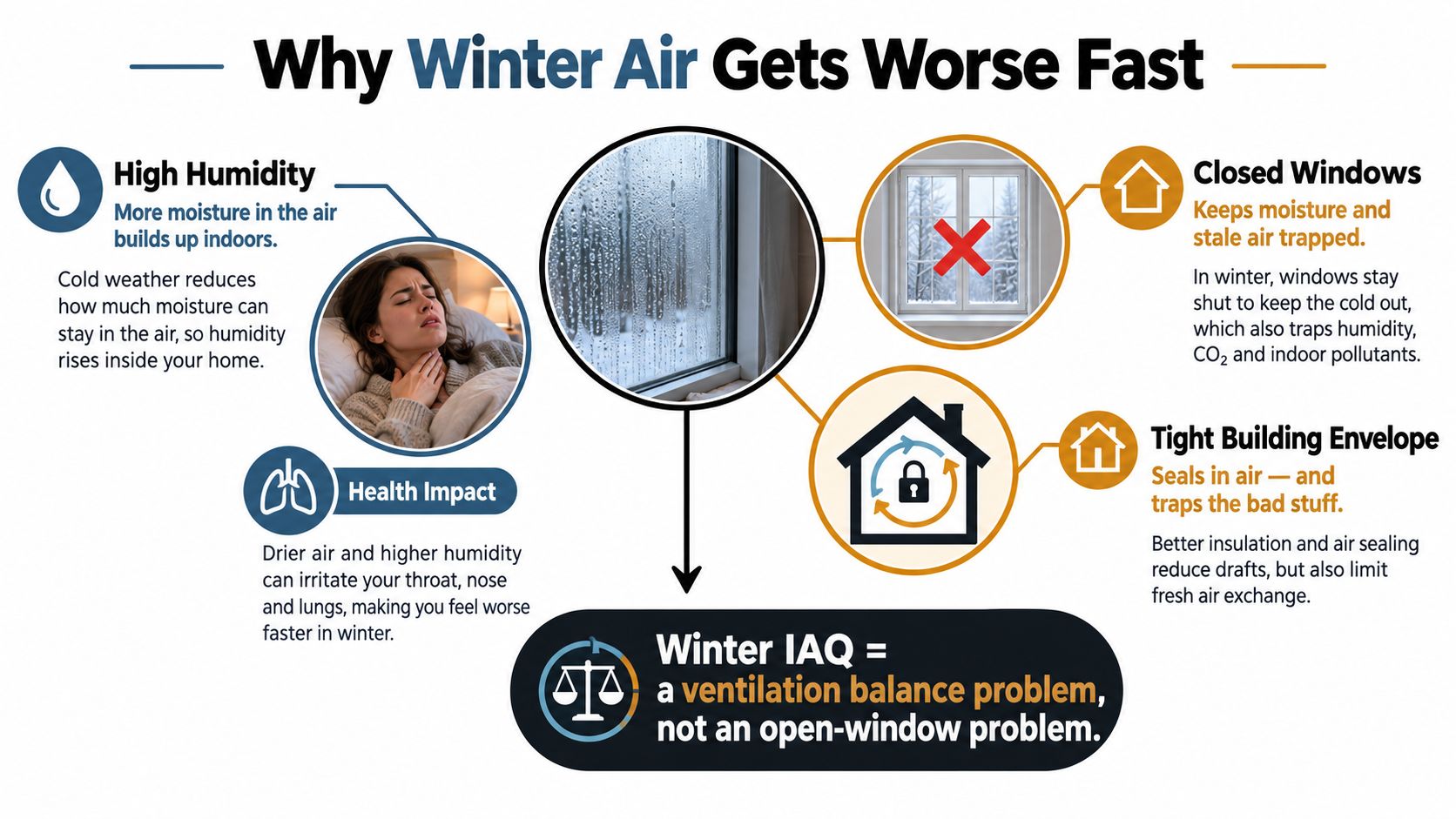
Why opening a window isn't the whole answer
Brief window opening can reduce CO₂ when outdoor air is clean, but it can also bring in outdoor PM2.5, create humidity swings, and waste heat. A 2026 study on winter ventilation tradeoffs found that closed windows paired with air conditioning and air purifiers maintained acceptable temperature and PM2.5, while CO₂ still accumulated during higher occupancy.
That finding captures the winter constraint: particle removal doesn't replace outdoor-air exchange. You need to manage CO₂, particles, humidity, and combustion gases together.
Get Humidity Into the Right Range
Start with measurement, not a humidifier purchase. Put a basic hygrometer in the room your household uses most, preferably away from a supply register, exterior window, kitchen steam, or bathroom door. Record the reading through different parts of the day for a week.
Target 30% to 50% relative humidity in winter. The EPA and technical guidance summarized by Quebec's public-health institute supports that range, while some expert sources recommend a narrower 40% to 60% band for respiratory and viral-risk considerations. In a real home, staying below about 50% is the safer operating ceiling when condensation or mold is a concern.
Use the result to choose the equipment:
Below target throughout the home, consider whole-house humidification.
Below target in one bedroom, use a room unit.
Near the upper end, don't add moisture. Find the source of condensation or improve exhaust ventilation.
Fluctuating readings, check cooking, bathing, laundry, and window surfaces before changing equipment settings.
The Consumer Product Safety Commission's indoor-air guidance also emphasizes humidity control and ventilation as ways to reduce biological pollutants indoors.
Choose the humidifier you can maintain
Warm-mist evaporative models suit a bedroom when you want localized output and can clean the tank consistently. Cool-mist whole-house units make more sense in dry climates when the HVAC system can distribute moisture evenly. Steam humidifiers generally provide the cleanest output and tightest control, but installation and operating demands are higher.
Be cautious with ultrasonic units. If you fill them with mineral-heavy water and skip cleaning, they can aerosolize minerals and spread residue through the room. The device type matters less than correct sizing, clean water, and disciplined maintenance.
Type | Best Room Size | Maintenance | Winter Fit |
|---|---|---|---|
Warm-mist evaporative | Bedroom or small room | Frequent tank cleaning and water changes | Good for localized dryness |
Cool-mist whole-house | Multiple rooms or full home | Pad, reservoir, and distribution-system care | Good when central control is needed |
Steam | Whole home or tightly controlled zones | Professional service and regular inspection | Strong control where precision matters |
Ultrasonic | Small room | Frequent cleaning and mineral management | Use cautiously because minerals can become airborne |
Excess humidity can create moisture damage that costs far more than the humidifier itself. For useful context on remediation costs explained, focus on prevention: measure first, add moisture gradually, and keep window condensation under control. You can also review this practical guide to indoor humidity control before selecting equipment.
Build a Winter Ventilation Strategy That Works
A winter ventilation plan should be short, deliberate, and measured. Don't leave a window cracked all day and assume the problem is solved. Flush occupied rooms when outdoor air is clean, remove pollutants at their source, and use mechanical ventilation when the building envelope is too tight for casual air exchange.
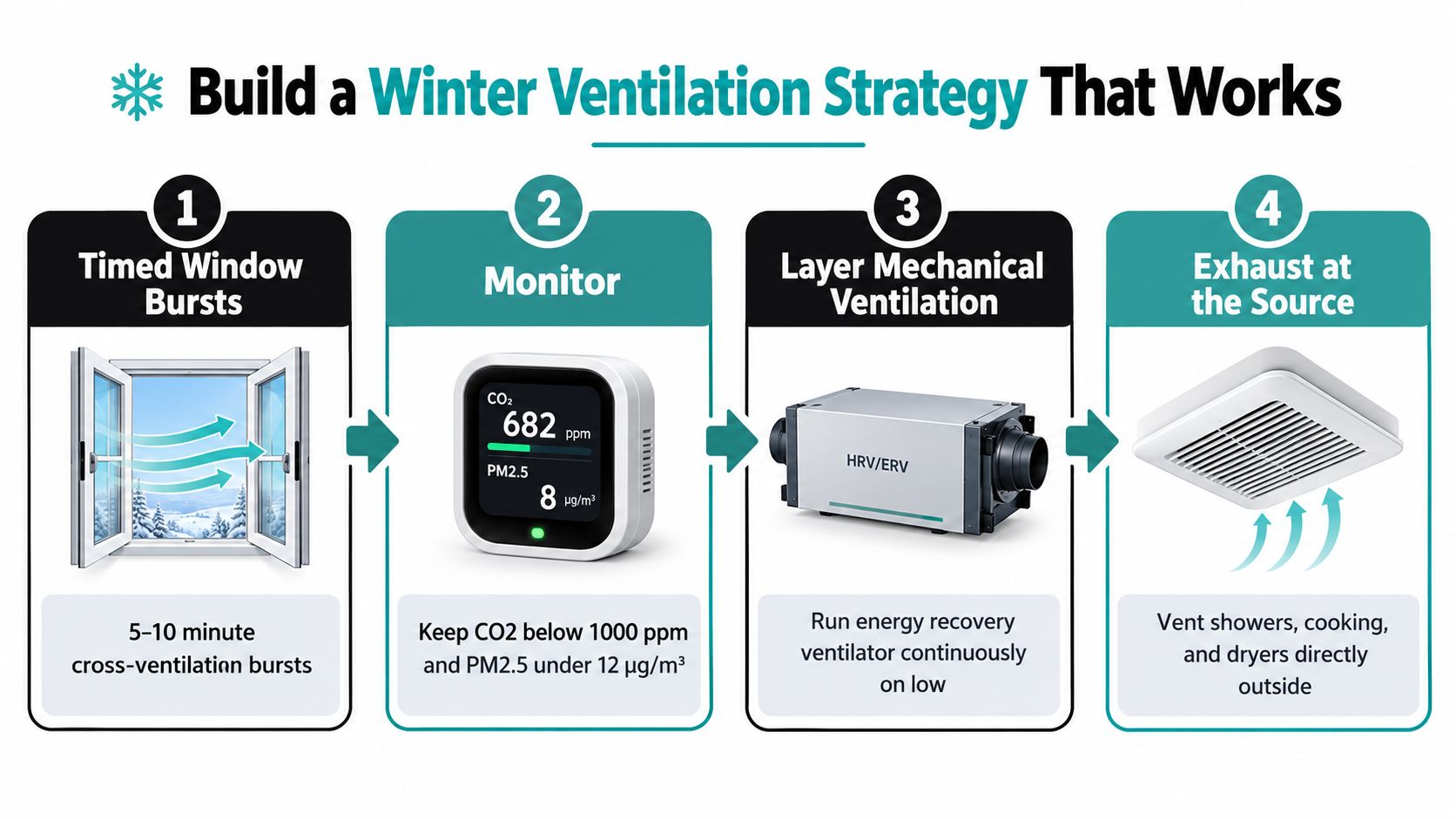
Use windows as a controlled tool
Open opposite windows briefly when outdoor air is clean and the weather allows. A 5 to 10 minute burst can refresh a room without keeping the building exposed for hours. Use a CO₂ monitor to confirm that the room is clearing, and check a PM2.5 monitor or local outdoor-air information before opening windows during smoke, dust, or pollution events.
The monitor matters because comfort can mislead you. A room may smell fresher while still carrying particles, or feel comfortable while CO₂ continues to rise. The EPA explains that poor ventilation allows indoor pollutants to build because insufficient outdoor air fails to dilute indoor emissions. Its winter indoor-air guidance also advises clearing snow and ice from furnace, stove, fireplace, radon, and dryer vents.
Exhaust moisture and particles where they start
Run the kitchen exhaust fan while cooking and the bathroom fan during showers. Use countdown timers so fans continue running after the activity ends, and confirm that each fan exhausts outdoors rather than into an attic or wall cavity. Clothes dryers also need an exterior discharge path.
For a practical overview of indoor air quality and ventilation, focus on source removal first. A fan at the shower or range is more effective than asking a portable purifier to deal with moisture after it has spread through the house.
Tighter homes need a more permanent solution:
Continuous bath fans: Choose quiet units with insulated exterior covers.
Supply-only ventilation: Bring in outdoor air through a dedicated duct connected to furnace operation.
HRV systems: Exchange stale indoor air for outdoor air while recovering heat.
ERV systems: Exchange air while also moderating moisture, making them useful where winter dryness is a persistent concern.
Practical rule: Ventilate more when CO₂ rises, but don't ignore PM2.5 and humidity. The right setting is the one that improves the whole indoor-air profile.
Low-emission materials also reduce what ventilation must remove. If you're repainting during the heating season, compare low VOC paint vs standard before bringing new coatings into a closed home.
Match Your Filter to the Problem
Filtration is useful, but it isn't ventilation. A furnace filter can capture recirculated particles, while only outdoor-air exchange addresses accumulated CO₂. Choose the filter based on the pollutant you care about, then confirm that the blower can handle it.
ASHRAE reports that MERV 13 captures at least 85% of particles from 1 to 3 micrometers, MERV 14 captures at least 90%, and HEPA filtration reaches 99.97% efficiency at 0.3 micrometers (ASHRAE's filtration guidance). Those figures describe capture performance under the relevant testing conditions, not a guarantee that every room will receive the same result.
Filter Rating | Capture Efficiency | Best For | Pressure Drop Risk |
|---|---|---|---|
MERV 8 | Lower-efficiency general filtration | Dust and larger household particles | Usually lower, but verify system specifications |
MERV 13 | At least 85% for 1 to 3 µm particles | Finer dust, dander, and many winter aerosols | Can restrict airflow in undersized systems |
MERV 14 | At least 90% for 1 to 3 µm particles | Higher particle-control demands | Higher restriction risk |
HEPA | 99.97% at 0.3 µm | Dedicated portable or specially designed systems | Often unsuitable for standard furnace slots |
The common mistake is installing a restrictive filter into a blower designed for a lighter one. Pressure drop can reduce airflow, increase operating strain, freeze an air-conditioning coil during warmer weather, and raise energy use. Check the furnace documentation and blower data plate, and ask a technician to measure static pressure when possible.
Move up gradually rather than jumping straight to the highest rating. A correctly fitted MERV 13 filter that the system can move air through is more useful than a poorly matched high-resistance filter.
For bedrooms, a dedicated HEPA portable cleaner earns its place when occupants need extra particle removal or when the central system doesn't run often. Review what MERV ratings mean and how to choose the right filter, then replace or refit the filter so air can't bypass the frame.
Tune Up the HVAC and Ducts Before Peak Heating
A furnace tune-up is an IAQ task, not just a reliability task. Combustion equipment that burns poorly or vents badly can affect indoor air, while a blower that struggles against the filter won't deliver the airflow the system was designed to provide.
Ask the technician to inspect the heating side in a defined sequence:
Burner and heat exchanger: Pull and inspect the burner, look for heat-exchanger cracks, and verify safe combustion.
Ignition and flame sensing: Test the ignitor and flame sensor so the system lights and proves flame correctly.
Gas and inducer operation: Verify gas pressure and confirm that the inducer motor and pressure switch cycle properly.
Blower performance: Clean the blower wheel, check the capacitor, and confirm fan speed against the installed filter and manufacturer specifications.
Static pressure: Measure pressure after a filter change, not only during the original service visit.
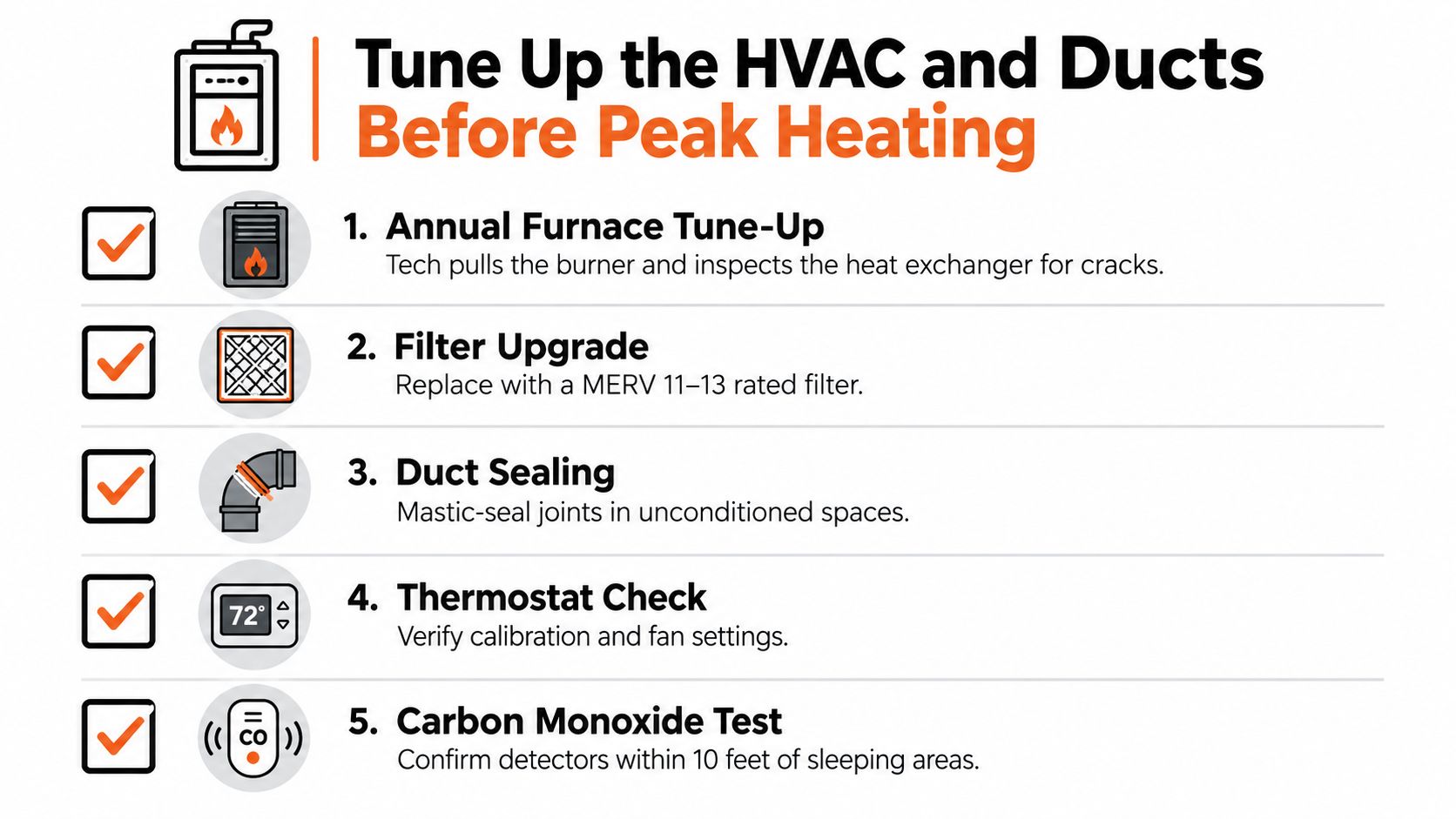
Seal the duct system you can reach
Walk accessible duct runs in the basement, crawlspace, and attic. Look for disconnected joints, loose boots, crushed flex duct, and open panning. Seal accessible leaks with mastic, not ordinary cloth duct tape, and insulate runs that pass through unconditioned space.
Leaky return ducts deserve particular attention. A return-side leak can draw dusty attic, crawlspace, or garage air into the system before the filter sees it. Supply leaks waste conditioned air and can change room pressure, but return leaks can directly worsen the air being circulated.
Don't treat duct cleaning as a substitute for repairs. Remove accumulated debris only after correcting the source of contamination and confirming that the duct system is intact. A service provider such as Purified Air Duct Cleaning can clean residential ductwork, dryer vents, and HVAC coils, and can install ActivePure purification equipment as an additional treatment layer. The fall HVAC maintenance checklist can help you organize the inspection before heavy heating demand.
ActivePure or another in-duct purification unit may complement filtration when ultrafine particles and VOCs remain a concern, but it shouldn't replace source control, ventilation, a sound furnace, or a properly fitted filter.
Control Combustion Sources and Carbon Monoxide Risk
Winter heating creates a special hazard because combustion appliances operate more frequently while doors and windows stay closed. Carbon monoxide has no reliable odor warning, so a home can have a serious problem without smelling smoky or gassy.
The EPA reports average indoor CO levels of 0.5 to 5 ppm in homes without gas stoves, 5 to 15 ppm near properly adjusted gas stoves, and 30 ppm or higher from poorly adjusted stoves. The EPA's carbon monoxide guidance recommends annual inspection, cleaning, and tune-up of furnaces, flues, and chimneys.
Remove the predictable sources
Run a range hood that vents outdoors when cooking. Never use a gas oven to heat the house, and don't assume a flame that looks normal proves the appliance is safe. Fireplaces and wood stoves need an open, functioning flue, especially during startup when a cold chimney can contribute to backdrafting.
Clear snow and ice from exterior furnace, fireplace, stove, and dryer vents. A blocked termination can force exhaust back toward the home or prevent equipment from operating safely.
Attached garages are another overlooked pathway. Vehicle exhaust and chemical vapors can migrate through the connecting door, wall penetrations, and return-air leaks. Never idle a car in the garage, even with the main garage door open.
Install listed CO alarms on every level and inside sleeping areas, test them regularly, and replace batteries at the start of each heating season. A detector alarm means leave the building and contact emergency services, not open a window and continue troubleshooting.
For a closer look at why the heat exchanger matters, read this explanation of furnace heat exchanger inspection. Portable generators and unvented kerosene heaters do not belong indoors, under any circumstances.
A 30 Day Indoor Air Quality Plan and When to Call a Pro
Improving winter IAQ becomes manageable when you sequence the work. Start with measurements, correct the mechanical basics, then adjust ventilation and combustion safety. Use this indoor air quality management plan as a practical record for readings, service dates, and follow-up actions.
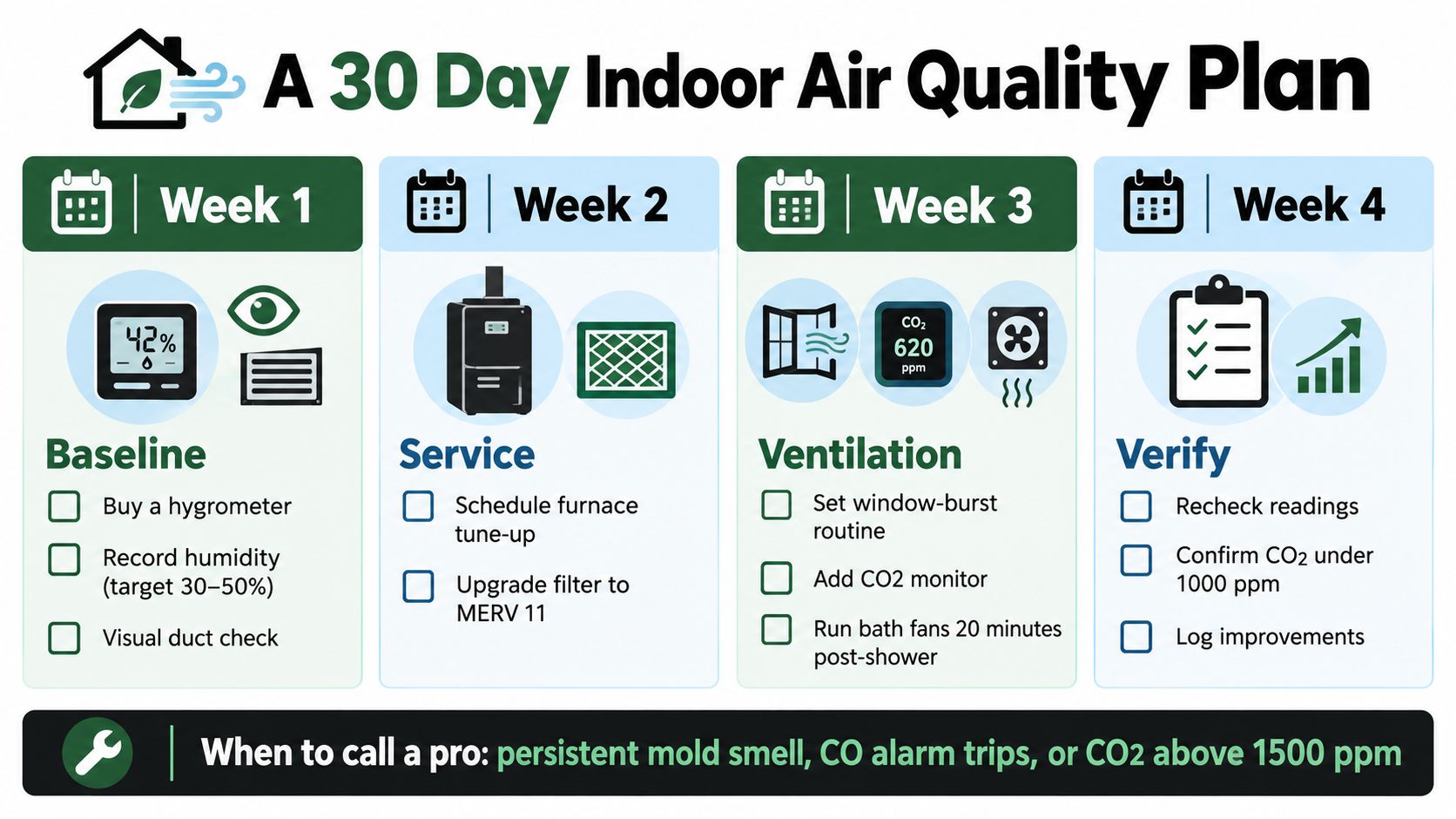
Week 1, establish the baseline
Buy a hygrometer and record humidity in the main living area and bedroom. Check window condensation, inspect accessible ductwork visually, and note rooms that feel stale, smoky, overly dry, or unusually warm.
Week 2, service the heating system
Schedule the furnace tune-up before peak demand. Ask for burner, heat-exchanger, ignition, flame-sensor, inducer, blower, and static-pressure checks. Replace the existing filter with a compatible MERV 11 or MERV 13 option only after confirming the system can handle it.
Week 3, create repeatable ventilation
Set a timed window-burst routine when outdoor air is clean. Use kitchen and bathroom timers, confirm dryer exhaust goes outdoors, and ask whether an HRV or ERV is appropriate for a tight home. Add a CO₂ monitor if bedrooms or occupied rooms repeatedly feel stuffy.
Week 4, verify combustion safety
Test every CO alarm, record test dates, clear exterior vents, and inspect fireplace or wood-stove operation. Recheck humidity, CO₂, condensation, and particle readings after the changes. If the readings haven't improved, stop adding random devices and investigate the building or HVAC system.
Know when DIY has ended
Call a qualified professional immediately if a CO detector alarms. Also schedule professional help for persistent condensation on north-facing windows, visible mold larger than 1 square foot, or HVAC short-cycling after a filter upgrade.
Those signs point to a moisture problem, combustion danger, contamination source, or airflow fault that a new purifier won't fix. A professional can measure static pressure, inspect combustion and venting, test airflow, identify duct leakage, and determine whether mechanical ventilation is needed.
The practical objective is balance: enough outdoor air to control CO₂, enough filtration to reduce particles, enough humidity for comfort, and no uncontrolled combustion gases.
Purified Air Duct Cleaning can inspect and clean ductwork, dryer vents, and HVAC coils, and install ActivePure air-purification systems when a home needs an added particle and contaminant-control layer. Visit Purified Air Duct Cleaning to request a quote for a winter IAQ assessment in the Phoenix metropolitan area.