

HEPA Vacuum Rental Guide for Cleaner Indoor Air
You've finished sanding drywall, the room looks clean, and then a fine film settles on the floor again. A regular shop vacuum may remove visible debris while sending the smallest particles back through its exhaust. That's why HEPA vacuum rental is less about borrowing a powerful machine and more about choosing equipment that captures dust without spreading it through the home.
The right unit can support lead-safe renovation cleanup, asbestos-related work where appropriate, mold remediation, allergy-focused cleaning, and controlled preparation before duct or vent service. The wrong unit may carry a HEPA-style label but lack the airflow, sealing, or filter condition needed for dependable indoor capture.
Why True HEPA Matters for Indoor Air Quality
After renovation work, dust doesn't stay where you made it. It travels under doors, settles on rugs, reaches window sills, and can move through return-air pathways. A homeowner may vacuum twice and still notice irritation or visible residue because the machine removed larger debris while its exhaust redistributed finer material.
What true HEPA means
A true HEPA vacuum is designed so all air drawn into the machine passes through the HEPA filter without bypass leakage. The filter must capture at least 99.97% of particles at 0.3 microns, the benchmark described in EPA safe-work practices for asbestos. That construction separates certified equipment from an ordinary shop vacuum and from products marketed only as “HEPA-style.”
The distinction matters most when the dust itself presents a health or compliance concern. EPA guidance warns that ordinary vacuum exhaust can re-release tiny asbestos fibers indoors, which is why special HEPA vacuums are recommended for certain asbestos-related cleaning tasks. Lead dust, renovation debris, and other fine particulate also require a controlled approach rather than simple suction.
Practical rule: If the work involves lead paint, asbestos, mold, silica, or regulated renovation dust, verify the machine's certification and containment design before you focus on its rental price.
A HEPA vacuum also fits into a broader indoor air plan. Before changing equipment, it can help to understand how residential air purification systems complement source removal. For marketing teams or contractors promoting indoor-air services, one-click ad launch Air can simplify campaign setup, but advertising can't compensate for unsuitable equipment or unsafe cleanup methods.
Renting makes sense when the contamination is localized, the task is clearly defined, and you can control the work area. It becomes less suitable when dust has entered extensive ductwork, containment must remain under negative pressure, or the material requires licensed handling.
How to Check Specs Before You Rent
Don't accept a rental counter description such as “high efficiency” as proof of true HEPA performance. Ask to see the equipment label, the filter specification, and the airflow rating before signing. A machine that seals poorly or moves too little air can leave fine dust behind even when its filter media looks impressive.
Start with the filter and housing
Look for true HEPA certification, not just “HEPA-style,” “HEPA media,” or “high-efficiency.” Confirm that the final exhaust passes through the HEPA stage and that the housing has intact gaskets, firm clamps, and no visible gaps. A loose lid or damaged seal can create a bypass route around otherwise effective filter media.
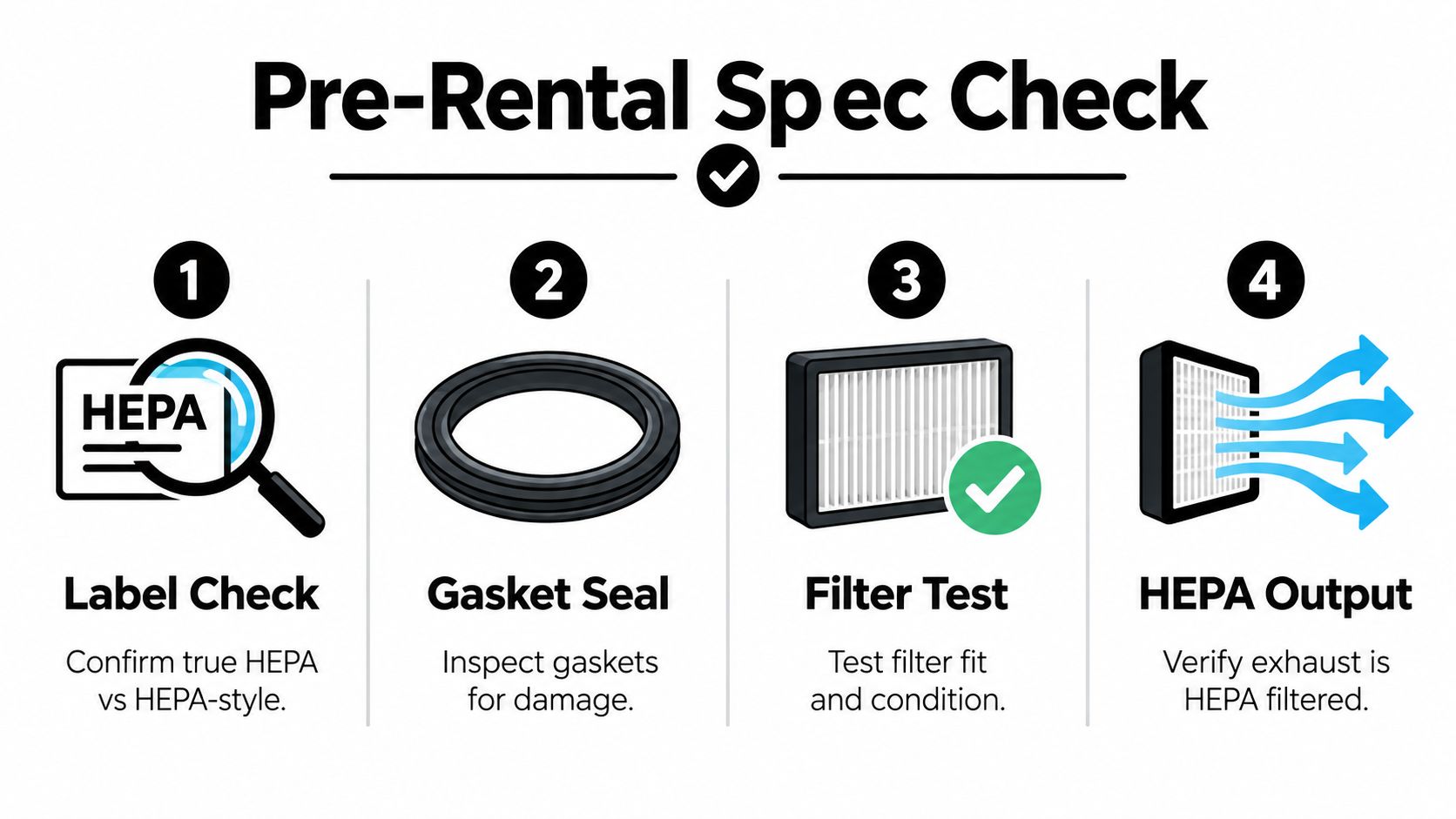
Ask the attendant to show you where the prefilter, primary filter, and final HEPA filter sit. If the design uses a disposable collection bag or pre-separator, check that the parts are present and compatible with the model. For a general explanation of filtration differences in home equipment, compare the approach used in home air purifier reviews, while remembering that an air purifier and a sealed vacuum perform different jobs.
Use airflow as your working specification
Suction alone doesn't tell you how effectively a machine will clean across a hose and tool. Airflow, measured in CFM, is more useful for judging cleaning reach, particularly when the hose is long or the tool must cover textured flooring. Field guidance places standard residential machines around 50 to 80 CFM, high-performance residential units around 80 to 120 CFM, and professional canister machines above 120 CFM. These ranges come from HEPA vacuum selection guidance.
Use this counter script:
“Is this true HEPA, or HEPA-style?” Ask for the actual grade and documentation.
“What is the airflow rating in CFM?” Don't accept suction language alone.
“Does all exhaust pass through the HEPA filter?” This tests the bypass issue.
“Can I inspect the gaskets and clamps?” Look for compression and damage.
“How do I know the filter is loaded?” Ask whether the machine has a pressure indicator or service limit.
Filter loading reduces airflow as resistance rises. Guidance describes a clean HEPA filter moving from roughly 100 to 250 Pa of initial resistance toward 375 to 500 or more Pa at terminal resistance, a signal that service or replacement may be necessary. If the rental company can't explain filter condition, choose another unit.
Where to Find a HEPA Vacuum Rental and What Terms to Expect
Local equipment rental shops, home-improvement rental counters, restoration suppliers, and municipal programs are the usual starting points. Search by equipment class rather than only by the phrase “vacuum rental.” Terms such as dust extractor, remediation vacuum, negative-air machine, or lead-safe HEPA vacuum often reveal more suitable options.
Compare the complete checkout cost
Rental listings show a wide spread. Consumer-style HEPA uprights may cost $18 to $24 per day, industrial HEPA systems and dust extractors may range from about $50 to over $100 per day, and remediation-grade packages can reach $150 to $400 or more per day, as described in HEPA vacuum rental equipment guidance. Another current equipment-rental listing shows rates from $95 to $2,070, reflecting different rental tiers and project durations, not a single standard market price.
The base rate is only one line on the agreement. Ask about:
Deposit and identification: Some programs require a government ID, a cash or check deposit, and appointment-only pickup.
Rental window: Confirm the exact return time, including whether after-hours returns trigger penalties.
Delivery and retrieval: Determine whether setup, transport, and pickup are included or billed separately.
Consumables: Clarify the cost of bags, prefilters, HEPA filters, and protective sheeting.
Damage and cleaning terms: Ask how concrete dust, mud, or contamination affects the final bill.
Accessories: Confirm that the hose, floor tool, crevice tool, and sealed bags match the machine.
A county flyer illustrates why logistics need attention. Rental arrangements can involve a short window such as one week or less, a deposit, identification, and scheduled collection. Review the HEPA vacuum rental requirements flyer before assuming a walk-in rental will work.
Check eligibility and permitted use
City programs may impose stricter rules than commercial suppliers. Milwaukee's program requires the renter to live in the city, present valid photo identification, and use the vacuum indoors only. The machine isn't permitted for outdoor use, according to the Milwaukee HEPA vacuum rental information.
Call two or three providers with the same job description. State the material, room count, flooring, expected rental period, and whether ductwork is involved. That makes the comparison useful because you're comparing equipment and service terms, not just headline prices.
For a contractor planning ductwork service, equipment capability and attachment selection deserve the same attention as the vacuum itself. A practical overview of professional duct-cleaning equipment can help clarify why household rental units don't always match duct-system requirements.
Using Your Rental Safely and Preventing Cross Contamination
A HEPA vacuum works best as part of a controlled cleaning sequence. It shouldn't become a tool for dragging contaminated dust from one room to another. Prepare the space before switching the machine on.
Set up the room first
Remove loose belongings, toys, curtains, and portable air cleaners from the work zone. Close doors, isolate the area with suitable sheeting where appropriate, and turn off air movement that could carry dust into clean rooms. Cover or seal HVAC supply and return openings during dusty work, unless a qualified containment plan requires a different arrangement.
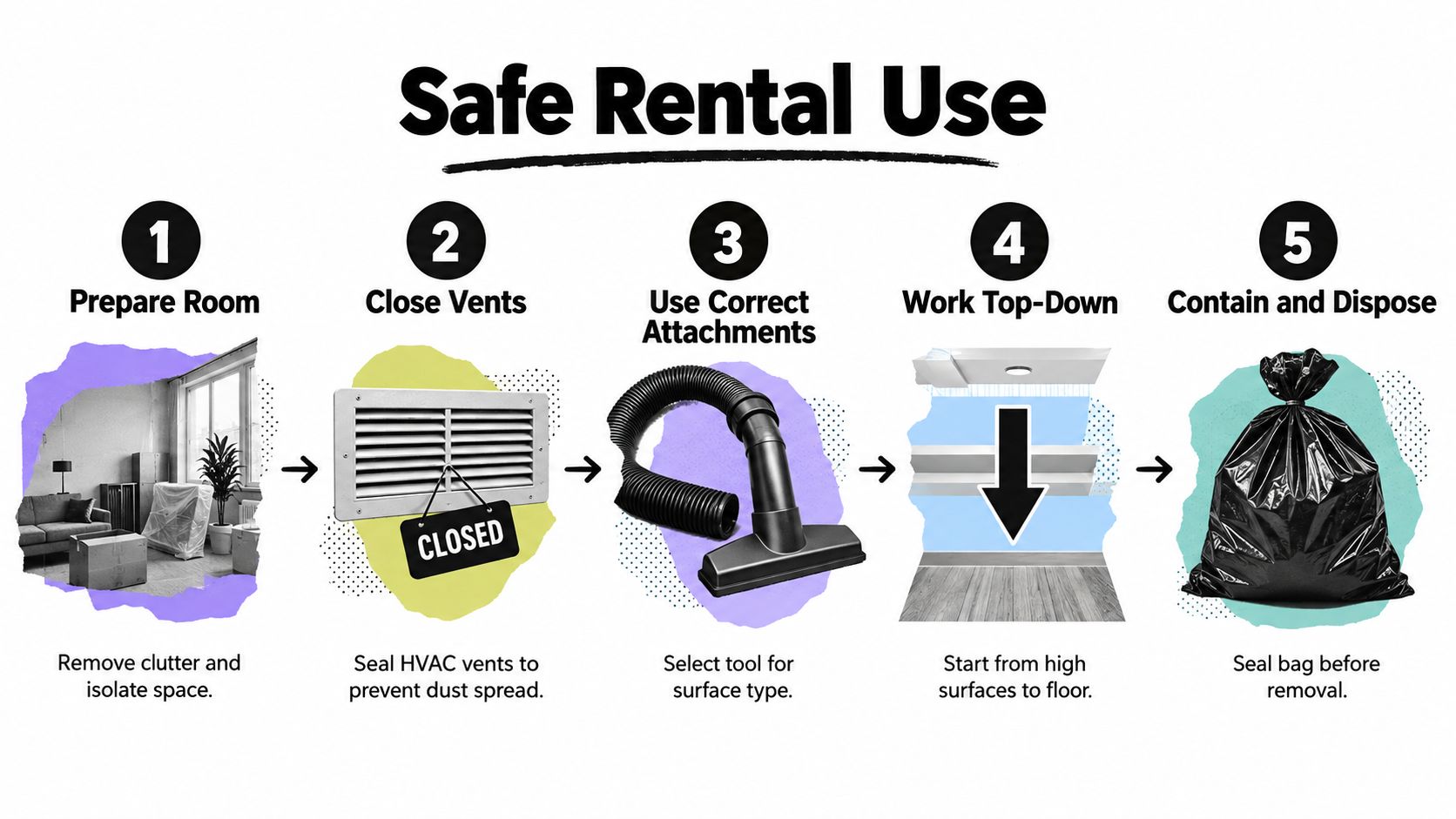
Use the correct attachment for each surface. A brush can loosen settled dust from trim, while a floor head may work better on smooth flooring or carpet. Keep the nozzle close to the surface without grinding debris into porous materials, and move from higher surfaces downward so you don't re-dirty finished areas.
Watch performance during the job
Airflow can fall as the filter loads. Reduced suction at the tool, a change in motor sound, a pressure alarm, or visible dust escaping at a joint deserves an immediate pause. Shut the unit down, inspect the hose and seals, and follow the rental company's service instructions. Don't open a contaminated housing casually or shake a loaded filter indoors.
The capture process still leaves a small residual particle release even when filtration performs correctly. A practical example describes a 100 CFM HEPA vacuum releasing about 3,000 particles per minute when the incoming stream carries roughly 10,000,000 particles per minute, which is why seal integrity and filter condition matter as much as the label. The example appears in flooring and allergy guidance.
Handle collected debris as contaminated material when the job calls for it. EPA guidance recommends sealed, labeled, leak-tight containers for certain asbestos-related debris. Don't empty a bag into an indoor trash can, and don't use a program unit outside when its terms prohibit outdoor work.
For duct-related preparation, distinguish surface cleaning from work inside the HVAC system. Negative-air duct cleaning guidance explains why pressure control and containment require more than attaching a hose to a household vacuum.
This video demonstrates the kind of controlled process homeowners should understand before starting:
When to Rent Versus Hire Professional Duct and Vent Cleaning
Renting suits a contained task with accessible surfaces and a clear endpoint. Professional service becomes the safer choice when the job involves hidden contamination, a large connected system, regulated materials, or equipment that must maintain negative pressure throughout the work.
A consumer upright may handle a light allergy-focused floor clean. An industrial dust extractor offers stronger airflow and better accessories for renovation debris. A remediation-grade setup may add continuous-duty operation, pre-separation, compliant hoses, sealed collection, and negative-air capability. Those features affect the result more than the word HEPA printed on a housing.
Decision Factor | Rent HEPA Vacuum | Hire Professional Service |
|---|---|---|
Job scope | One room, localized dust, or accessible surfaces | Whole-home ductwork, multiple zones, or hidden contamination |
Material | Ordinary settled dust or controlled renovation residue | Lead, mold, silica, asbestos-related work, or uncertain material |
Containment | You can isolate the room and manage debris | The job requires pressure control, specialized barriers, or coordinated air handling |
Access | Floors, trim, shelves, and visible registers | HVAC coils, internal duct surfaces, air handlers, and difficult access points |
Equipment | You can verify true HEPA filtration, airflow, and seals | The crew supplies matched extractors, hoses, agitation tools, and containment |
Responsibility | You manage setup, cleaning, disposal, and return | The provider manages the work sequence and equipment handling |
Lead-safe renovation in pre-1978 homes is a major example. EPA's RRP framework requires certified contractors working in those homes to use HEPA vacuums during renovation dust cleanup, as outlined in EPA RRP guidance. A rental doesn't make an uncertified activity compliant.
For duct and vent work, the question isn't whether a vacuum can create suction. The operator must control access, prevent cross-contamination, clean the system components properly, and verify that the method follows accepted practice. Review NADCA duct-cleaning standards when comparing a DIY rental with a professional proposal.
Purified Air Duct Cleaning, based in Avondale, Arizona, offers duct, dryer vent, and HVAC coil cleaning across the Phoenix metropolitan area, using certified technicians and HEPA-equipped collection practices for applicable work. For a short, accessible cleanup, renting may be reasonable. For connected ductwork, contaminated coils, or a project where rework would be costly, hiring the right crew usually reduces risk.
Your HEPA Vacuum Rental Checklist and Next Steps
Take this checklist to the rental counter:
Confirm true HEPA status: Verify the 99.97% capture benchmark at 0.3 microns and no-bypass exhaust design.
Match airflow to the task: Ask for CFM, not just suction, and choose a machine suited to the hose length and surface.
Inspect the seals: Check gaskets, clamps, hose connections, collection bags, and filter seating.
Ask about filter condition: Find out how loading is monitored and who replaces a restricted filter.
Read the terms: Confirm ID, deposit, pickup time, delivery, consumables, cleaning charges, and late-return rules.
Plan the room: Isolate the area, close or seal HVAC openings as appropriate, work from high surfaces downward, and keep clean areas separate.
Contain waste: Seal bags or containers before removing them from the work zone, following the requirements for the material involved.
Know when to stop: Call a professional for lead, asbestos-related work, mold, silica, extensive duct contamination, or any job requiring negative air.
Before pickup, photograph the machine, record existing damage, and confirm every attachment. At return, follow the supplier's cleaning instructions, keep the filter and bag intact, and arrive within the agreed window. Afterward, replace or clean washable materials as directed and continue source control through ventilation, moisture management, and appropriate air cleaning.
If your project involves ductwork, vents, dryer ducts, or HVAC coils rather than a single room, Purified Air Duct Cleaning can assess the system and provide a service quote in the Phoenix metropolitan area. Contact the team before renting so you can compare the complete cost of professional cleaning with the equipment, containment, and return logistics your project requires.