

Indoor Air Quality Services That Make Homes Healthier
You notice it on a normal day first. Dust keeps collecting around a supply vent you just wiped down, one bedroom feels stuffy while the living room gets blasted with air, and someone in the house wakes up congested even though the windows stayed closed. In an office, it can look different: stale air in a conference room, uneven temperatures across workstations, or a musty smell that returns every afternoon when the system ramps up.
Those clues often get treated as separate annoyances. They usually aren't. They point to one shared system problem: the air moving through the building isn't being controlled well enough.
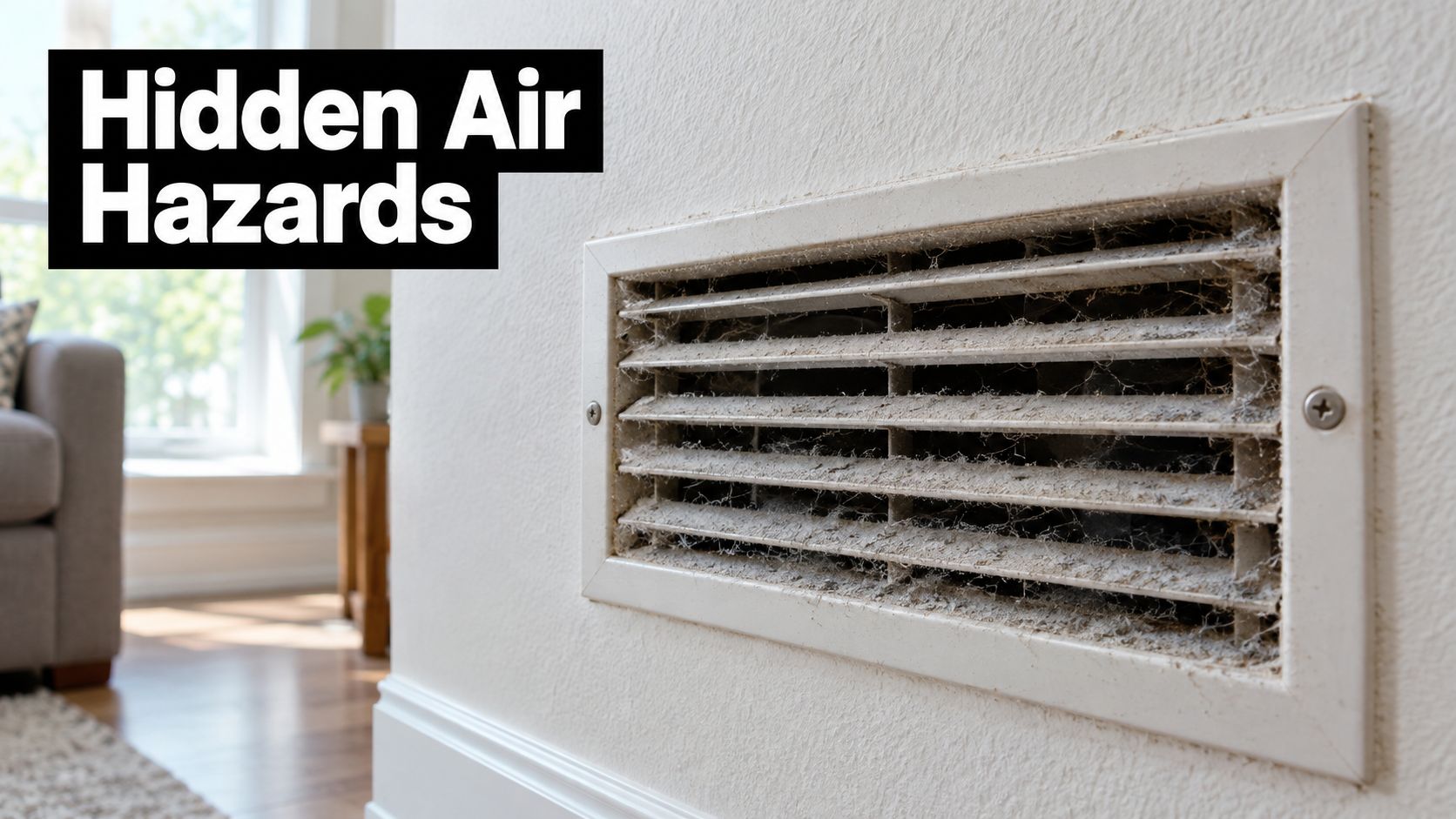
A lot of people think indoor air quality services mean buying one purifier or scheduling one duct cleaning. In real buildings, cleaner air comes from several parts working together: ducts that carry air properly, coils that stay clean enough to transfer heat and moisture, vents that deliver balanced airflow, filters that catch particles, and ventilation that brings in outdoor air without dragging in extra pollution. If one part struggles, the whole system feels off.
That matters because indoor air problems aren't just about comfort. The World Health Organization reports that around 2.1 billion people still cook with polluting fuels in open fires or inefficient stoves, and household air pollution caused about 2.9 million premature deaths in 2021, including more than 309,000 deaths among children under age 5. WHO also notes that household air pollution and ambient air pollution together are associated with 6.7 million premature deaths annually, with roughly 95 million disability-adjusted life years attributable to household air pollution exposure in 2021, which underscores how serious indoor contamination can be as a public-health issue according to WHO.
For homeowners, that big picture helps explain why small warning signs at home deserve attention. If you're trying to understand the everyday mix of dust, odors, and contaminants trapped in your home, it helps to look at the whole air pathway, not just one symptom. A building-focused primer on indoor air quality in buildings can also help frame what you're seeing before you decide on service.
Introduction to Healthier Indoor Air at Home and Work
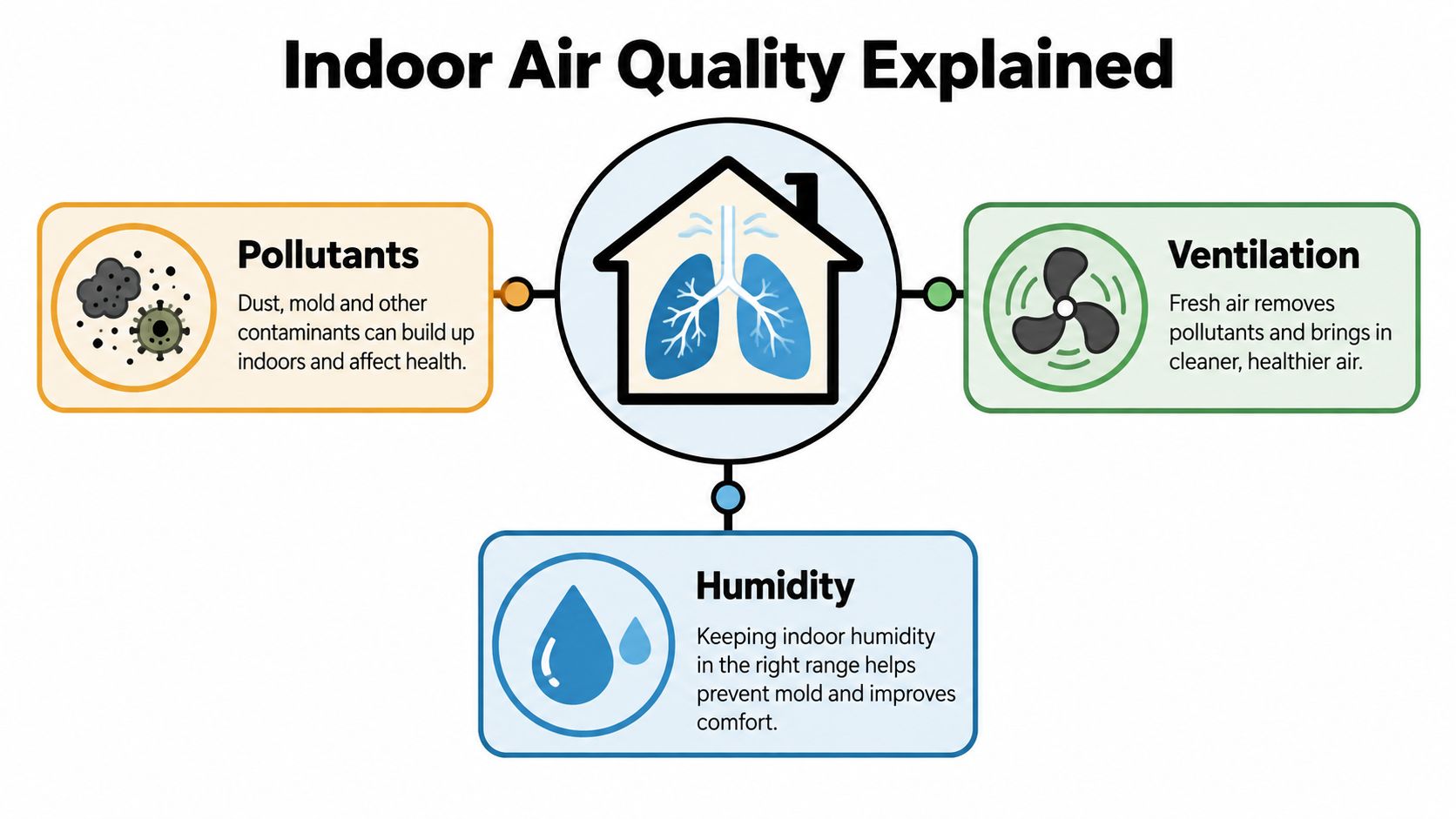
Indoor air quality gets confusing because you can't judge it by one thing. A shiny vent cover doesn't guarantee clean air, and a powerful filter doesn't fix stale rooms if the system isn't moving enough air. Most buildings behave more like lungs than like boxes. They take air in, move it, filter some of it, condition it, and send it back out into occupied spaces.
What people usually notice first
The first signs are practical, not technical:
Dust that returns fast: You clean a table, then a light film comes back quickly.
Rooms that feel different from each other: One space is muggy, another dry, another noticeably warmer.
Odors with a schedule: Cooking smells, pet smells, or a damp scent seem to reappear when the HVAC system runs.
Those symptoms don't all point to the same fix. Some come from source problems inside the building. Others come from weak ventilation or poor filtration. Sometimes a dirty coil or neglected duct system turns HVAC equipment into a contamination source instead of a comfort tool.
The three levers that change indoor air
There are three main ways to improve indoor air quality, and EPA puts them in a simple order: source control, improved ventilation, and air cleaners or filtration in its indoor air guidance.
Keeping a fish tank clear. First, stop dumping extra waste into the water. Second, refresh the water properly. Third, use the right filter to catch what remains.
Practical rule: Start by reducing what gets into the air, then make sure the building can bring in and move clean air, then add filtration and air cleaning that match the system.
Why standards matter more than guesswork
Good indoor air quality services don't stop at "it looks cleaner now." They look for measurable system conditions. ASHRAE's ventilation standards treat indoor air quality as an integrated building issue that includes filtration, air cleaning, operations, and maintenance. They also note that when outdoor particulate levels are high, filters or air-cleaning devices should be used before air enters occupied spaces, with at least MERV 8 filtration in the cited criteria through ASHRAE Standard 62.1 and 62.2 resources.
That shifts the question from "Are my ducts dusty?" to better questions:
Is the building getting enough outdoor air?
Is the filter efficient enough for the goal?
Can the fan handle that filter without losing airflow?
Are coils, fans, and duct surfaces staying clean enough to avoid becoming pollutant sources?
For readers comparing climates and building conditions, regional reading like understanding Flagstaff air quality can be useful because outdoor conditions always affect what indoor systems need to do.
Understanding What Indoor Air Quality Really Means
A lot of service names sound similar until you line them up by job. Duct cleaning, dryer vent cleaning, coil cleaning, and purification don't compete with each other. They solve different problems in different parts of the air system.
The easiest way to sort them is to ask one question: What part of the building are we trying to improve, airflow, cleanliness inside the HVAC path, fire safety, or contaminant reduction in occupied rooms?
Four common services, four different jobs
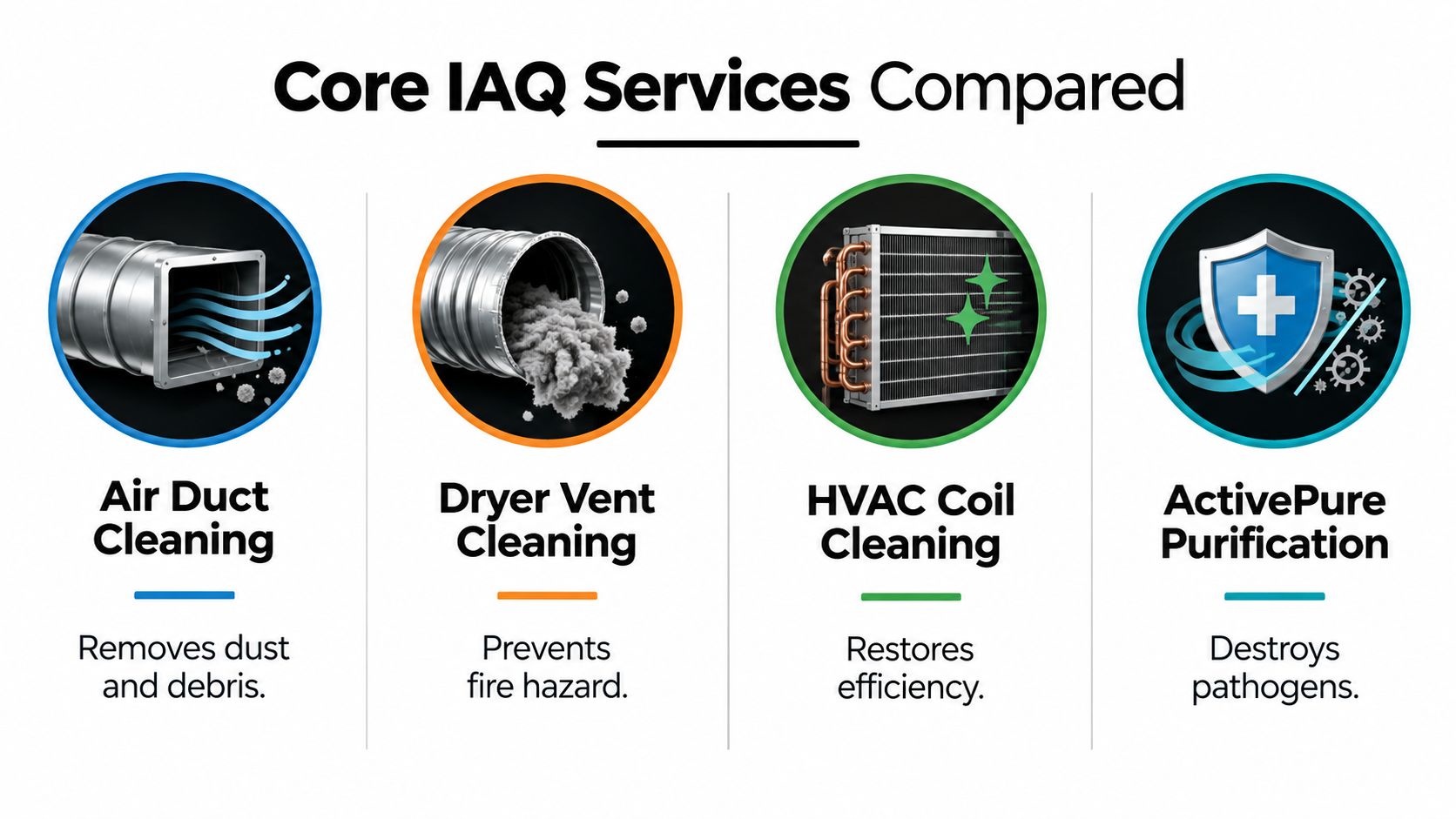
Air duct cleaning focuses on the passages that carry supply and return air. When debris builds up inside those runs, it can affect cleanliness and, in some cases, airflow delivery. It's often considered when vents show heavy dust, renovations created debris, or a building has gone a long time without inspection.
Dryer vent cleaning isn't really an HVAC cleaning task, but it belongs in indoor air quality conversations because it affects home safety and moisture management. A clogged dryer vent can keep hot, damp air from exhausting properly. Families usually notice longer dry times, extra heat in the laundry area, or lint collecting where it shouldn't.
HVAC coil cleaning deals with the evaporator or condenser coils that help the system exchange heat. When a coil gets coated, the equipment can struggle to move heat and moisture effectively. That can show up as weaker comfort, sticky indoor conditions, or more runtime than expected.
ActivePure air purification installation adds an air-cleaning technology to the system or room setup. It doesn't replace filtration or ventilation. It supplements them, especially when occupants want another layer of treatment beyond what a passive filter can do as air passes through the system.
A practical overview of indoor air quality monitoring services can help once you're trying to verify whether a cleaning or purification step is solving the actual problem.
Here's a quick side-by-side view.
Service | Primary Problem Solved | Best For | Expected Outcome |
|---|---|---|---|
Air Duct Cleaning | Debris and contamination inside duct pathways | Homes after remodeling, dusty systems, buildings with visible vent contamination | Cleaner air pathways, reduced recirculation of settled debris |
Dryer Vent Cleaning | Lint buildup and restricted exhaust | Families using dryers frequently, property managers, real estate prep | Better exhaust flow, improved dryer performance, lower fire risk |
HVAC Coil Cleaning | Dirty heat-transfer surfaces | Systems with weak cooling, moisture issues, heavy dust load | Restored system performance, steadier airflow, cleaner HVAC interior |
ActivePure Purification | Added contaminant reduction beyond basic filtration | Occupants wanting an extra in-duct or portable air-cleaning layer | Supplemental air cleaning used alongside ventilation and filtration |
A short visual can help make the differences easier to spot in practice:
When each service becomes the right next move
People often book the wrong service because they match by symptom instead of cause.
Musty smell near vents: Could point to duct contamination, but it may also come from coil moisture or drainage issues.
Higher utility bills with weak comfort: Often worth checking coil condition and total airflow before assuming the ducts are the main problem.
Laundry taking too long to dry: Usually sends attention to the dryer itself, when the vent path may be the restriction.
Allergy concerns in an otherwise clean-looking home: May call for filtration upgrades and purification support more than a cleaning alone.
A good provider should be able to explain why one service is enough, or why several need to work together, without treating every symptom like a duct-cleaning sale.
Standards help. NADCA's ACR standard defines minimum procedural and performance requirements for HVAC assessment, cleaning, and restoration. It also gives recommended inspection intervals, including annual checks for air-handling units across residential, commercial, industrial, healthcare, and marine buildings, with supply ducts and return or exhaust ducts typically recommended every 1 to 2 years depending on building type. The standard also includes a cleanliness threshold under the NADCA Vacuum Test, where collected debris must not exceed 0.75 mg per 100 cm² for the HVAC system to be considered clean under the NADCA ACR standard.
How Filtration and Purification Improve Your Air
Filters get talked about as if higher is always better. They aren't that simple. A filter has two jobs at once: catch particles and still let the system move enough air.
If you only focus on capture, you can end up with a filter that makes the fan work harder and reduces delivered airflow. That's like putting a very fine strainer in a hose line. You might trap more debris, but if water barely moves, the result still isn't good.
What MERV ratings actually tell you
EPA gives a practical target for many HVAC systems: MERV 13, if the fan and filter slot can accommodate it in EPA's MERV guidance. That matters because MERV 13 captures at least 50% of particles in the 0.3 to 1.0 µm range, at least 85% in the 1.0 to 3.0 µm range, and at least 90% in the 3.0 to 10.0 µm range in the same EPA guidance.
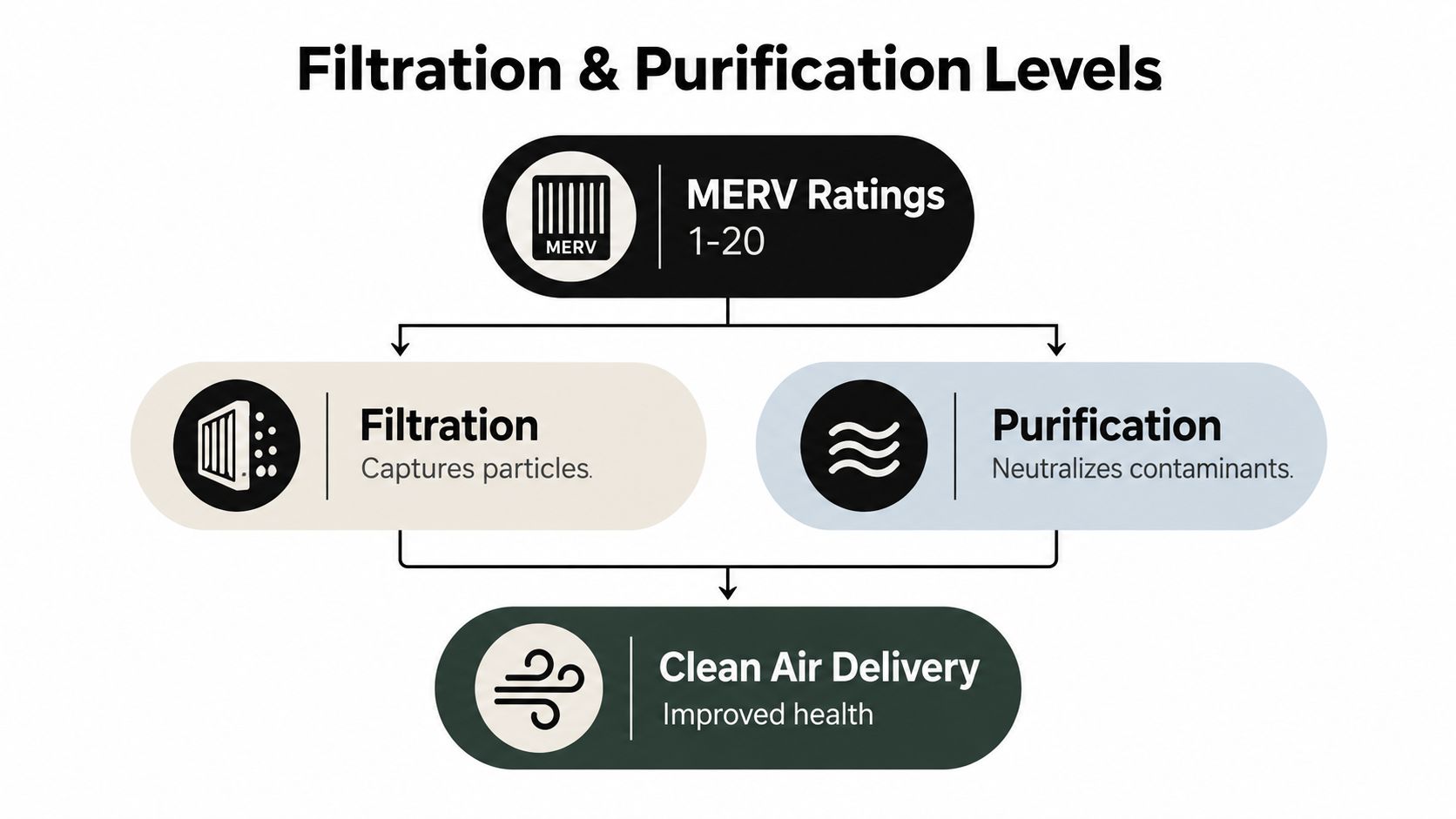
That first range is important because it includes fine smoke and many aerosolized contaminants. But EPA also makes an equally important point: filters and portable air cleaners help, yet they don't eliminate all pollutants. The strongest approach is layered. Remove the source first, ventilate with clean outdoor air, then use filtration or air cleaning as a supplement.
Why airflow compatibility matters
A strong filter in a weak setup can backfire. If static pressure rises too much, airflow can drop. Then rooms may get less conditioned air, coils may not perform as intended, and comfort complaints can persist even with a better filter installed.
For homes, there are concrete minimums and targets that help frame that decision:
Residential ventilation target: EPA cites ASHRAE Standard 62.2-2016 as recommending either 0.35 air changes per hour or at least 15 cubic feet per minute per person, whichever is greater, for homes in EPA's home ventilation guidance.
Residential ducted-system filtration minimum: ASHRAE Standard 62.2-2019 requires that mechanical systems supplying air through ductwork longer than 10 feet and through a thermal conditioning component use a filter with MERV 6 or better, or at least 50% particle efficiency in the 3.0 to 10 micrometer range in the standard addendum document.
California's 2019 Energy Standards go further for many residential systems, requiring MERV 13 or better for space conditioning systems and outdoor ventilation supply air in that cited standard document. That shows why filter advice can vary by market and code environment.
Clean air delivery is not just a filter number. It's the combination of capture efficiency and enough airflow in cubic feet per minute to move that cleaner air where people actually breathe.
For households dealing with allergy triggers from several surfaces at once, practical cleaning ideas outside the HVAC system can support the same goal. Articles on Birmingham allergen reduction can be useful as a reminder that floors, soft materials, and air handling often affect the same occupants together.
If you're comparing room units and whole-home options, a guide to the best residential air purifier can help you distinguish between portable support and in-duct treatment. One available example in this category is Purified Air Duct Cleaning's installation of ActivePure systems for in-duct and portable use, which fits as a supplemental layer rather than a substitute for ventilation and filtration.
Benefits for Homes Businesses and Sensitive Groups
Once the system is working as a system, the benefits become easier to notice. Not because the air suddenly feels magical, but because the building behaves more predictably.
At home, that usually means less visible dust settling at supply areas, fewer stale rooms, and a steadier feel from one part of the house to another. In commercial buildings, the payoff often shows up as fewer comfort complaints, cleaner HVAC components, and better confidence that the ventilation and filtration strategy matches the space.
For homeowners and families
A house with better airflow and cleaner HVAC pathways is often easier to live in day to day.
Morning comfort improves: Bedrooms don't feel as closed off or stale.
Routine cleaning gets easier: Dust still exists, but it doesn't seem to race back as fast from the vents.
Laundry areas stay safer: A clear dryer vent reduces one of the most overlooked household maintenance hazards.
Families preparing to sell a home also care about first impressions. Musty odors, lint-packed vents, and visibly dirty grilles can make a house feel neglected even when the structure is sound.
For businesses and facility teams
Facility managers usually care less about the phrase "fresh air" and more about repeatable building performance. They need rooms that stay usable, equipment that isn't burdened by preventable buildup, and service plans that don't rely on guesswork.
That includes knowing when indoor conditions may connect to larger environmental concerns. A practical resource on environmental health hazards can help teams think beyond visible dirt and consider how building conditions, occupant sensitivity, and maintenance practices overlap.
When people say a building feels "off," they usually mean the HVAC system isn't delivering clean, stable, balanced air where it's needed.
For allergy-prone and sensitive occupants
Sensitive groups tend to notice system flaws first. A room with weak circulation, excess particulates, or poor ventilation can bother them long before it bothers everyone else.
That doesn't mean every symptom has one simple fix. It means these occupants benefit most when service providers treat indoor air quality services as coordinated building care, not isolated cleanings.
How to Choose a Provider and Understand Costs
Choosing a provider gets easier when you stop shopping by slogan. Ask how they inspect, how they verify results, and how they decide whether your issue needs cleaning, filtration changes, ventilation work, or some mix of all three.
A strong provider should be comfortable talking about standards, pressure drop, airflow, contamination sources, and maintenance intervals in plain language. If they can only describe one service, they may only know how to sell one service.
Questions that quickly separate good providers from vague ones
Use this checklist when comparing companies:
Ask about standards: Do they follow NADCA-aligned procedures for HVAC cleaning and inspection?
Ask how they verify cleanliness: Will they explain what "clean" means beyond appearance?
Ask what they inspect first: Do they look at ducts, coils, filters, vents, and air handling components together?
Ask about airflow after upgrades: If they recommend a higher-MERV filter, how will they confirm the system can handle it?
Ask about recurring care: What maintenance rhythm do they suggest for your building type?
If you want a benchmark for what an informed specialist should be able to discuss, this guide to choosing an indoor air quality expert gives a useful starting point.
What usually drives the quote
Indoor air quality service pricing varies because buildings vary. A small single-story home with accessible duct runs is very different from a large house with multiple systems or a commercial property with harder access and stricter scheduling needs.
Cost usually moves based on factors like:
System size and layout: More vents, longer runs, or multiple air handlers increase labor.
Condition of the equipment: Heavy buildup can require more time and specialized cleaning steps.
Service scope: Duct cleaning alone differs from a package that includes coil work, dryer vent cleaning, and purification installation.
Verification and monitoring: Some owners want only a one-time cleaning, while others want ongoing checks and data review.
There's also a budget trend worth paying attention to. One market report says services accounted for 32% of IAQ market value in 2023, with 1.8 million active analytics subscriptions and 210,000 annual maintenance contracts, while another estimate in the same market coverage projects the service market will grow from USD 8.37 billion in 2025 to USD 15.4 billion by 2035 in this indoor air quality solutions market report. Treat those future-year figures as projections, not guarantees.
That matters for one simple reason: installation is only the starting point. Filters load up, coils collect buildup, vents drift out of balance, and buildings change as occupants, pets, work patterns, and outdoor conditions change.
What to Expect After Service and Next Steps
After a proper service visit, the first results are usually practical. Airflow often feels steadier, vents look cleaner, and rooms may smell less stale. In homes with obvious buildup issues, people also tend to notice that dust around registers doesn't return as aggressively.
The longer-term result is more important: the HVAC system has a better chance of delivering air the way it was meant to. That means filtration can do its job, ventilation strategies work more consistently, and dirty components are less likely to become part of the problem.
A simple maintenance rhythm that works
Keep the gains with a short routine:
Change filters on schedule: Use the right MERV level for your system, not just the highest one on the shelf.
Watch for airflow changes: A room getting stuffy again is often an early warning sign.
Pay attention to odors: Smells that appear when the system starts can signal a returning issue.
Schedule inspections before problems stack up: Air-handling equipment and duct systems benefit from planned checks instead of crisis calls.
For many properties, the smartest next step isn't another product. It's a maintenance rhythm. Clean what needs cleaning, verify airflow, keep ventilation intentional, and treat purification as support for the system, not a shortcut around it.
If your vents are dusty, your rooms feel uneven, or your building never seems quite fresh, that isn't just a nuisance. It's usually the HVAC system asking for a more complete indoor air strategy.
Purified Air Duct Cleaning provides residential and commercial indoor air quality services across the Phoenix area, including air duct cleaning, dryer vent cleaning, HVAC coil cleaning, and ActivePure purification installation. If you want cleaner airflow, better system performance, and a practical plan for maintaining indoor air over time, visit Purified Air Duct Cleaning to review services and request a free quote.