

A Guide to Commercial Air Duct Cleaning
Commercial air duct cleaning is a vital maintenance service that clears out all the dust, debris, and other contaminants that get stuck in a building's HVAC system. It’s one of those "out of sight, out of mind" tasks, but it's absolutely essential for maintaining healthy indoor air quality and keeping your heating and cooling system running efficiently. Getting this right directly impacts both the well-being of everyone in your building and your operational costs.
Why Clean Air Ducts Are Your Building's Unsung Hero
Think of your building's HVAC system as its lungs. In this analogy, the network of air ducts acts like the bronchial tubes, responsible for delivering conditioned air to every single room, office, and common space. Just like our own bodies need clean air to function properly, your building needs a clean air delivery system to foster a healthy, productive environment.
Over time, this complex network of ductwork inevitably collects a buildup of things you don't want circulating. Dust, dirt, pollen, and other fine debris get sucked into the system every time the heat or AC kicks on. This accumulation doesn't just sit there; it can become a breeding ground for contaminants that are then continuously pushed throughout your entire facility.
The Impact on People and Productivity
The quality of the air your employees and customers breathe has a real, tangible effect on their health and comfort. When ducts are caked with grime, they can spread allergens and pollutants that trigger everything from nagging headaches and allergic reactions to more serious respiratory issues. Poor indoor air quality can easily lead to more sick days and a noticeable dip in focus and productivity.
The U.S. Environmental Protection Agency has a sobering statistic: indoor air can be up to five times more polluted than the air outside. This really highlights the critical need for professional air duct cleaning services in commercial spaces to cut down on airborne irritants and allergens.
A clean, fresh-smelling building also makes a huge difference in the customer experience, making your space far more inviting. On the flip side, musty odors wafting from dirty ducts can create a poor first impression and detract from your business’s professional image. Understanding the reasons to clean the ductwork in a commercial building is the first step toward protecting your environment.
The Financial Case for Cleanliness
Beyond the health and comfort of your occupants, there's a strong financial argument for regular commercial air duct cleaning. When dust and debris clog up key HVAC components like coils and fans, the whole system has to work much harder to move air. That inefficiency translates directly to higher energy use and bigger utility bills.
A strained system also suffers from more wear and tear, which can lead to more frequent breakdowns and a shorter lifespan for your expensive equipment. Proactive cleaning is a smart investment that protects your HVAC assets and helps you avoid costly emergency repairs down the road. It's a growing priority for businesses, too; the global air duct cleaning market was valued at around USD 5.6 billion and is expected to climb to USD 9.8 billion by 2033.
Ultimately, neglecting your ductwork is a silent drain on your bottom line. Prioritizing this essential maintenance delivers a powerful triple benefit:
Healthier Occupants: Reduced exposure to airborne irritants means better well-being and productivity.
Lower Operating Costs: An efficient HVAC system uses less energy, saving you money every month.
Asset Preservation: Proper maintenance extends the life of your critical HVAC infrastructure.
The Business Case for Professional Duct Cleaning

It’s easy to think of commercial air duct cleaning as just another maintenance task to check off the list. But savvy business owners see it differently: as a strategic investment with real, measurable returns. This goes way beyond just having a cleaner building. We're talking about direct impacts on your team's health, your monthly budget, and the lifespan of your most critical equipment.
When you reframe it as an investment instead of an expense, the value becomes crystal clear. You’re not just cleaning ducts; you're actively creating a healthier, more efficient, and more pleasant space for every single person who walks through your doors.
Improve Your Building's Indoor Air Quality
The most immediate win from a thorough duct cleaning is a dramatic improvement in your indoor air quality. Over time, your HVAC system becomes a repository for a nasty cocktail of pollutants, which it then circulates for your team and clients to breathe day in and day out.
A professional cleaning physically scours your ductwork and removes these contaminants. And we’re not just talking about a bit of dust. This includes:
Allergens and Irritants: We pull out things like pollen, dander (in some facilities), and dust mites that can make life miserable for employees with allergies or asthma.
Microbial Growth: The dark, damp environment inside ducts is perfect for mold and mildew. Getting rid of that growth means eliminating musty odors and potential health hazards at their source.
Debris and Particulates: Fine dust, lingering construction debris, and other tiny particles get dislodged and pulled out, stopping them from being blown back into your offices and common areas.
Better air quality means fewer airborne triggers for headaches, stuffy noses, and allergic reactions. The result? A healthier team that feels better and works more productively.
Enhance Your HVAC System Efficiency
A dirty HVAC system is a lazy, expensive one. Think of it like trying to run a marathon while breathing through a coffee stirrer; it has to work so much harder just to do its job.
When grime and dust build up on vital parts like evaporator coils, blowers, and heat exchangers, it's like wrapping them in an insulating blanket. The system is forced to run longer and harder to hit the temperature on the thermostat, causing a very real spike in your energy bills.
A clean system, on the other hand, runs just like it was meant to. Air flows without restriction, components transfer heat efficiently, and you stop wasting energy. That translates directly to lower utility bills and a smaller carbon footprint, making duct cleaning a smart move for your bottom line and the environment. To see more of these advantages, you can check out some of the key air duct cleaning benefits for 2025 in our detailed post.
Eliminate Persistent and Unpleasant Odors
Ever walked into a part of your building and noticed a musty, stale smell you just can’t seem to pin down? Chances are, the culprit is hiding deep inside your air ducts.
Trapped moisture, mold, mildew, and even debris from pests can create funky odors that just won't go away. As your HVAC system runs, it spreads those smells throughout the entire facility. Air fresheners are just a temporary cover-up. Professional commercial air duct cleaning gets to the root of the problem, eliminating the source of the odors for good and leaving you with a genuinely fresh and welcoming environment.
Extend the Lifespan of Your HVAC System
Your HVAC system is one of the most expensive and important assets in your building. It makes sense to protect that investment. When a system is choked with dirt and debris, it's constantly under strain.
This ongoing stress takes a toll, causing premature wear and tear on crucial components, such as:
Blower Motors: They have to work overtime to force air through clogged pathways.
Compressors: They can run excessively when coils are dirty and can't exchange heat properly.
Coils: Blockages can lead to corrosion and, eventually, major system failures.
By cleaning the system regularly, you reduce all that unnecessary strain. This helps prevent sudden breakdowns, avoid costly emergency repair bills, and significantly extend the working life of your equipment. It's proactive care that maximizes your investment and ensures your system runs reliably for years.
The Commercial Duct Cleaning Process From Start to Finish
Ever wondered what actually happens during a professional commercial air duct cleaning? Knowing what to expect can help you feel confident in your investment. This isn't just about running a vacuum through your vents; it's a systematic process that’s more like a full respiratory restoration for your entire building.
When a legitimate, professional crew shows up, they follow a clear and thorough game plan. They arrive not just with tools, but with a strategy to protect your workspace, methodically remove contaminants, and prove the job was done right. Each step is built on the last, ensuring no corner of your HVAC system gets missed.
To make it easier to understand, we've broken down the entire service into its key phases. Here's a quick overview of what a comprehensive cleaning looks like from start to finish.
Phases of a Professional Commercial Duct Cleaning Service
Phase | Objective | Key Activities |
|---|---|---|
1. Assessment & Prep | To understand the system's condition and prevent cross-contamination. | Camera inspection, sealing all registers, protecting workspace and furniture. |
2. Agitation & Extraction | To dislodge and capture all debris from within the ductwork. | Connecting a negative air machine, using brushes and air whips, vacuuming out all loosened contaminants. |
3. System & Component Cleaning | To clean the heart of the HVAC system and ensure total cleanliness. | Cleaning the blower, coils, and drain pan; reassembling components. |
4. Final Checks & Verification | To confirm the system is clean, reassembled correctly, and functioning properly. | Running a final system test, performing a post-cleaning inspection, and removing all protective coverings. |
Now, let's dive into what each of these phases involves in more detail.
Phase 1: Initial Inspection and System Preparation
The process always kicks off with a detailed inspection. Before a single tool is turned on, technicians need to understand the state of your ductwork. They’ll often use specialized cameras to get a live feed from deep inside the ducts, letting them spot areas with heavy buildup, potential moisture issues, or even obstructions.
This initial look is crucial, as it helps the team customize their cleaning approach to your system's specific needs. After the assessment, the prep work begins. Technicians will carefully seal every single supply and return vent across your facility, usually with a temporary adhesive plastic film. This is a non-negotiable step that creates a closed-loop system, ensuring dust and debris can't escape back into your workspace during the cleaning.
This meticulous preparation is what separates the pros from the amateurs. If you don't create a sealed system, the cleaning process could just blow years of dust and contaminants from the ducts right into your offices, which completely defeats the purpose.
Phase 2: Agitation and Powerful Extraction
With the system fully sealed, the real work begins. The core of this phase is a two-part punch: agitation and extraction. A massive, high-powered negative air pressure machine, which you can think of as an industrial-strength vacuum, is hooked up to your ductwork's main trunk lines. Once it's fired up, it creates an intense vacuum, pulling all air and debris toward its collection unit.
While the entire system is under this constant negative pressure, technicians get to work inside the ducts. They use an arsenal of specialized tools to break loose all the stubborn, caked-on gunk, including:
Rotating Brushes: These scrub the inner walls of the ductwork, physically breaking free grime and dust.
Air Whips: These are high-pressure air hoses that whip around inside the ducts to dislodge contaminants from tricky corners and uneven surfaces.
Skipper Balls: These tools blast compressed air in all directions, loosening debris from every angle.
The infographic below gives a great visual of how a cleaning project flows from the initial assessment to the final treatment.
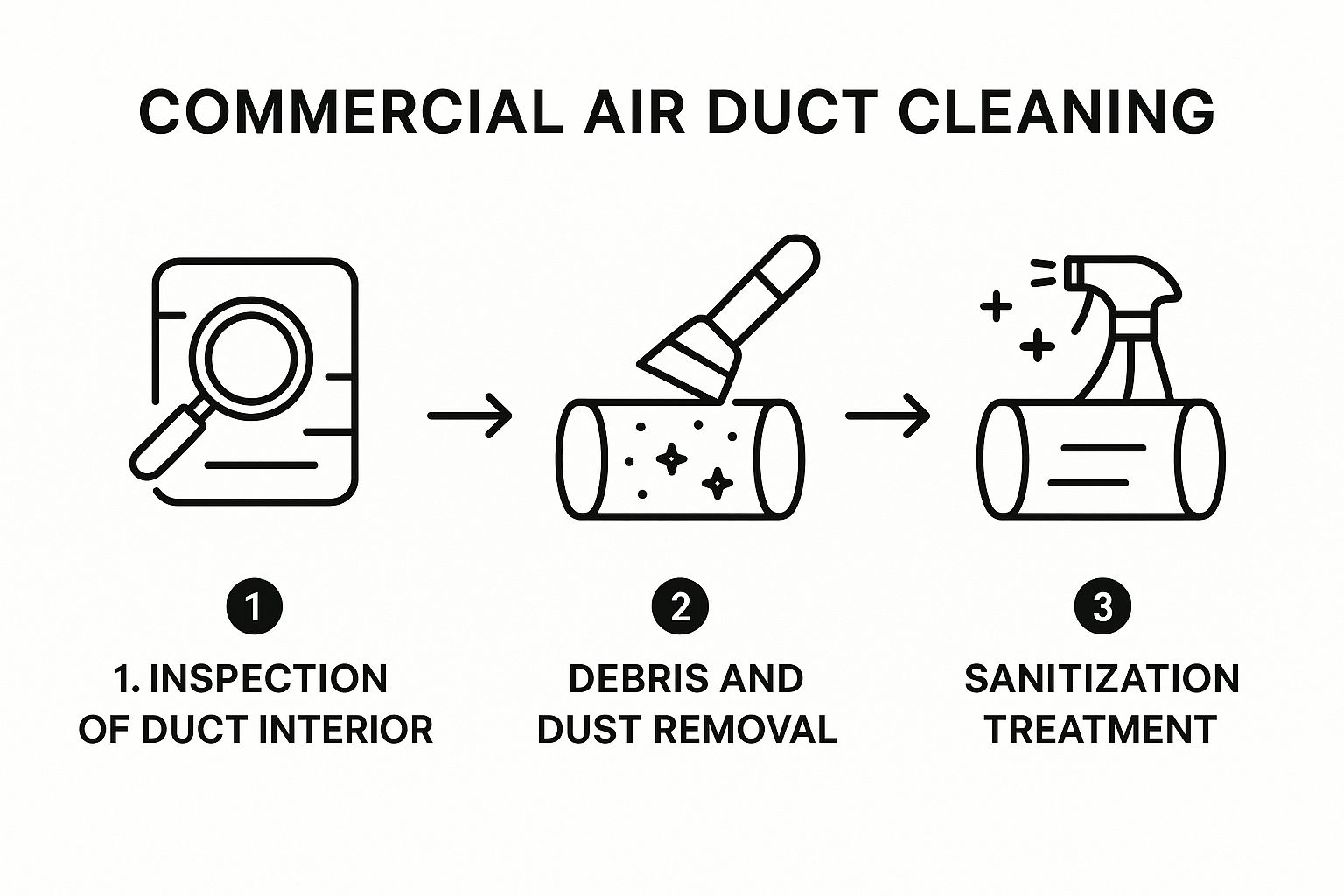
As you can see, the process is logical: inspection informs the debris removal, and optional sanitization provides a complete service. Thanks to the powerful vacuum, all those loosened contaminants are instantly sucked out of the ductwork and removed from your building for good.
Phase 3: HVAC Component Cleaning and Final System Test
A truly professional commercial air duct cleaning goes far beyond the ducts. The job isn't done until every critical component of the HVAC air handler unit has been thoroughly cleaned. Why? Because a dirty air handler will just re-contaminate your freshly cleaned ducts in no time.
Technicians will meticulously clean key parts, including:
The blower motor and its fan assembly
The evaporator and condenser coils
The drain pan and condensate lines
The entire interior of the air handler cabinet
In some situations, particularly if microbial growth was discovered during the inspection, a sanitization step might be recommended. When you're dealing with a specific issue like mold, a highly detailed approach is non-negotiable. You can learn more about the specialized procedures involved by reading your guide to air duct cleaning mold removal.
Once everything is cleaned, sanitized (if needed), and put back together, the crew performs a final system test. They'll turn on your HVAC system to make sure everything is running smoothly and efficiently. This last check is the final seal of approval, confirming the job was a success and leaving you with a clean, efficient system that’s ready to deliver healthier air.
Understanding Commercial Air Duct Cleaning Costs
When it's time to budget for building maintenance, one of the first questions we hear is, "So, how much does commercial air duct cleaning actually cost?" It’s a fair question, but there's no simple, off-the-shelf price. The cost is a completely variable figure that depends entirely on the unique characteristics of your building. Honestly, any company that gives you a flat price without a thorough inspection is a major red flag.
Instead of hunting for a universal number, it’s much more useful to understand what drives the price up or down. Once you know these variables, you can look at different proposals with a critical eye, easily spot a suspiciously low bid, and feel confident that you’re paying a fair price for a truly comprehensive service.
This knowledge empowers you to make a smart financial decision. You'll quickly see that a higher quote might just reflect a more thorough job, while a rock-bottom price often means cut corners, leaving you with a half-cleaned system and compromised air quality.
Primary Cost Factors for Your Facility
The final price tag for a commercial air duct cleaning service is custom-built around your building and its specific HVAC system. It's less like buying a product and more like commissioning a custom project. The scope and complexity are what truly dictate the investment.
Here are the main things a professional cleaning company will look at:
Building Size and Square Footage: This is the most straightforward factor. A sprawling warehouse or a multi-story office building simply has more linear feet of ductwork to clean than a small retail shop. More ductwork means more time and more labor.
HVAC System Complexity: The number of individual HVAC units, or air handlers, is a huge part of the equation. A building with one massive rooftop unit is a very different job than a facility with dozens of separate, smaller systems that each need individual attention.
Accessibility of Ductwork: How easy is it for technicians to get to the ducts? If they're in an open-ceiling warehouse, access is simple. If they're hidden behind drywall, dropped ceilings, or other complex structures, the job requires more time, specialized tools, and labor, all of which add to the cost.
The critical takeaway here is that pricing is a direct reflection of the labor, equipment, and expertise needed for the job. A quote that seems too good to be true almost always is. It often leads to an incomplete cleaning that you'll just have to pay someone else to fix correctly.
Contamination Levels and Required Methods
Beyond the physical layout, the actual condition of your ductwork plays a massive role in determining the final cost. A system that's been ignored for a decade is going to be a much bigger job than one that gets regular, preventative maintenance.
Level of Contamination: Ducts filled with a standard layer of dust and debris are relatively simple to clean. But if we find mold, pest droppings, or heavy construction debris like drywall dust, that's a different ballgame. It requires specialized cleaning techniques, strict safety protocols, and more time on-site.
Specific Cleaning Methods: While standard agitation and negative-pressure extraction handle most situations, severe contamination might demand extra steps. This could include antimicrobial treatments or applying a sealant to the ducts, which would be quoted as separate line items.
Regional Labor Rates: Just like any skilled trade, the cost of certified technicians varies by location. The going rates in major cities are naturally going to be different than in smaller towns.
The demand for quality air duct cleaning is clearly on the rise. The global market was valued at USD 3.87 billion in 2023 and is on track to hit USD 5.6 billion by 2031. This growth is largely fueled by a greater awareness of indoor air quality's importance in commercial spaces, especially where regulations are tight. You can see the full analysis of the growing air duct cleaning market on verifiedmarketresearch.com.
Of course, how often you clean your ducts also affects your long-term costs. You can dive deeper into our professional recommendations in our guide on how often to get air ducts cleaned.
How to Choose the Right Duct Cleaning Company
Picking a company for your commercial air duct cleaning is a big deal. It’s a decision that directly impacts your building’s health, your employees' well-being, and your operational budget. A great contractor leaves you with fresh air, a more efficient HVAC system, and total peace of mind. On the flip side, hiring the wrong crew can actually make things worse, potentially damaging your system or just stirring up dust without removing it.
Think of it like hiring a specialized surgeon for your building's "lungs." You wouldn’t just go with the cheapest option or someone who can't show you their credentials. You'd want an expert with the right equipment, a solid plan, and a proven history of successful operations. The same logic applies here.
Vet Their Credentials and Experience
The first move is to separate the real experts from the amateurs by checking their qualifications. Any company worth its salt will be proud of its certifications and happy to show you the proof.
Here’s your non-negotiable checklist:
Proof of Insurance: Never, ever hire a company that can’t show you a certificate of insurance. This needs to cover both general liability and workers' compensation. It’s what protects your business from any liability if an accident or property damage happens on your watch.
Relevant Commercial Experience: Ask for case studies or references from businesses with buildings like yours. A team that mostly cleans small residential homes probably won't have the heavy-duty equipment or the experience needed to tackle a large, complex commercial HVAC system.
The demand for professional duct cleaning is no small thing. In 2023, the market hit about USD 8.5 billion. North America is a huge part of that, thanks to high awareness and the complex HVAC systems common in commercial buildings. With such a big market, you have plenty of choices, so you can afford to be picky. You can learn more about global trends in the air duct cleaning market at dataintelo.com.
Ask the Right Questions During the Consultation
A detailed consultation is your chance to see how professional and knowledgeable a company really is. A reputable crew will welcome your questions and give you clear, straightforward answers. If they get defensive or can’t explain their process, that’s a major red flag.
Make sure you ask these questions:
What cleaning methods and equipment do you use? They should be able to walk you through their process, mentioning things like a powerful negative air machine, agitation tools (like rotating brushes or air whips), and how they contain the mess.
Will you clean the *entire* HVAC system? The only acceptable answer is "yes." A proper commercial air duct cleaning isn't just about the ducts; it includes the air handler, coils, drain pan, and blower motor.
How do you keep our workspace clean while you work? They need to have a clear plan for sealing off vents and protecting your furniture and equipment from dust and debris.
Can you give me a detailed, written proposal? A professional quote breaks down every part of the job and all the costs. A vague estimate or a "we'll figure it out" attitude is a sign to look elsewhere.
Spot the Red Flags and Avoid Scams
Unfortunately, like any industry, this one has its share of scammers. These "blow-and-go" outfits often use bait-and-switch tactics. They'll hook you with a ridiculously low price, then hit you with hidden fees or do a quick, sloppy job that barely cleans a thing.
Keep an eye out for these classic warning signs:
Unrealistically Low Prices: A "$99 for the whole building" special is pure fantasy. Real commercial cleaning takes time, labor, and expensive equipment. Those lowball offers are just a trick to get their foot in the door so they can pressure you into paying more.
High-Pressure Sales Tactics: A trustworthy contractor will give you their proposal and the space you need to make a decision. Anyone pushing you to sign on the spot is a clear sign to run, not walk, away.
No Physical Business Address: Fly-by-night operations often use a P.O. box or have no address listed at all. A legitimate business should have a local office you can actually verify exists.
Common Questions About Commercial Duct Cleaning
Even with a solid grasp of the process and benefits, it's natural for business owners and facility managers to have some lingering practical questions about commercial air duct cleaning. Getting these points cleared up beforehand helps you plan, budget, and feel confident you're making the right call for your property. Let's walk through some of the most common questions we get.
Answering these up front means you can move forward with a clear picture of what to expect from a professional service, with no surprises down the line.
How Often Should We Clean Our Commercial Air Ducts?
This is easily the question we hear most, and the truth is, there's no single, universal schedule. The right frequency for your building's duct cleaning really hinges on its specific environment and how it's used day-to-day.
As a solid rule of thumb, the National Air Duct Cleaners Association (NADCA) suggests getting your system inspected every one to two years. From that inspection, a full cleaning is usually recommended every three to five years.
However, some places just can't wait that long. You'll want to think about a more frequent cleaning schedule if your facility is one of these:
Healthcare Facilities: Hospitals, clinics, and assisted living centers have to maintain pristine air quality for vulnerable patients. Annual cleanings are often the standard here.
Industrial or Manufacturing Plants: Any facility that produces a lot of dust, chemicals, or other airborne particles will need more frequent cleanings to keep heavy buildup at bay.
Buildings with Smokers or Pets: If your property allows smoking or is pet-friendly (like a hotel), you'll likely need more regular cleaning to manage odors and dander effectively.
Post-Construction or Renovation: Always, always get your ducts cleaned right after any major construction. That fine dust gets everywhere, and you need to get it out of your system.
What Are the Signs Our Building Needs Duct Cleaning?
Your building has its own way of telling you it's time for a commercial air duct cleaning. If you learn to spot these signals, you can tackle problems before they grow into bigger, more expensive headaches.
Don't just wait for a scheduled inspection if you see these red flags. They're clear indicators that your HVAC system needs a professional look, and soon.
Obvious signs shouldn't be ignored. If you can physically see dust puffing out of your supply vents when the system turns on, or if there's a visible film of grime on the vent covers themselves, that's a dead giveaway that the inside of the ducts are far dirtier.
Here are the telltale signs to keep an eye out for:
Sign | What It Indicates |
|---|---|
Visible Dust and Debris | The system is choked with contaminants and is just blowing them back into your workspace. |
Persistent Musty Odors | This is a classic sign of mold or mildew growing somewhere in the dark, damp ductwork. |
Increased Allergy Symptoms | If your team is complaining more about allergies, headaches, or respiratory issues, your ducts could be the culprit. |
Evidence of Pests | Finding droppings, nests, or insects near your vents suggests an infestation has taken hold inside the ductwork. |
Sudden Spike in Energy Bills | A dirty system has to work much harder to push air, causing a noticeable jump in your monthly energy costs. |
Will the Cleaning Process Disrupt Our Business Operations?
This is a huge concern for any business, and the short answer is: a professional company will work around you to minimize or completely avoid disruption. We get it; you can't afford to shut down.
Most experienced commercial cleaners offer flexible scheduling to fit your operational needs. This usually includes options like:
After-Hours Service: We can do the entire cleaning job in the evening or at night when your building is empty.
Weekend Appointments: We'll come in over a weekend to get the job done without interrupting your workweek.
Phased Cleaning: For really large buildings, we can break the project into smaller sections, tackling one area at a time over several days or weeks.
A true professional team also uses containment strategies, like sealing off vents and protecting work areas with plastic sheeting, to make sure our work doesn't interfere with anything else happening in the building. For more specific details, you can find answers to other frequently asked questions on our website.
How Long Does a Typical Commercial Duct Cleaning Take?
Much like the cost, the timeline for a commercial air duct cleaning project can vary quite a bit. The duration really depends on the same key factors: the size of your building and the complexity of its HVAC system.
For example, a small retail shop with a single, simple HVAC unit might only take a few hours to complete. On the other hand, a large, multi-story office building, a school, or a hospital with numerous air handlers and miles of ductwork could easily take several days, or even a full week.
When you get your initial inspection and consultation, a good contractor will give you a detailed proposal that includes a reliable time estimate. This lets you plan ahead and understand the full project scope before any work even starts.
When you're ready to ensure your building has the clean, healthy air your employees and customers deserve, trust the certified experts at Purified Air Duct Cleaning. We offer transparent pricing, flexible scheduling, and a commitment to quality. Visit us at purifiedairductcleaning.com to request your free, no-obligation quote today.