

Duct Cleaning Meaning: What It Covers and Why It Matters
Duct cleaning is the mechanical removal of dust, debris and other contaminants from the components of a heating, ventilation and air-conditioning system, not a guaranteed health treatment.
If a service removes dust from hidden ductwork, does that automatically mean it will cure allergies or lower your energy bills? That's the gap between the literal duct cleaning meaning and the promises sometimes attached to it. Understanding the difference helps you decide whether your system needs cleaning, another repair, or ongoing filter maintenance.
What Duct Cleaning Means in Plain Terms
Duct cleaning means physically removing accumulated material from the HVAC system, rather than covering up odors or treating symptoms in the home. Think of cleaning a dryer's lint trap: you remove material that has collected in a machine's air path. The analogy concerns maintenance, not identical hazards or cleaning methods.
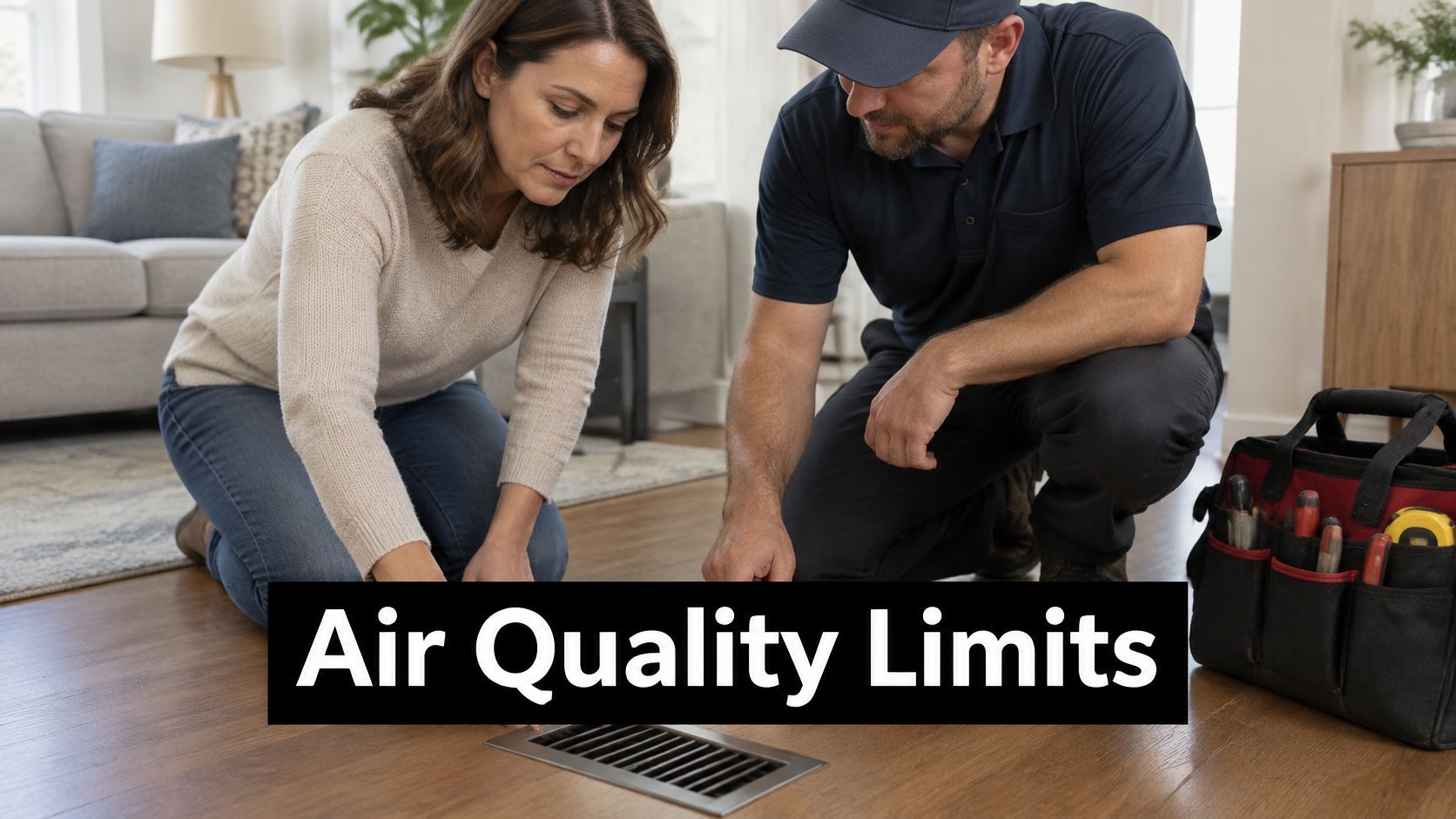
Say you're standing in a living room beside a floor supply register. You can wipe its slats, but the metal branch beneath it connects to larger ductwork and equipment you can't see. Cleaning that visible cover doesn't tell you whether the hidden surfaces need attention.
An inspection connects the room opening to the condition of the system behind it.
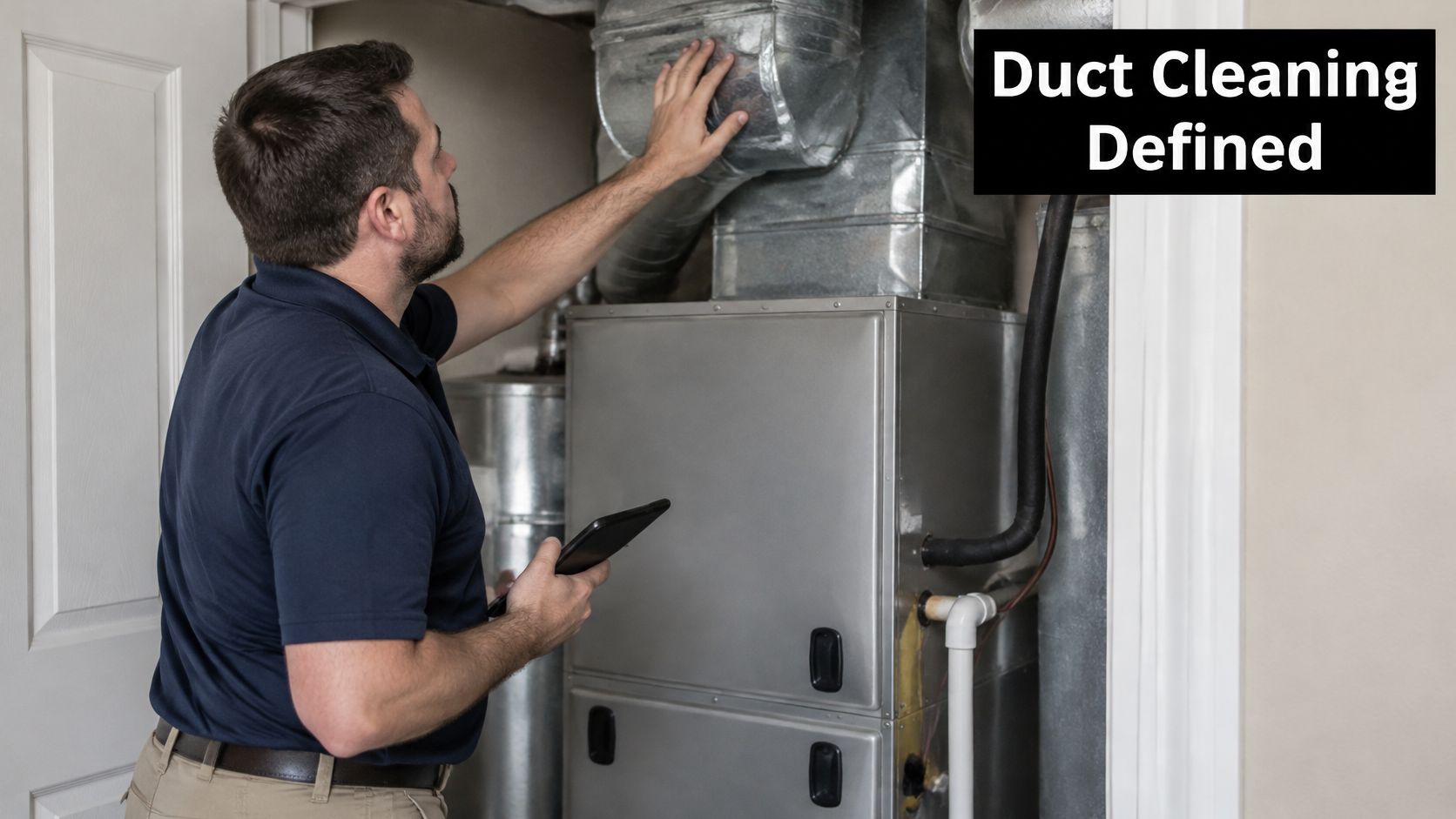
Source removal rather than a health treatment
The U.S. Environmental Protection Agency's guide to air duct cleaning describes a scope that includes supply and return ducts, registers, grilles, coils and air-handling components. It also states that duct cleaning has never been shown to prevent health problems and doesn't recommend routine cleaning for every home.
The useful term is source removal: loosen deposited material, collect it and remove it from the system. Brushing without collection merely moves contamination somewhere else. Spraying a fragrance doesn't remove it at all.
Definition boundary: Removing contamination is a maintenance task. It isn't a diagnosis, a medical treatment or proof that every indoor-air problem has been solved.
Mechanical cleaning doesn't automatically sanitize a surface, either. Any proposed chemical treatment is a separate decision, not something implied by the word cleaning.
For a homeowner or facility manager, a meaningful service starts with a specific finding. The technician should be able to explain what's contaminated, where it is and how it will be removed without spreading it through occupied rooms.
HVAC Parts Duct Cleaning Can Include
Follow the air path to understand the scope. Supply ducts carry heated or cooled air toward rooms. Return ducts bring room air back to the equipment, while registers and grilles cover the openings where air enters or leaves occupied spaces.
At the equipment, the blower moves air through the system and coils transfer heat. Cooling equipment also has a drain pan to collect condensation. These connected components need separate attention because a clean duct wall doesn't establish that the blower, coil or pan is clean.
The diagram shows how the air path and equipment fit together.
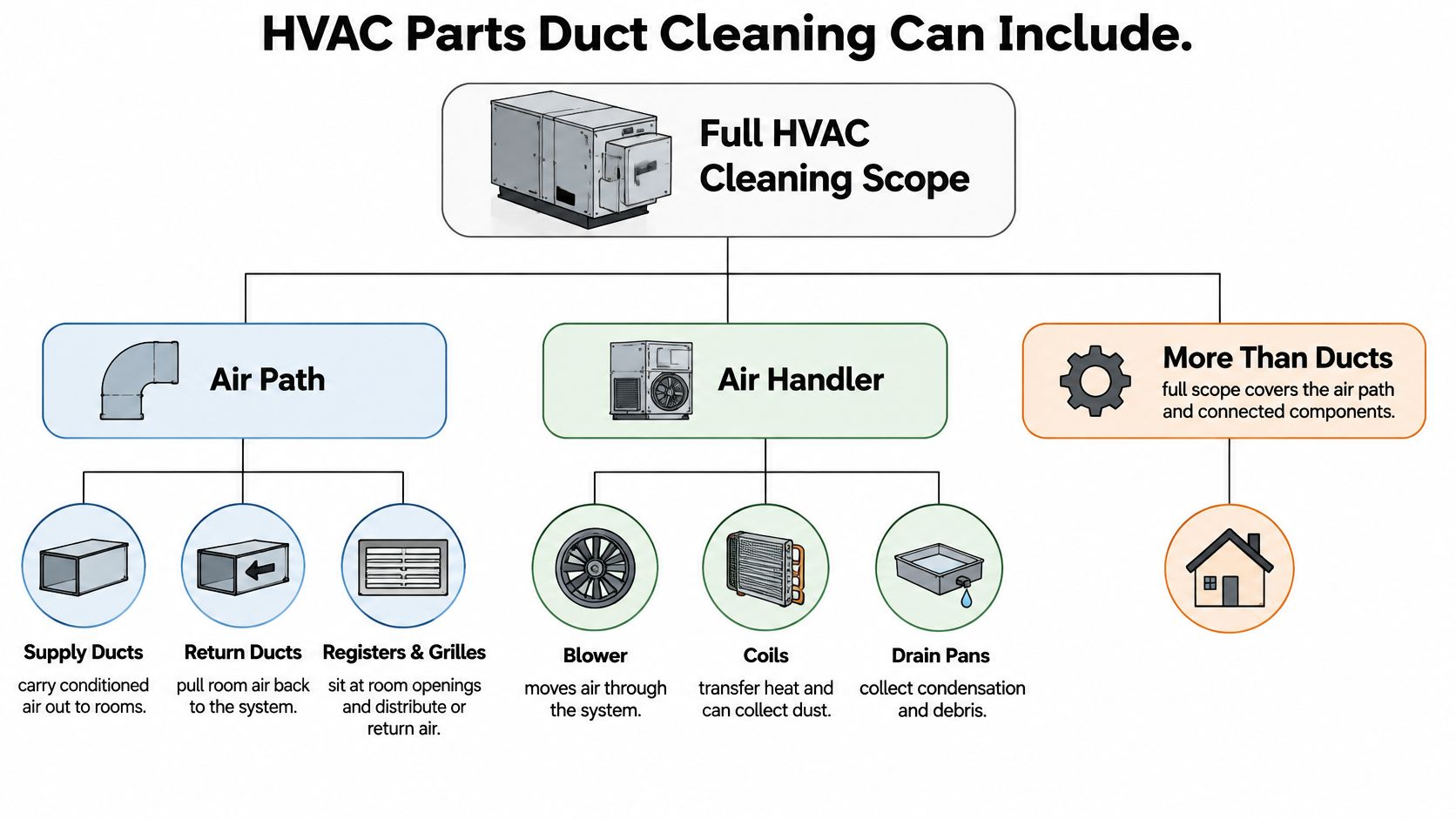
HVAC components duct cleaning may include
Component | What cleaning removes | Typical scope |
|---|---|---|
Supply ducts | Dust, debris and loose contaminants on duct walls | Brushed and vacuumed end to end |
Return ducts | Dust and debris drawn in from rooms | Cleaned with supply ducts for balanced results |
Registers and grilles | Dust, pet hair and debris at room openings | Vacuumed and wiped; removed for access |
Air handler and blower compartment | Settled dust on blower wheel and housing | Vacuumed and cleaned where accessible |
Evaporator and heating coils | Dust films that restrict heat transfer and airflow | Specialized coil cleaning when fouled |
Drain pan | Standing water residue and microbial film | Inspected and cleaned, not only wiped |
Filters and filter slots | Captured dust and bypass gaps | Filter replaced; seals checked |
Accessible insulation or lining | Loose fibers and deteriorated material | Assessed; damaged lining may need replacement |
The NADCA ACR standard frames this work around assessing system condition, determining whether cleaning is justified and verifying cleanliness afterward. Its scope extends beyond duct runs to connected HVAC components, with controls for access, collection and cross-contamination.
That distinction matters when you compare quotations. A proposal that includes every register but excludes the air handler could leave the principal contamination untouched.
Match the method to the material
Metal duct interiors can tolerate suitable mechanical agitation, while coils require tools and cleaning methods that won't flatten their delicate fins. Wet cleaning also requires control of runoff and drainage. Insulated or lined ducts need a material assessment before a brush is introduced.
Our process uses a snake rotor brush to extract contaminants from duct interiors, with vacuuming from end to end. That describes ductwork cleaning, not permission to use the same tool on every HVAC surface.
Use the table as a quote-review checklist. Mark each component as included, excluded or not present, and resolve inaccessible areas before work begins. This explanation of NADCA duct cleaning standards can help you translate technical language into a clear scope.
What Cleaning Does and Does Not Do for Air Quality
Cleaning has a straightforward physical purpose: remove deposited material from components where it doesn't belong. On a fouled blower or coil, that can support normal airflow and heat transfer. Inside ducts, it removes an existing reservoir of loose material that might otherwise be disturbed.
A useful conversation starts with the component, not a promise about how everyone in the home will feel.
Think of a greasy kitchen exhaust fan. Removing grease can help the fan do its assigned job, but it doesn't turn the fan into a room-air purifier. Similarly, restoring an HVAC component's condition isn't the same as demonstrating a medical benefit or measuring an improvement throughout the building.
New particles can still enter through outdoor air, filter bypass or leaks. Furnishings, occupants and everyday activities remain sources of indoor dust.
Cleaning removes what's already there. The source must be addressed to keep it from returning.
Capture matters as much as agitation
Poorly controlled cleaning can release dust and debris into occupied spaces. Risks also include allergic reactions and mold growth, particularly if moisture remains; these risks are rare when a qualified company performs the work properly.
Our negative-air process uses a portable HEPA-filtered negative-pressure machine. We lay plastic around the service area, collect debris in a HEPA bag and vacuum material that falls onto the protective covering.
Those precautions help distinguish controlled removal from stirring up dust. A completion check should also confirm that access openings are closed, components are reassembled, and cleaned areas haven't been left wet.
For the health-related questions behind many booking decisions, read our explanation of whether cleaning air ducts helps with allergies. Keep the decision tied to an identified contamination problem rather than an expectation that cleaning will replace medical care.
For an additional visual explanation of the topic, the following video provides a companion to the inspection discussion.
When Duct Cleaning Is Actually Justified
Light dust alone isn't a compelling reason to book cleaning. The EPA's assessment of duct-cleaning evidence states that light household dust inside ducts hasn't been shown to create a health risk and that evidence for improving efficiency by cleaning ducts alone is limited.
Start by identifying the condition, then identify its cause. A photograph of a dusty grille isn't enough to establish what's happening throughout the duct system. An inspection should distinguish surface housekeeping from substantial deposits, moisture damage or contamination entering the airstream.
Conditions that justify duct cleaning and the usual response
Condition | Why it matters | Usual response |
|---|---|---|
Substantial visible mold on hard-surface ducts or coils | Mold growth signals moisture and can spread | Fix the moisture source, then clean and verify |
Evidence of pests or vermin | Droppings and nesting material enter the airflow | Seal entry points, then clean |
Heavy debris visible at vents | Material is reaching occupied rooms | Inspect the return path, then clean |
Dust or debris restricting airflow | Blocked flow strains the blower and coils | Clean affected components and replace the filter |
Recent renovation or construction | Drywall dust and sawdust settle inside ducts | Clean after openings are contained and covered |
Light household dust only | No proven health risk from light dust alone | Usually no cleaning; keep filters maintained |
Damaged or crumbling fibrous-glass duct | Cleaning cannot restore deteriorated surfaces | Replacement is often required |
Recent construction is a reason to inspect, not proof that every duct needs cleaning. Confirm that construction residue entered the system, and finish dust-producing work before arranging removal. Protect openings so the cleaned system isn't immediately exposed again.
Moisture and pest problems require the same cause-first thinking. Removing deposits without repairing a leak or closing an entry point leaves a route for recurrence.
Before authorizing work: Separate material that can be cleaned from material that has deteriorated and needs replacement.
Our general recommendation is cleaning every 3 to 5 years, depending on ductwork age and condition, the heating and cooling system, and allergies or respiratory problems in the home. That's a planning guideline, not evidence that a clean system requires treatment on a fixed date.
Use this guide to when to clean air ducts to prepare for an inspection. Match your situation to a concrete condition before booking, and make sure the proposed response addresses its cause.
Duct Cleaning Compared With Duct Sealing and Dryer Vent Cleaning
A homeowner may request duct cleaning because a bedroom is uncomfortable, then discover that a disconnected duct is the main problem. Another may use the phrase vent cleaning when they mean the clothes dryer's exhaust. The names sound related, but the work addresses different failures.
Cleaning removes deposits. Sealing closes air leaks. Dryer vent cleaning clears a separate exhaust path. HVAC coil cleaning focuses on heat-transfer surfaces rather than the duct network.
Duct cleaning, sealing and vent services compared
Service | What it targets | Main reason | Typical trigger |
|---|---|---|---|
Duct cleaning | Dust, debris and contaminants in ducts and components | Airflow and condition of components | Visible buildup, mold, pests or construction dust |
Duct sealing | Leaks, holes and poor connections | Energy losses through leaks | High bills, uneven rooms or leaks found in inspection |
Dryer vent cleaning | Lint and blockage in the dryer exhaust | Fire safety and drying efficiency | Slow drying, hot dryer or visible lint buildup |
HVAC coil cleaning | Dust films on evaporator or condenser coils | Heat transfer and efficiency | Reduced cooling or a fouled coil found on inspection |
According to ENERGY STAR's duct-sealing guidance, approximately 20 percent of the air moving through a typical house's duct system can be lost through leaks, holes and poor connections. Removing dust doesn't close those openings.
Sealing and insulation therefore deserve their own evaluation when conditioned air isn't reaching its intended rooms. Engle Services' explanation of why sealing ductwork matters provides useful context for understanding that distinction. Our guide to duct sealing and potential energy savings also explains what a leakage-focused assessment addresses.
Let the symptom guide the inspection
Say the living room receives good airflow, but a distant bedroom barely receives any. The inspection should consider duct connections, restrictions and distribution, rather than assume accumulated dust explains everything.
A dryer that takes unusually long to dry clothing needs attention to its own exhaust route. Its lint trap, connecting duct and outdoor termination aren't substitutes for inspecting the central HVAC system.
Keep the booking rule practical: visible contamination calls for a cleanliness assessment; high bills and uneven rooms call for a broader performance and leakage assessment. Neither symptom, by itself, proves which service you need.
Common Misconceptions About Duct Cleaning
Similar service names and broad advertising claims can make a straightforward maintenance decision confusing. These beliefs deserve a clear correction.
Vacuuming the registers is the same as duct cleaning. A household vacuum can remove dust around a room opening, but it doesn't establish the condition of the branch duct, return network or equipment. Keep visible covers clean as housekeeping, then request documented inspection findings if you suspect a deeper problem. Don't judge a whole-system job by how shiny the grille looks afterward.
Duct cleaning cures allergies or asthma. Removing a deposit isn't the same as treating a respiratory condition. Someone with symptoms may also encounter triggers in bedding, carpets, outdoor air or other indoor sources. Describe your concerns during the inspection, but keep medical treatment decisions with your healthcare professional and reject guaranteed symptom-relief claims.
Every home needs cleaning every year. An annual cleaning commitment shouldn't replace evidence about the system's condition. The multiyear planning interval is a reminder to review maintenance needs, not a reason to clean intact ducts automatically. Maintain the filter, investigate new signs of contamination and schedule an inspection when the circumstances warrant one.
Dryer vent cleaning is just another name for HVAC duct cleaning. The dryer exhaust carries lint and moisture away from a specific appliance, so its maintenance has a distinct fire-safety purpose. The National Fire Protection Association's report on dryer and washing-machine fires found that dust, fiber or lint was the first material ignited in 26 percent of dryer fires during 2010 through 2014. Identify dryer exhaust work separately when arranging service, rather than assume it's included in an HVAC cleaning quote.
The practical correction is the same across these misunderstandings: name the component and the condition. A clear description makes it easier to compare proposed work and harder to confuse a maintenance service with a health promise or an unrelated repair.
Confirm the Need Before You Book Duct Cleaning
Use a short checklist before authorizing work:
Identify a trigger. Look for substantial contamination, pests, debris entering rooms, restricted airflow or construction residue.
Check the basics. Inspect the filter and look for moisture before assuming the ducts are responsible.
Request documentation. Have ducts, coils and drain pans assessed with location-specific notes or photographs.
Compare the scope. Confirm that affected equipment is included, not just room openings.
Confirm protection and verification. Establish how occupied spaces will be protected and how completed work will be checked.
Keep these air duct cleaning questions to ask with your quote so exclusions don't get lost in conversation.
Purified Air Duct Cleaning, based in Avondale, Arizona, offers packages with free dryer vent inspections and even free dryer vent cleaning; call for details and confirm the offer directly before booking. The inspection, rather than the package, should determine whether cleaning is needed.
Purified Air Duct Cleaning offers residential and commercial air duct cleaning, HVAC coil cleaning and dryer vent cleaning across the Phoenix metropolitan area. Visit Purified Air Duct Cleaning to discuss the condition you've found, request a free quote and clarify which service fits your system.