

Indoor Air Quality and Asthma: Triggers and Fixes
About 75% of indoor particulate matter originated inside the home in an EPA-supported study that continuously monitored 294 homes across seven U.S. cities for two weeks each; indoor particle concentrations were generally about twice outdoor levels, according to the EPA's account of the Inner-City Asthma Study. Only about 25% came from outdoors. For families managing asthma, that changes the starting question from “Which purifier should I buy?” to “What's getting into the air inside my home?”
The connection between indoor air quality and asthma is practical, not just technical. Identify likely triggers, stop them at their source, choose ventilation and filtration for the remaining problem, and judge progress by breathing symptoms rather than how fresh a room smells.
Indoor Asthma Triggers and Why Particles Matter
Common indoor triggers, sources and controls
Trigger | Common Indoor Sources | Most Effective Control |
|---|---|---|
Secondhand tobacco smoke | Cigarettes, vapes, smoke carried in on clothing | Smoke-free home and car |
Dust mites | Bedding, carpets, upholstery | Hot-water washing and allergen-proof covers |
Mold | Damp bathrooms, leaks, condensation | Fix the moisture source and dry wet materials |
Pet dander | Cats, dogs, pet bedding, upholstery | Keep pets out of bedrooms and use HEPA vacuuming |
Cockroach and rodent allergens | Food debris, pests, droppings | Seal entry points and remove food and water sources |
Fine particles (PM2.5) | Cooking, candles, incense, fireplaces | Range hood exhaust and no unvented heaters |
Outdoor pollen and smoke | Open windows, doors, HVAC air intake | Close windows on bad days and use filtered ventilation |
Circle the two or three triggers that seem most likely in your home. This isn't a diagnosis, but it gives you a sensible starting point instead of a shopping list.
The EPA's asthma and health guidance identifies secondhand smoke, dust mites, mold, pet dander, cockroach allergens, and fine particulate matter as indoor asthma triggers, and notes that people spend up to 90% of their time indoors. Many people react to several exposures, so solving one problem may help without eliminating every symptom.
The table groups exposures by the action they call for, not because everything in a row is chemically identical. Vaping creates an aerosol rather than tobacco smoke, and residue carried on clothing isn't the same as breathing fresh secondhand smoke. Keeping both smoking and vaping out of the home and car remains the practical boundary.
How air carries a trigger into your lungs
When you breathe, air carries suspended material through your nose or mouth into your airways. Larger particles may settle or become trapped earlier, while fine particles can travel deeper into the lungs. In someone with asthma, those exposures can aggravate already sensitive airways.
PM2.5 means fine particulate matter, not a particular ingredient. Cooking smoke, combustion residue, and outdoor smoke can all contribute to this particle category. A room can look clean while still containing airborne particles you can't see.
For a plain-language explanation of this distinction, the guide to indoor air quality and PM2.5 can help you understand what a particle reading does and doesn't tell you.
Think of a closed room as a jar with a lid, although real homes aren't completely sealed. Every candle, smoking event, and overheated frying pan adds material to the same enclosed space. Outdoor air keeps moving and dispersing, while indoor particles can accumulate when removal is slow.
Match the fix to the exposure
An allergen is something your immune system reacts to; an irritant can bother airways without an allergic response. That distinction matters because removing pet allergen won't necessarily solve symptoms caused by cooking emissions or fragranced products.
Painting introduces another question: gases and vapors aren't the same as particles. If redecorating coincides with symptoms, Aqua Painting's explanation of how low VOC coatings affect air provides useful context for choosing coatings and planning ventilation. A particle filter alone isn't a complete strategy for paint-related emissions.
Practical rule: Start with what enters the air, not with what promises to clean it afterward.
Symptoms that flare at home, during the night, or after cleaning are clues worth recording. They don't prove an indoor cause, because infections, treatment problems, and other exposures can produce similar patterns. Use the pattern to guide an inspection and a conversation with your clinician.
Moisture, Mold and Humidity Control
Mold needs moisture, so the useful question isn't whether you can wipe away a spot. It's why that surface became wet and whether it will become wet again.
CDC asthma guidance notes that household mold exposure has been associated with as much as a twofold increase in the risk of asthma development in children, that mold can trigger attacks without a known mold allergy, and recommends indoor relative humidity around 30% to 50%. An association doesn't mean every exposed child will develop asthma, but it supports taking dampness seriously.
Inspect from the water source outward
Look for leaks first. Open sink cabinets, examine plumbing connections, and check around windows and along roof and wall lines. Discoloration, swollen cabinet panels, peeling finishes, or recurring damp patches deserve investigation rather than another coat of paint.
Watch for condensation. Water on windows or cold walls can reveal a moisture problem even when plumbing is sound. Move stored items away from damp surfaces so you can inspect behind them and allow air to circulate.
Check where exhaust air goes. Run bathroom and kitchen exhaust during use and afterward while moisture remains. A fan that empties into an attic or enclosed cavity moves the problem instead of removing it from the building.
For building-focused examples, Aureli Construction's guide to mold prevention for Boston homes explains why construction details and moisture prevention belong together. The climate differs from Phoenix, but tracing water before repairing finishes is relevant in either location.
Measure moisture and maintain the equipment
Use an inexpensive digital hygrometer rather than judging humidity by comfort alone. Place it away from direct supply airflow and splash zones, then compare readings in the bedroom, bathroom, and any musty closet. The guide to indoor humidity control can help you connect those readings with household moisture sources.
A dehumidifier needs attention: empty and clean its reservoir, keep its filter clear, and inspect any drain hose. Neglected standing water can become a microbial growth site, and a disconnected drain can create another wet area.
Have HVAC drain pans, condensate drains, and coils inspected when moisture persists around the system. Clean, properly draining components matter more than masking an odor with fragrance.
A dry-looking surface isn't enough if the material behind it stays wet.
Moisture control helps address conditions associated with both mold and dust mites. Aim for rooms without visible growth, musty smells, active condensation, or wet stains, while remembering that these reassuring signs don't rule out hidden damage.
A Cleaning Routine That Cuts Daily Exposure
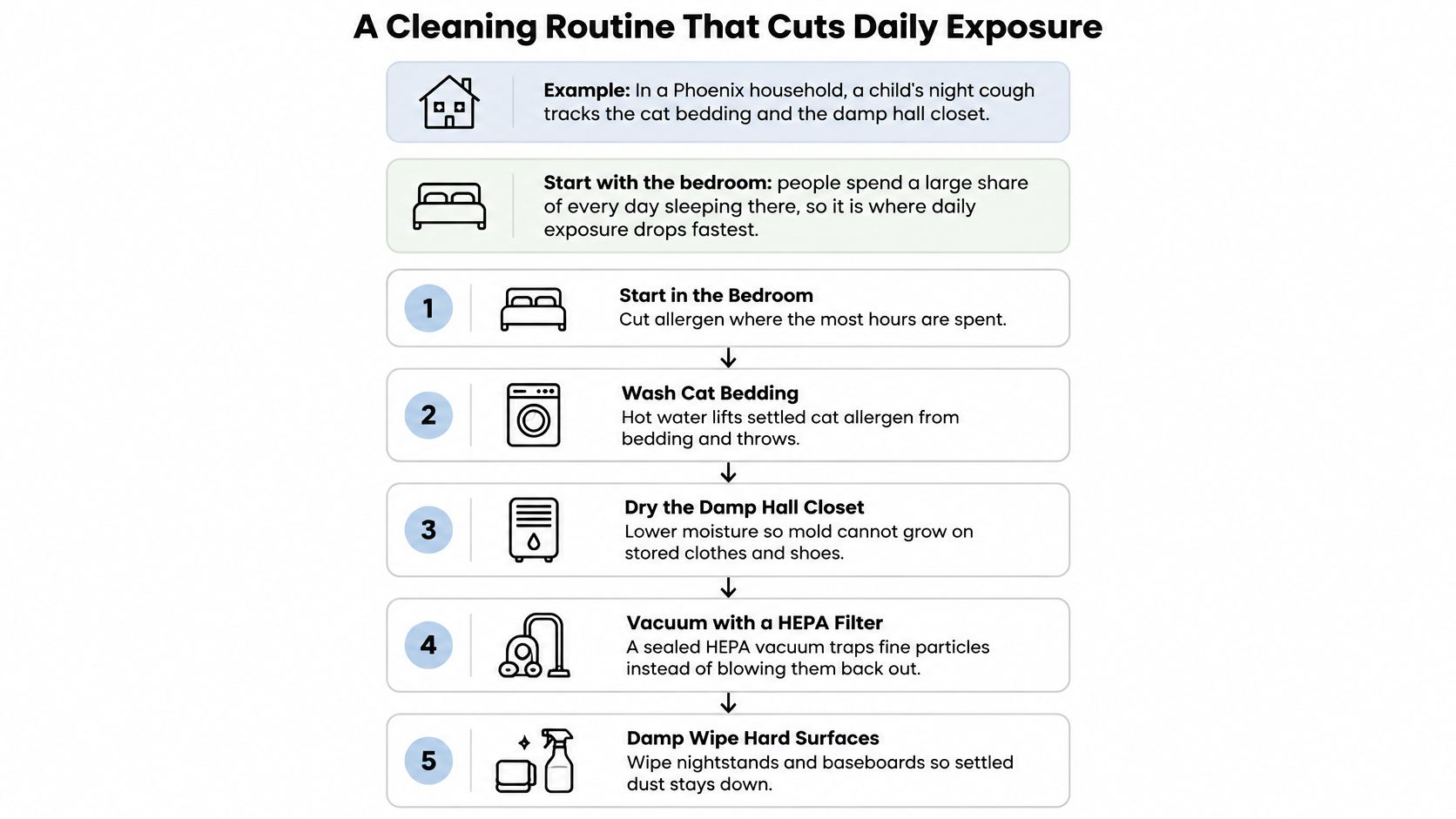
Say a Phoenix household notices that a child's night cough seems worse near cat bedding and a damp hall closet. That pattern suggests places to investigate, not proof that the cat or closet caused the cough. Begin in the bedroom because sleeping creates a long, repeated exposure in the same space.
This visual shows how bedroom cleaning and moisture correction can work together.
Build a routine you can maintain
Begin with a symptom record. Set aside two weeks to record cough, wheeze, night waking, rescue inhaler use, and visible triggers. Don't postpone urgent repairs or medical care just to complete the record.
Remove indoor combustion. Stop smoking indoors and stop burning candles and incense, or move those activities outside, away from doors and windows. This avoids repeatedly adding particles while you're trying to remove settled dust.
Wash and cover bedding. Wash bedding weekly in water at least 130°F (54°C) where fabric care and equipment permit, and use allergen-proof mattress and pillow covers. Manage scalding risk carefully, especially around children, and use the dust mite allergy guide to plan bedroom changes beyond washing alone.
Capture dust rather than scattering it. Vacuum weekly with a well-sealed HEPA-filter vacuum, then damp-dust hard surfaces. Dry dusting can lift settled material into the air, so wipe nightstands, shelves, and baseboards with a lightly damp microfiber cloth.
Separate pet spaces from sleeping spaces. Keep pets out of bedrooms and wash pet bedding weekly. Moving the animal without cleaning its bedding and favorite upholstered surfaces leaves an important reservoir behind.
Make the home less welcoming to pests. Store food in sealed containers, remove crumbs, correct accessible water sources, and close entry gaps. Droppings and nesting material need careful cleanup rather than dry sweeping that sends debris airborne.
Keep cleaning from becoming another exposure
Choose unscented cleaning products when fragrance bothers your breathing, and avoid spraying products into the air. Apply a suitable cleaner to the cloth when the label allows, and never mix cleaning chemicals.
If vacuuming reliably triggers symptoms, have someone else handle it while the person with asthma stays out of the room. Empty the vacuum and maintain its seals and filters without spreading collected dust through the living area.
The accompanying video provides another way to review household asthma-trigger control.
Start with sleeping areas and smoke sources, then extend the routine to the rest of the home. Consistent, manageable changes are more useful than an exhausting deep clean followed by a return to the same exposures.
Ventilation, Filters, Purifiers and Professional Help
Which option fits which indoor air situation
Option | Best For | Main Limit |
|---|---|---|
Portable HEPA air purifier | One bedroom or main room with a particle source that cannot be removed | Does not fix moisture, mold at the source, or leaks |
In-duct air cleaner | Whole-home particle reduction through an HVAC system in good repair | Only as good as its filter, airflow and maintenance |
HVAC filter upgrade (MERV 13 where equipment allows) | Ducted systems with a documented airflow margin | Can reduce airflow if the equipment is not rated for it |
Dehumidifier | Homes where indoor humidity stays above 50% | Needs regular emptying and cleaning; does not stop leaks |
Duct cleaning | Visible dust blowing from vents, heavy dust after renovation | Does not treat mold in building materials or replace source control |
Professional mold remediation | Growth that covers a large area or is hidden behind walls or in ducts | Should be scoped by an inspection before comparing costs |
The EPA's Care for Your Air guide prioritizes source control, with ventilation and filtration serving different supporting roles. Choose the row that matches the remaining problem, not the device with the broadest advertising claims.
Decide whether you need exhaust or particle removal
A kitchen hood that exhausts outdoors removes cooking emissions near their source. A recirculating hood isn't equivalent, because it returns air to the room after passing through its filters. Bathroom exhaust serves a different purpose, removing moisture before it spreads.
Opening windows isn't always the right substitute. In Phoenix, consider outdoor smoke, pollen, heat, and the building's cooling needs before bringing in outdoor air. Mechanically filtered ventilation may be more appropriate when outdoor conditions are poor.
A portable cleaner becomes useful when particles remain in a room despite reasonable source controls. Place it where air can circulate, not behind curtains or furniture, and choose a room-appropriate unit you can tolerate running at an effective fan speed.
In a randomized, double-blind, crossover study of 43 children with mild or moderate asthma, bedroom use of a particle-removing device for two weeks was significantly associated with improved small-airway mechanics, increased peak expiratory flow, and reduced pulmonary inflammation, according to the JAMA Pediatrics study. Those findings are encouraging, but a short trial in a small group doesn't establish that every purifier will produce lasting symptom improvement.
The guide addressing whether an air purifier helps asthma can help you distinguish a supporting tool from a promised cure. Keep prescribed treatment in place while evaluating any device.
Check the HVAC system before upgrading its filter
The EPA's indoor particulate matter guidance describes the Indoor airPLUS recommendation for MERV 13 filters where equipment can accommodate the associated pressure drop. A higher-rated filter isn't automatically a better installation if it restricts the system's airflow.
Confirm filter dimensions, fit, and the air handler's capacity before changing filter type. A filter that allows air to bypass its edges won't perform as intended.
Check monthly: Inspect for loading, damage, moisture, and poor fit.
Replace appropriately: Follow the manufacturer's schedule, adjusting when inspection shows the filter needs earlier attention.
Keep airflow paths clear: Don't block return grilles with furniture or stored items.
In-duct systems also depend on operating conditions and maintenance. For air purification, we assess each customer's specific needs and recommend the most suitable system for the home, rather than treating every building as the same problem.
Know when cleaning or remediation fits
Visible dust puffing from vents or heavy debris after renovation can justify a duct inspection. Suspected growth inside ducts needs identification and a moisture investigation, not an automatic cleaning appointment.
Ducts are generally recommended for cleaning every 3 to 5 years, depending on ductwork age and condition, heating and cooling equipment, and allergies or respiratory problems in the home. That maintenance interval isn't evidence that cleaning on a calendar will improve asthma.
Risks include dust and debris released into the air, allergic reactions, and mold growth. These risks are rare when a qualified company performs the work properly.
Before approving work: Require a clear explanation of the observed problem, the proposed correction, and how success will be checked.
For workplaces, Arelli Cleaning's guidance on ways to improve indoor air quality at work offers context for coordinating cleaning with building operations. Facility managers should connect complaints to specific rooms, activities, and maintenance conditions rather than buying equipment before investigating.
When Indoor Fixes Are Not Enough
Environmental changes support asthma treatment; they don't replace it. If breathing remains difficult, don't keep trying household fixes while delaying medical assessment.
Controller medicines are the main long-term treatment for persistent asthma. A clinician can determine whether worsening symptoms reflect an indoor exposure, an infection, inhaler technique, medication access, or a treatment plan that needs adjustment.
Separate a treatment review from an emergency
Arrange prompt medical advice when you notice:
Increasing reliever use: You need your rescue inhaler more often than your clinician advised.
Night waking: Cough or wheeze repeatedly interrupts sleep.
Reduced activity: Ordinary tasks become harder because of breathing symptoms.
Seek emergency services immediately for severe breathing difficulty, trouble speaking in full sentences, lips or fingertips turning blue or gray, or no relief from the rescue inhaler. Follow the emergency instructions in your asthma action plan while help is coming. Don't wait for a purifier, open window, or duct service to make a difference.
Use a written asthma action plan
Ask your clinician for a written plan with green, yellow, and red zones. Each zone should explain which medicines to take and what action to follow for your particular symptoms or prescribed monitoring results.
The green zone describes your usual controlled condition. Yellow-zone instructions tell you how to respond to worsening symptoms, while red-zone instructions identify urgent actions and when to seek emergency care. Don't copy someone else's medication instructions, even if their asthma seems similar.
Bring your symptom log and inhalers to appointments. Demonstrating how you use an inhaler can reveal problems that a description alone may miss, and the log can show whether symptoms follow cleaning, cooking, sleep, or time away from home.
If likely triggers remain unclear, ask whether allergy testing would change your management. Testing is most useful when the result can guide a realistic exposure change, rather than producing a long list of things to avoid.
Track Symptoms and Decide Your Next Fix
Cleaner air measurements don't automatically mean better asthma control. Environmental interventions differ, and the same change can help one household more than another.
A 2025 systematic review summarized in the evidence supporting EPA asthma home-visit programs identified 54 randomized studies in children and adolescents: 24 focused on dust mites, 3 on pet allergens, 4 on pests, 17 on indoor air quality, and 6 were multifaceted. Those categories represent different interventions, not interchangeable proof for every home upgrade.
Make the comparison useful
Medication adherence, infections, outdoor pollen, wildfire smoke, and seasonality can all change symptoms. A better week after a service visit doesn't establish what caused the improvement.
Record a baseline. Use a two-week observation period for symptoms, rescue inhaler use, sleep disruption, and indoor conditions.
Choose one major exposure where feasible. Don't delay correcting dangerous or active problems, but avoid changing everything at once when you're trying to understand a pattern.
Review after several weeks. Compare similar activities and conditions, noting illnesses or outdoor smoke that might confuse the comparison.
Bring the record to your clinician. Use it to review treatment and update the action plan.
The guide to how to measure indoor air quality can help you choose relevant measurements. A particle monitor doesn't diagnose asthma or identify every allergen, so keep symptom tracking central.
Judge the next purchase by the problem it solves, not by how many pollutants appear in its description.
We bring over 20 years of experience in the Indoor Air Quality, HVAC, and Duct Cleaning industries to evaluating building-related concerns. This week, choose one trigger from your circled list and make one concrete fix, such as removing incense, relocating pet bedding, or arranging a leak repair.
Purified Air Duct Cleaning offers residential and commercial duct cleaning, HVAC coil cleaning, and air purification systems to address identified indoor-air problems. Visit Purified Air Duct Cleaning to discuss your home's conditions and request a quote for work that fits the problem you're trying to solve.