

Home Air Quality: What It Means and How to Improve It
The World Health Organization estimates that household air pollution caused about 2.9 million premature deaths in 2021, including more than 309,000 deaths in children under age five. It also attributes roughly 95 million disability-adjusted life years to exposure during that year. (WHO household air pollution facts) Those figures reframe home air quality. It isn't only about stale odors, visible dust, or whether a room feels comfortable. The air inside a home can carry particles, gases, allergens, and moisture that affect health over time.
The mechanical systems in your house determine how those contaminants move. Return vents pull air toward the HVAC equipment, filters capture some particles, coils and drain pans can collect debris or biological growth, and supply ducts distribute conditioned air back into living spaces. A purifier may reduce contaminants in the air stream, but it can't fully compensate for a polluted source path. Cleaner home air usually comes from combining source control, ventilation, HVAC maintenance, filtration, and carefully selected purification.
What Home Air Quality Actually Means
Home air quality describes the condition of the air inside the living envelope of a house. It includes the concentration of gases, fine particles, biological material, and moisture circulating through bedrooms, kitchens, living rooms, basements, and mechanical spaces. The mixture changes throughout the day. Cooking can create a short burst of particles, a shower adds moisture, a new sofa can release chemical vapors, and an HVAC blower can move settled dust through the duct system.
Some pollution begins outside. Vehicle exhaust, pollen, construction dust, and wildfire smoke can enter through open windows, doors, cracks, and normal air infiltration. Other contaminants are produced indoors by people, pets, fuel-burning appliances, cleaning products, furnishings, fireplaces, candles, and moisture-damaged materials. The EPA emphasizes that indoor pollution sources that release gases or particles are a primary cause of indoor air-quality problems, which is why source control, ventilation, and filtration work best as a combined strategy. (EPA indoor air quality guidance)
Indoor air isn't outdoor air trapped in a box. In the United States, the EPA says Americans spend about 90% of their time indoors, while pollutant concentrations inside homes are often 2 to 5 times higher than typical outdoor levels. The agency's classic TEAM studies identified about a dozen common organic pollutants at concentrations 2 to 5 times higher indoors, whether homes were in rural areas or highly industrial settings. (EPA indoor air quality data summarized here)
Why the mechanical path matters
Air follows a loop in a forced-air home. Return grilles collect room air, the filter removes a portion of airborne particles, the blower moves air across the coil, and supply ducts send it back through registers. Dust or biological debris in the return plenum, blower compartment, coil, or supply branches can become part of that loop.
A practical comparison of the two environments can help homeowners understand why outdoor conditions don't tell the whole story. This guide to indoor air quality compared with outdoor air offers useful context, while homeowners seeking regional advice can also find indoor air quality tips for Connecticut from J.G. Carpet Cleaning LLC.
The Pollutants Hiding in Your Home
A home can contain several pollutant classes at the same time. The important question isn't whether your house has one perfect contaminant or none at all. It's which sources are active, how much they release, and whether the HVAC system or insufficient ventilation spreads them.
Particles and chemical vapors
Particulate matter comes from familiar activities. Frying food, searing meat, burning candles, using a fireplace, smoking, and operating an unvented heater can release fine particles that remain suspended before settling on furniture and floors. Return vents may pull some of that material into the HVAC system, where the blower can redistribute it.
Volatile organic compounds, or VOCs, are gases released by products and materials. Paint, new furniture, vinyl flooring, carpet, adhesives, cleaning products, air fresheners, cosmetics, and personal-care items can all contribute. Chemical odors aren't a complete measurement of VOC exposure, since some pollutants have little or no noticeable smell. For a closer look at one common material source, see this explanation of carpet off-gassing and indoor air.
Biological contaminants and combustion gases
Biological pollutants include pet dander, dust mite debris, pollen tracked indoors, mold spores, and particles associated with pests. Moisture determines how serious some of these sources become. The EPA states that mold can grow on wood, drywall, carpet, and furniture when they remain wet for more than 24 hours. (EPA mold and moisture guidance) A damp basement, leaking air handler, or wet carpet can therefore change the air-quality problem from ordinary dust to an ongoing moisture and microbial issue.
Combustion creates a separate concern. Gas stoves, furnaces, fireplaces, attached garages, and unvented heaters can introduce carbon monoxide and nitrogen dioxide. Carbon monoxide is especially dangerous because it has no reliable odor warning. Nitrogen dioxide can irritate airways and is a concern for people with asthma.
Radon behaves differently from particles and odors. This naturally occurring soil gas can enter through foundation cracks and other openings, and you can't see or smell it. Testing is the only practical way to know whether your home has a high level.
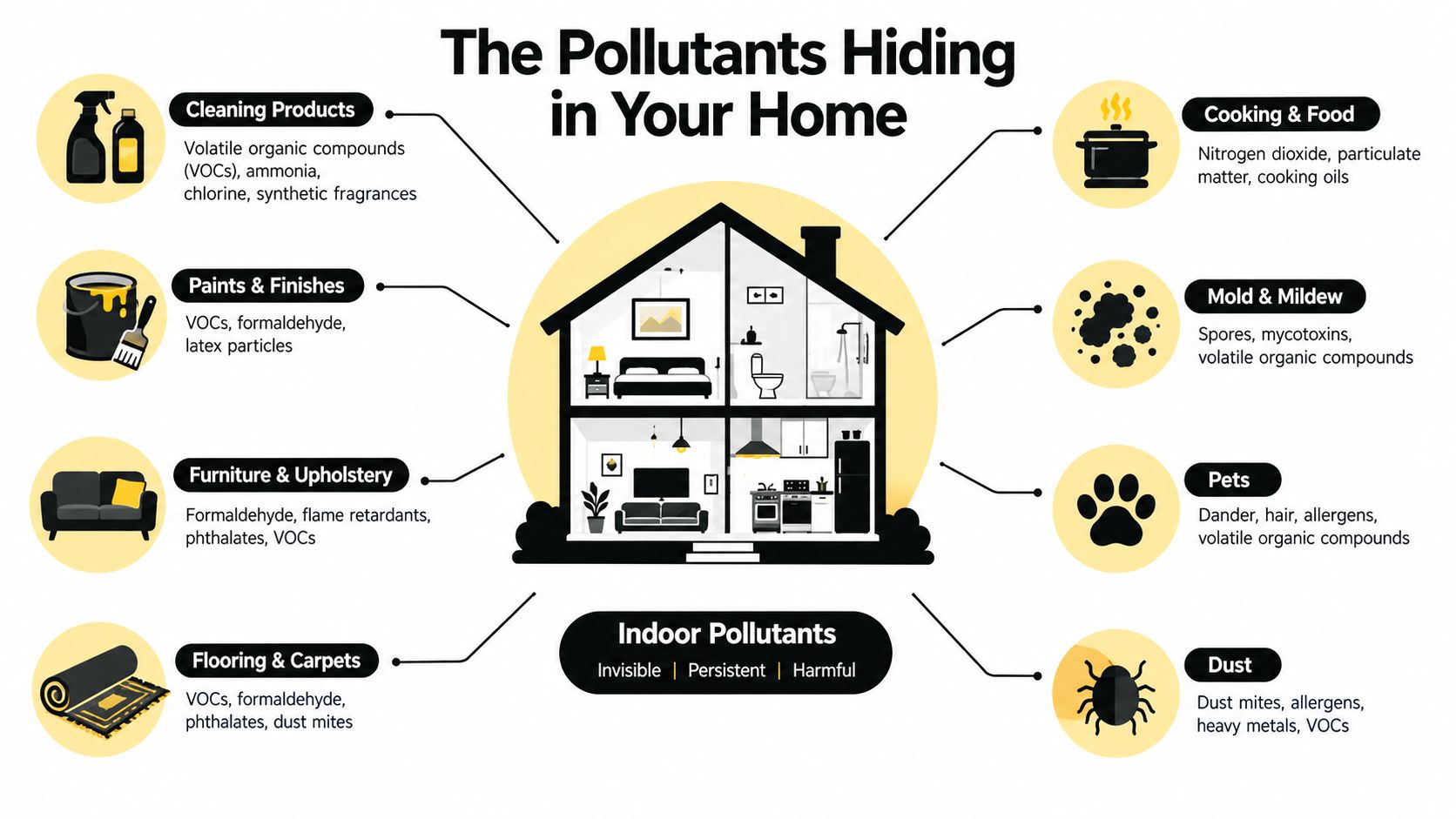
Humidity acts as an amplifier rather than a pollutant by itself. Excess moisture supports mold and dust mites, while dry conditions can irritate the nose, throat, and skin and keep settled dust moving more easily. Most homes contain a changing mixture of particles, VOCs, biological matter, combustion gases, and moisture, not one isolated problem.
How Poor Air Quality Affects Your Health
Health effects depend on the contaminant, concentration, duration of exposure, and the person breathing the air. A brief exposure to cooking particles may cause irritation, while repeated exposure to combustion gases, mold, or fine particulate matter can contribute to more serious problems. Symptoms alone can't identify the source, but they can tell you when to investigate patterns in the home.
Particles, VOCs, and biological allergens often produce the most recognizable early symptoms: irritated eyes or throat, headaches, fatigue, congestion, sneezing, coughing, and aggravated allergies. People may notice that symptoms worsen during cooking, after cleaning, in a damp room, or after the HVAC system starts. Persistent symptoms deserve medical advice, especially when they involve breathing difficulty, chest pain, confusion, or severe fatigue.
Fine particles and mold can aggravate respiratory disease. Repeated exposure may worsen asthma control, particularly in children and adults who already have sensitive airways. Nitrogen dioxide from fuel-burning appliances is another respiratory concern. Longer-term exposure to fine particles and combustion byproducts is also associated with cardiovascular effects, including increased risk related to heart disease and stroke.
Pollutants and their health effects at a glance
Pollutant | Short-term effects | Long-term risks |
|---|---|---|
Fine particulate matter | Coughing, throat irritation, eye irritation, breathing discomfort | Worsened respiratory disease and cardiovascular harm |
VOCs | Headaches, nausea, fatigue, irritation | Risks vary by chemical, with some linked to cancer |
Mold and allergens | Sneezing, congestion, wheezing, itchy eyes | Persistent asthma and allergy aggravation |
Carbon monoxide | Headache, dizziness, confusion, nausea | Severe poisoning can cause lasting injury or death |
Nitrogen dioxide | Airway irritation, coughing, wheezing | Increased respiratory burden and asthma risk |
Radon | Usually no immediate warning signs | Lung cancer risk |
Excess moisture | Musty odor and discomfort | Mold growth and continuing biological contamination |
Cancer risk requires particular caution. The International Agency for Research on Cancer classifies benzene and formaldehyde as known carcinogens, while radon exposure is a recognized lung-cancer hazard. The EPA recommends fixing a home when radon reaches 4 picocuries per liter, and it notes that lower levels still carry risk and may also be reduced. (EPA radon guidance)
Infants, older adults, pregnant women, and people with existing lung or heart disease may feel the effects sooner or more severely. If allergies are interfering with breathing or asthma seems harder to control at home, this resource on whether allergies can make asthma worse can help explain the connection, but it shouldn't replace clinical care.
Testing the Air You Live With
Start with observations, but don't treat your senses as a complete test. Persistent odors, visible dust at supply vents, condensation on windows, musty rooms, and discomfort that follows cooking or cleaning can identify locations and activities worth investigating. Odor tells you that something is present, not whether the concentration is safe.
Consumer monitors can add useful context. Many measure PM2.5, carbon dioxide, temperature, and relative humidity. A carbon dioxide reading above 1,000 ppm usually indicates poor ventilation, but it doesn't identify every pollutant or prove that a room is unsafe. Use readings to compare rooms and activities, then look for repeatable patterns rather than reacting to a single number.
Professional testing is more targeted. Depending on the concern, an assessor may sample mold spores, VOCs, formaldehyde, and carbon monoxide. A qualified professional should explain what the test can and can't establish, where samples will be taken, and what action would follow each possible result.
Testing choices for a typical home
Test type | What it detects | Duration | Typical cost |
|---|---|---|---|
Consumer air monitor | PM2.5, carbon dioxide, temperature, humidity | Continuous | Varies by device |
Professional IAQ assessment | Selected particles, mold, VOCs, formaldehyde, or carbon monoxide | Usually scheduled sampling | Varies by scope |
Short-term radon test | Radon concentration | 2 to 7 days | Varies by kit or provider |
Long-term radon test | Longer-term radon exposure pattern | 90 days or more | Varies by kit or provider |
Radon testing deserves its own decision rule. Place a short-term charcoal canister in the lowest lived-in space for 2 to 7 days, or use a long-term alpha-track test for 90 days or more. A result at or above the EPA action level of 4 pCi/L warrants mitigation, while a result between 2 and 4 pCi/L still deserves attention and may justify reduction measures. For homeowner-focused background, this guide explains how to test your home for radon gas.
Keep a simple log with the date, room, activity, monitor reading, filter change, weather, and symptoms. A record can show that a problem appears after showers, during cooking, when the HVAC runs, or only in a basement. Guidance on choosing an indoor air quality meter can help you decide which readings are worth tracking.
Source Control, Ventilation, and Duct Cleaning
The EPA's layered approach works because it follows the direction of the problem. Source control comes first, ventilation dilutes what remains, and filtration or purification handles contaminants that still circulate. Reversing that order often leads homeowners to buy stronger equipment while leaving the original source untouched.
Start with the source
Use low-VOC paint, unscented cleaning products, and tightly sealed flooring materials where practical. Run a kitchen exhaust hood that vents outdoors whenever you cook, especially during frying or high-heat cooking. Keep gas stoves and furnaces maintained, and never use fuel-burning appliances in ways the manufacturer doesn't permit.
Moisture control is source control too. Repair leaks, dry wet materials quickly, and address damp basements instead of expecting a portable purifier to solve mold-related emissions. During wildfire smoke or other outdoor pollution events, keep windows closed when outdoor air is poor and use filtration while avoiding activities that add indoor particles.
Dilute, then clean the air path
When outdoor air is acceptable, opening windows on opposite sides of the home can create cross-ventilation. Bathroom and laundry fans should exhaust outdoors, not into an attic or wall cavity. A central HVAC system may need a dedicated outdoor-air intake or economizer to introduce fresh air without relying on random leakage. More ventilation isn't automatically better during smoke, high pollen, or poor outdoor air conditions.
The duct system deserves attention because it carries air through the house. Return plenums, supply branches, evaporator coils, blower assemblies, and drain pans can collect dust, debris, and biological growth. A thorough cleaning generally uses negative-pressure vacuuming, agitation of trunk lines and branches, access to the blower assembly, and coil cleaning. Look for the NADCA ACR standard when comparing providers.
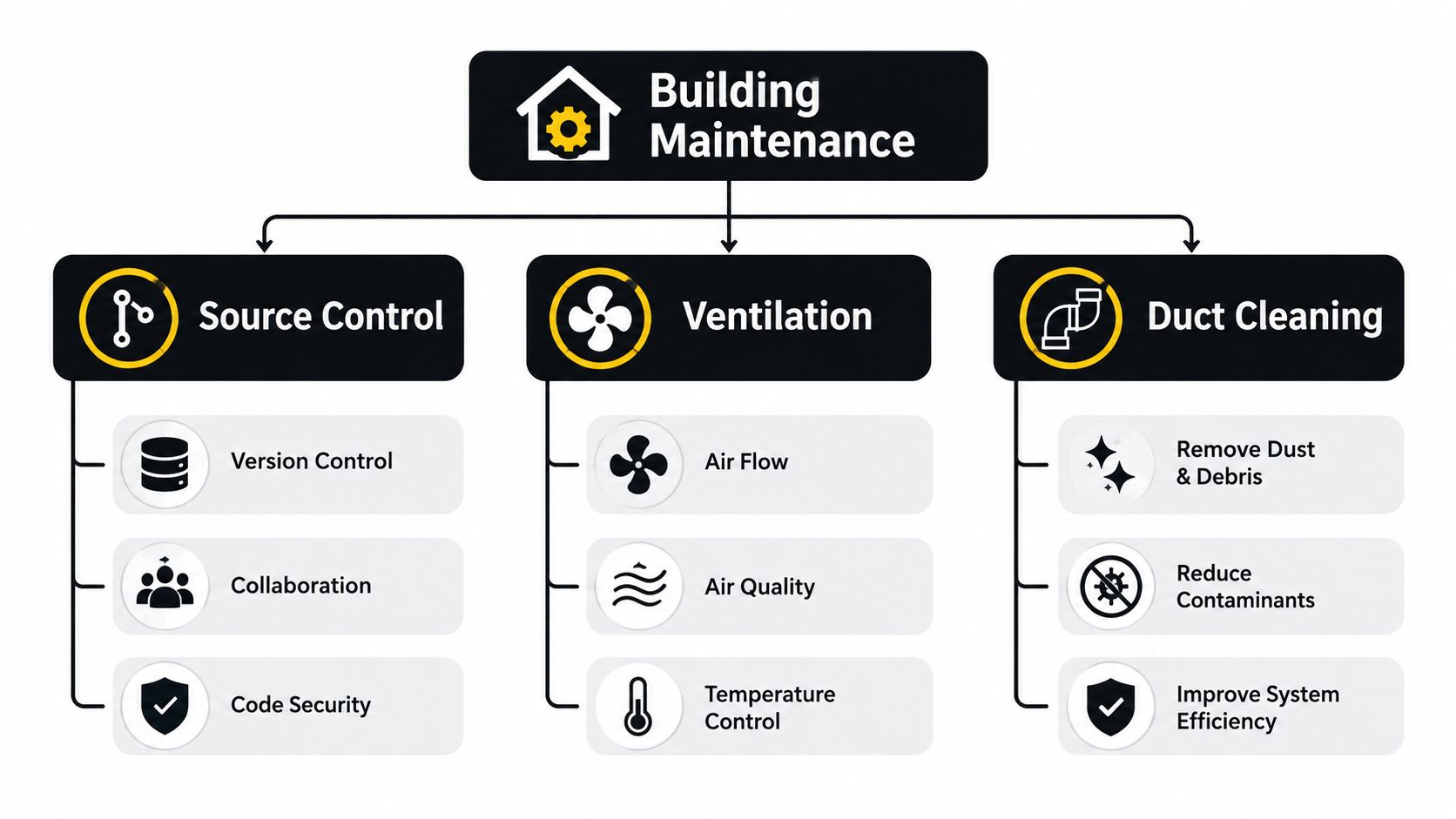
A clean mechanical path helps filtration work on the air that reaches the filter and occupants. More detail on indoor air quality and ventilation can help you evaluate whether your current system exchanges air effectively.
Filtration and ActivePure Technology
Filtration and purification don't perform the same job. A filter captures particles as air passes through it. A purification technology may act on airborne contaminants or surfaces, depending on its design. Choosing correctly starts with identifying the problem, then checking whether the HVAC system can support the equipment.
An HVAC filter rated MERV 8 provides basic residential filtration, while MERV 13 captures finer particles, including much of the particle range associated with smoke and many bacteria. Higher resistance can restrict airflow, increase blower strain, or reduce system performance if the equipment wasn't designed for it. Check the manufacturer's guidance or ask an HVAC technician before moving to a higher-MERV filter.
A portable purifier with a true HEPA filter captures 99.97% of particles at 0.3 microns. That makes it useful for a bedroom, office, or other single room, particularly with the door closed and the unit sized for that room. HEPA media doesn't remove every gas or odor, so a unit with activated carbon is more appropriate when VOCs or smells are the central concern.
Filtration and purification technologies compared
Technology | How it works | What it targets | Best use | Limitation |
|---|---|---|---|---|
HVAC filter | Captures particles in the central air stream | Dust and airborne particles | Whole-home circulation | Depends on fit, replacement, and blower capacity |
Portable HEPA purifier | Pulls room air through fine particle media | Fine particles and allergens | One occupied room | Doesn't address the source or all gases |
Activated carbon | Adsorbs selected gases and odors | VOCs and smells | Chemical or odor concerns | Capacity varies and media eventually fills |
ActivePure Technology | Uses a photocatalytic process to produce oxidizing molecules | Airborne and surface contaminants | Complementary whole-home treatment | Doesn't replace source control, duct cleaning, or filtration |
ActivePure Technology is a complementary layer. Its photocatalytic process produces oxidizing molecules that continuously seek out and reduce contaminants in air and on surfaces, rather than trapping particles on a filter. ActivePure has been FDA-cleared as a Class II medical device for certain applications, a distinction that separates it from generic ionizers or ozone generators, but the specific device and installation still matter.
The practical match is straightforward. Use HEPA filtration for particles, activated carbon for gases and odors, and consider an in-duct ActivePure unit when broad treatment through the central air path is appropriate. ActivePure works alongside clean ducts and suitable filtration, not instead of them.
When to Call a Professional
A filter change is a reasonable first step for routine dust, but some warning signs point to a deeper mechanical or building problem. Call for an inspection when visible mold appears inside ducts or around vents, or when musty or burning odors remain after you replace the filter. Recent renovation dust, water damage near the air handler, and heavy dust returning to surfaces within days also deserve attention.
Symptoms can provide another clue. If coughing, congestion, wheezing, or allergy symptoms consistently worsen at home and improve elsewhere, investigate the rooms, activities, and HVAC cycles involved. Don't assume the ductwork is automatically responsible, since moisture, furnishings, combustion, and outdoor infiltration may be contributing sources.
What a meaningful service includes
A qualified duct-cleaning provider should inspect the system, ideally using camera access where appropriate, then explain what was found before cleaning. Source removal should address accessible trunk lines, branches, returns, supply components, and debris. The job may also include cleaning the evaporator coil, blower assembly, and drain pan, along with identifying and sealing duct leaks.
A quick vacuum of register grilles is cosmetic maintenance, not full system cleaning. Ask how the provider will create negative pressure, reach the main duct paths, protect the home, and document the work. NADCA certification or equivalent credentials can help you distinguish a trained contractor from a service that offers only surface-level cleaning.

Some complaints belong with an HVAC technician instead. Poor airflow, refrigerant problems, unusual system performance, frozen coils, and repeated shutdowns require mechanical diagnosis. Duct cleaning can remove contamination, but it can't repair a failing blower, correct an improperly sized system, or solve every comfort problem.
A Simple Routine for Cleaner Indoor Air
Cleaner air comes from repeatable habits, not one expensive purchase. A homeowner who controls sources, removes settled dust, ventilates moisture, and maintains the HVAC path will usually get more value than someone who buys a purifier while ignoring a wet coil or blocked exhaust fan.
Weekly habits
Clean floors carefully: Vacuum carpets with a HEPA-equipped vacuum and mop hard floors so settled dust doesn't return to the air.
Exhaust moisture: Run kitchen and bathroom fans during cooking and bathing, then keep them running long enough to remove lingering moisture.
Refresh selectively: Open windows briefly for cross-ventilation when outdoor air quality is acceptable. Keep them closed during smoke or other poor outdoor conditions.
Reduce additions: Skip candles, incense, and air fresheners when possible, especially in rooms used by people with sensitive airways.
Monthly, check the HVAC filter and replace it according to the equipment and filter instructions. Wipe vent covers, inspect return grilles for visible dust, and look around the air handler for moisture, staining, or unusual debris. Dusting with a damp cloth or mop is more effective than dry dusting for keeping settled particles from becoming airborne, and this overview of how dusting helps indoor air quality provides useful cleaning context.
Seasonal checks
Before heavy heating or cooling use, inspect the filter, confirm exhaust fans discharge outdoors, and look for condensation or leaks around the HVAC equipment. Have ducts inspected when dust, odors, renovation debris, or moisture problems suggest contamination, and test lower levels for radon when you haven't established a reliable baseline.
Practical rule: Match the response to the source. Remove or vent pollutants first, clean the mechanical path second, then use filtration or purification to manage what remains.
Small, consistent actions can improve comfort and reduce the amount of material your HVAC system has to move. Watch for changes in odors, dust, congestion, sleep quality, and room freshness, while seeking medical care for serious or persistent symptoms.
Purified Air Duct Cleaning can inspect and clean residential HVAC ductwork, vents, coils, and related components, and it can install in-duct or portable ActivePure systems as a complementary purification layer. Visit Purified Air Duct Cleaning to request a quote and discuss a practical plan for cleaner home air.